
We read your photo as:
Define the total number of marbles and the probability of picking two black marbles.
ScanSolve AI Answer
Answer
Step-by-step solution
7 stepsHere's how to solve the problem:
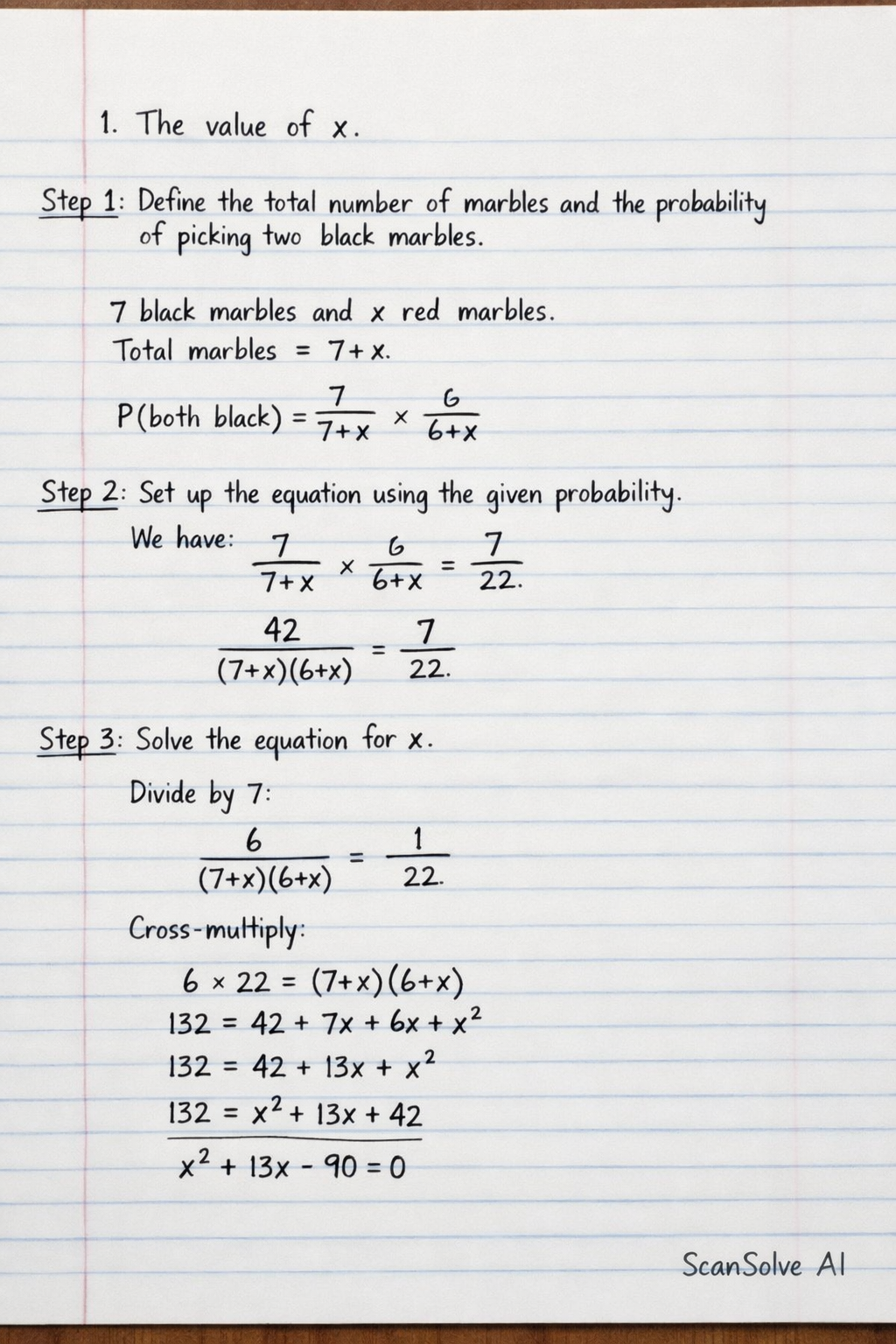
1. The value of .
Define the total number of marbles and the probability of picking two black marbles.
There are 7 black marbles and red marbles.
The total number of marbles is .
The probability of picking two black marbles without replacement is the product of the probability of picking the first black marble and the probability of picking the second black marble (given the first was black):Set up the equation using the given probability.
We are given that the probability of both marbles being black is .
Solve the equation for .
Divide both sides by 7:
Cross-multiply:
Rearrange into a quadratic equation:
Factor the quadratic equation and find .
We look for two numbers that multiply to -90 and add to 13. These numbers are 18 and -5.
This gives two possible values for : or . Since the number of marbles cannot be negative, we choose the positive value.
The value of is .2. The probability of picking one marble of each color.
Determine the total number of marbles with the value of .
With :
Number of black marbles = 7.
Number of red marbles = 5.
Total number of marbles = .Calculate the probability of picking one black and one red marble.
There are two mutually exclusive ways to pick one marble of each color:
- Picking a black marble first, then a red marble ().
- Picking a red marble first, then a black marble ().
Sum the probabilities and simplify.
The total probability of picking one marble of each color is the sum of these two probabilities:
Simplify the fraction by dividing the numerator and denominator by 2:
The probability of picking one marble of each color is .
Try one yourself
A new problem that tests the same skill.
Still stuck on this one?
Ask a follow-up, and the answer starts from this question.
More Mathematics Questions
Handwritten Step-by-Step Solution
Get this as a handwritten image on WhatsApp — like a tutor wrote it for you.
Try on WhatsApp