
We read your photo as:
A ball selected at random from a bag containing 3 red balls and 4 black balls. The first ball is not replaced and a second ball is selected. Find the probability of selecting two different balls.
ScanSolve AI Answer
Step-by-step solution
15 stepsHere are the solutions for the questions.
b) A ball selected at random from a bag containing 3 red balls and 4 black balls. The first ball is not replaced and a second ball is selected. Find the probability of selecting two different balls.
Determine the total number of balls.
Total balls = 3 red + 4 black = 7 balls.
Identify the two possible scenarios for selecting two different balls.
Scenario 1: First ball is Red (R), second ball is Black (B).
Scenario 2: First ball is Black (B), second ball is Red (R).Calculate the probability for Scenario 1 (R then B).
- Probability of drawing a Red ball first: .
- After drawing one red ball, there are 2 red balls and 4 black balls left, making a total of 6 balls.
- Probability of drawing a Black ball second (given the first was red): .
- Probability of Scenario 1: .
Calculate the probability for Scenario 2 (B then R).
- Probability of drawing a Black ball first: .
- After drawing one black ball, there are 3 red balls and 3 black balls left, making a total of 6 balls.
- Probability of drawing a Red ball second (given the first was black): .
- Probability of Scenario 2: .
Add the probabilities of the two scenarios to find the total probability of selecting two different balls.
Simplify the fraction.
The probability of selecting two different balls is .
3. a) Given that , calculate the value of .
Convert the mixed fraction to an improper fraction.
Rewrite the logarithmic equation in exponential form.
The definition of a logarithm states that if , then .
Applying this to the given equation:Solve for .
Take the square root of both sides:
Consider the domain restrictions for the base of a logarithm.
The base of a logarithm () must be positive and not equal to 1.
Therefore, is the valid solution.The value of is .
3. b) Prove that the exterior angle of a cyclic quadrilateral is equal to the interior opposite angle of the cyclic quadrilateral.
Consider a cyclic quadrilateral ABCD.
Let's extend side BC to a point E, forming an exterior angle .
We need to prove that .Use the property of angles on a straight line.
Angles and form a linear pair on the straight line BCE.
Therefore, their sum is .Use the property of a cyclic quadrilateral.
In a cyclic quadrilateral, the sum of opposite interior angles is .
Angles and are opposite interior angles.
Therefore, their sum is .Compare the two equations.
From equation (1), we can express as:
From equation (2), we can express as:
Conclude the proof.
Since both and are equal to the same expression (), they must be equal to each other.
Thus, the exterior angle of a cyclic quadrilateral is equal to its interior opposite angle.
Still stuck on this one?
Ask a follow-up, and the answer starts from this question.
More Mathematics Questions
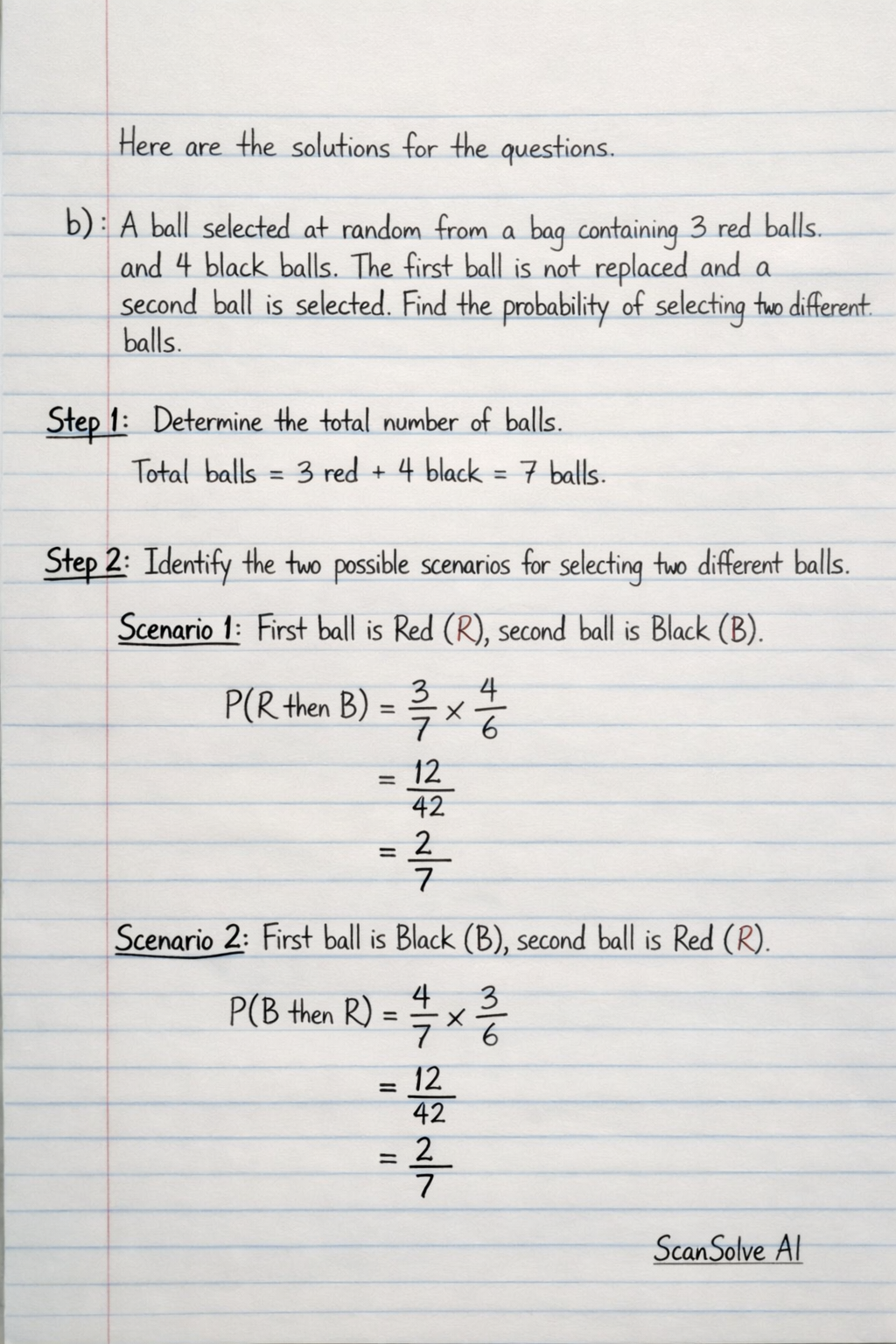
Handwritten Step-by-Step Solution
Get this as a handwritten image on WhatsApp — like a tutor wrote it for you.
Try on WhatsApp