
We read your photo as:
A bag contains 5 blue balls, 4 green balls, and 3 yellow balls. Three balls are drawn at random without replacement. What is the probability that all three balls are the same colour?
Mathematics
ScanSolve AI Answer
Step-by-step solution
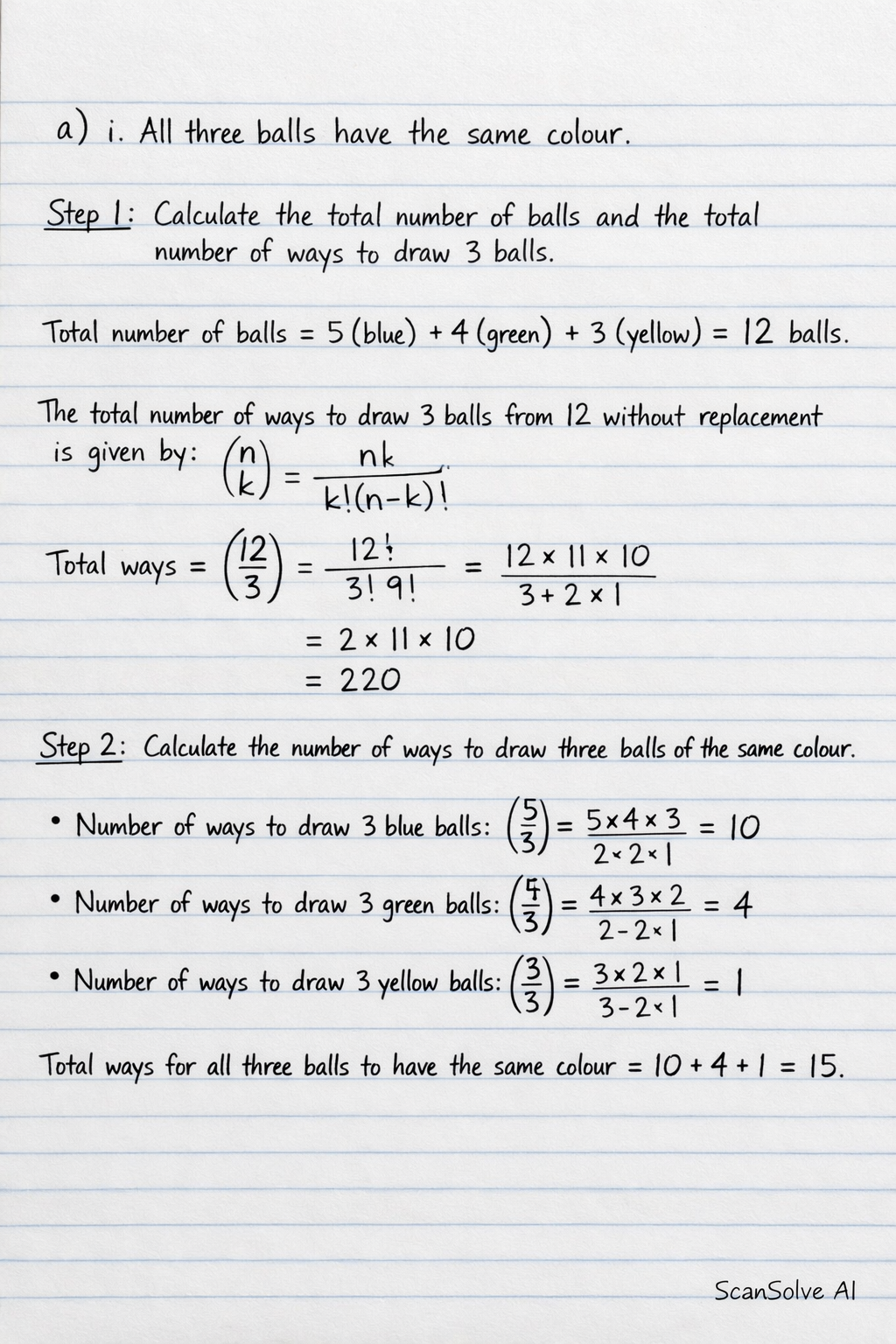
6 stepsa) i. All three balls have the same colour.
Calculate the total number of balls and the total number of ways to draw 3 balls.
Total number of balls = balls.
The total number of ways to draw 3 balls from 12 without replacement is given by the combination formula .Calculate the number of ways to draw three balls of the same colour.
- Number of ways to draw 3 blue balls:
- Number of ways to draw 3 green balls:
- Number of ways to draw 3 yellow balls: Total ways for all three balls to have the same colour = .
Calculate the probability.
The probability that all three balls have the same colour is .
a) ii. Two balls have the same colour.
Calculate the number of ways to draw exactly two balls of one colour and one ball of a different colour.
- 2 Blue and 1 Green:
- 2 Blue and 1 Yellow:
- 2 Green and 1 Blue:
- 2 Green and 1 Yellow:
- 2 Yellow and 1 Blue:
- 2 Yellow and 1 Green: Total ways for two balls to have the same colour = .
Calculate the probability.
The probability that two balls have the same colour is .
b) Calculate the Spearman's rank correlation coefficient.
List the ranks and calculate the differences () and squared differences ().
The number of candidates, .
Candidate Physics Rank () Chemistry Rank () 1 6 7 -1 1 2 5 6 -1 1 3 4 2 2
Was this helpful?
Still stuck on this one?
Ask a follow-up, and the answer starts from this question.
Got a different question?Ask your own question
More Mathematics Questions
QA bag contains 5 red, 4 blue, and 3 green balls. Three balls are drawn at random. What is the…QA bag contains 5 red balls, 3 blue balls, and 2 green balls. What is the probability of drawing a…QA bag contains 3 red balls and 4 black balls. If two balls are drawn without replacement, what is…QA bag contains 6 blue balls, 7 green balls and 3 yellow balls. One ball is drawn at random and not…QA bag contains 6 balls, 4 red and 2 black. What is the probability of drawing two balls of the same…
Browse by topic:Statistics
Handwritten Step-by-Step Solution
Get this as a handwritten image on WhatsApp — like a tutor wrote it for you.
Try on WhatsApp