
We read your photo as:
A bag contains 3 red balls, 4 blue balls, 5 white balls and 6 black balls. What is the probability that it is either red, white or blue? What is the probability of blue or white? What is probability of not black?
ScanSolve AI Answer
This answer stops before the end.
It was cut off when it was first written. Ask ScanSolve this question again for the full working.
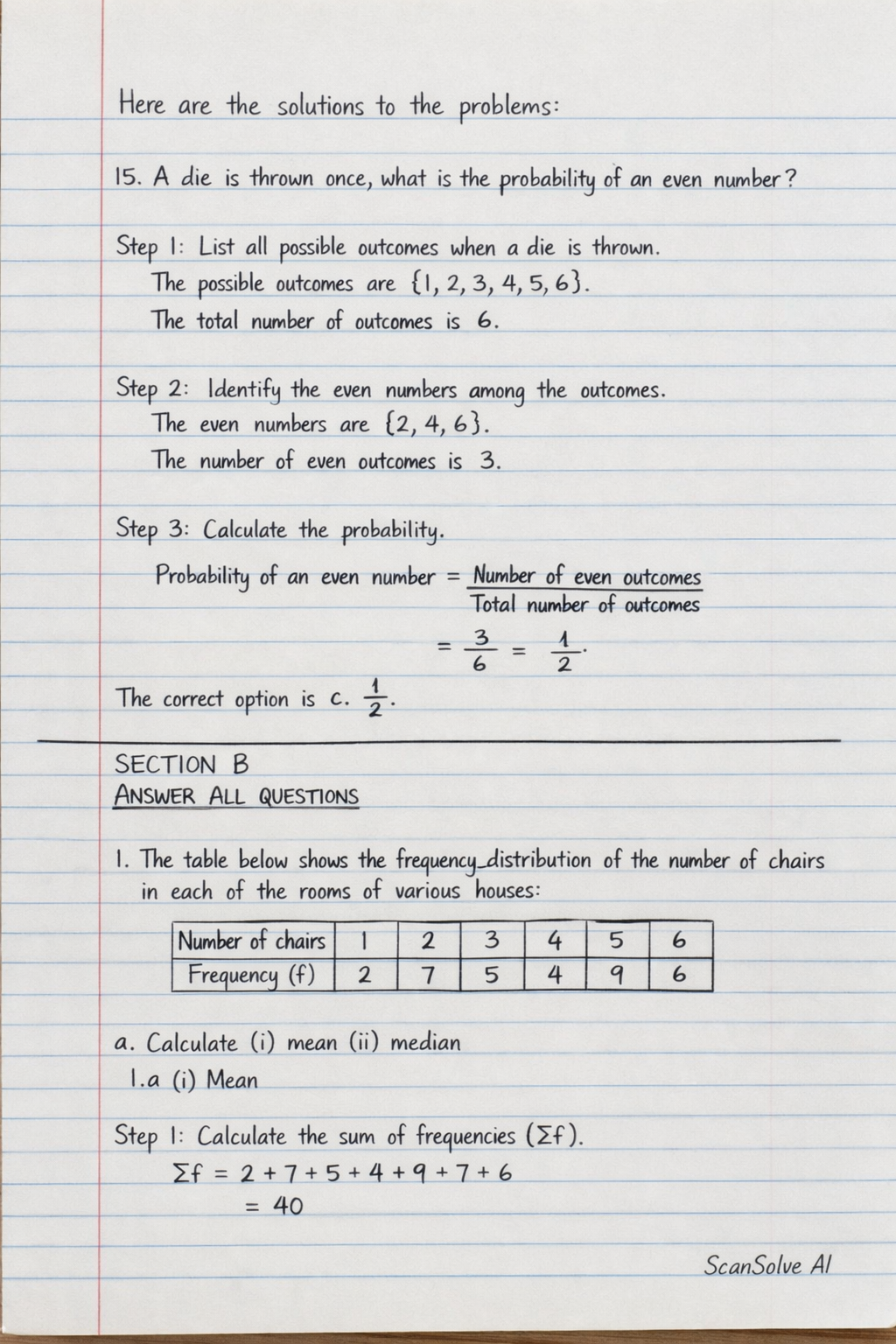
Here are the solutions to the problems:
15. A dice is thrown once, what is the probability of an even number?
Step 1: List all possible outcomes when a die is thrown.
The possible outcomes are .
The total number of outcomes is 6.
Step 2: Identify the even numbers among the outcomes.
The even numbers are .
The number of even outcomes is 3.
Step 3: Calculate the probability.
Probability of an even number = .
The correct option is c. .
SECTION B
ANSWER ALL QUESTIONS
1. The table below shows the frequency distribution of the number of chairs in each of the rooms of various houses.
| Number of chairs () | 1 | 2 | 3 | 4 | 5 | 6 | 7 |
|---|---|---|---|---|---|---|---|
| Frequency () | 2 | 7 | 5 | 4 | 9 | 7 | 6 |
a. Calculate (i) mean (ii) median
- 1.a (i) Mean
Step 1: Calculate the sum of frequencies ().
Step 2: Calculate the sum of (frequency number of chairs) ().
Step 3: Calculate the mean.
The mean is .
- 1.a (ii) Median
Step 1: Find the position of the median.
The total number of data points is .
The median position is -th position.
Step 2: Determine the value at the median position using cumulative frequencies.
- For , cumulative frequency = 2
- For , cumulative frequency =
- For , cumulative frequency =
- For , cumulative frequency =
- For , cumulative frequency = Since the 20.5-th position falls within the cumulative frequency range for (i.e., ), the median is 5. The median is .
b. Find the mode
Step 1: Identify the highest frequency in the table.
The highest frequency is 9.
Step 2: Determine the number of chairs corresponding to the highest frequency.
The value has the highest frequency of 9.
The mode is .
2. a. Simplify
Step 1: Factorize the first fraction.
Numerator:
Denominator:
So, the first fraction is (assuming ).
Step 2: Factorize the second fraction.
Numerator: (This expression does not factor easily into simple linear terms. We will keep it as is.)
Denominator:
Step 3: Add the simplified fractions.
The common denominator is .
Step 4: Expand the numerator and combine terms.
The simplified expression is .
b. Given , evaluate
Step 1: Express the ratio as a fraction.
Step 2: Divide the numerator and denominator of the expression by .
Step 3: Substitute the value of .
Step 4: Simplify the expression.
The value of the expression is .
c. Find the value of m for which the expression is undefined.
This refers to the expression in part 2a: .
An expression is undefined when its denominator is zero.
Step 1: Set the denominator of the first term to zero.
This implies or .
So, or .
Step 2: Set the denominator of the second term to zero.
This implies or .
So, or .
Step 3: Combine the conditions for .
The expression is undefined if or . (Also if , but the question asks for values of ).
The values of for which the expression is undefined are .
3. a. The distance of a chord of a circle of radius 5cm from the centre of the circle is 4cm. Calculate the length of chord.
Step 1: Draw a diagram and identify the relevant geometric relationship.
Let be the radius of the circle, be the distance from the center to the chord, and be the length of the chord. A radius drawn to an endpoint of the chord, the distance from the center to the chord, and half the chord form a right-angled triangle.
We are given cm and cm. Let the half-length of the chord be .
Step 2: Apply the Pythagorean theorem.
Step 3: Solve for .
Step 4: Calculate the full length of the chord.
The length of the chord is .
b. Calculate the value of x and y (referring to the diagram)
Step 1: Identify the properties of a cyclic quadrilateral.
The diagram shows a cyclic quadrilateral (a quadrilateral inscribed in a circle). In a cyclic quadrilateral, opposite angles sum to .
Step 2: Calculate the value of .
The angle is opposite the angle .
Step 3: Identify angles subtended by the same arc.
The angle is marked as . The angle subtends the same arc AB as . Therefore, .
The angles marked with a single arc are and . These angles subtend the same arc CD, so they are equal. Let's call this angle .
The angles marked with a double arc are and . These angles subtend the same arc BC, so they are equal. Let's call this angle .
Step 4: Use the sum of angles in a triangle.
Consider . The sum of its angles is .
Substitute :
This is consistent with .
Step 5: Use the sum of angles in .
The sum of angles in is .
We also know that (angles subtended by arc AD).
From , we have .
So, and . Since , these equations are consistent but do not allow us to find or individually.
There seems to be insufficient information in the diagram to determine uniquely with the given markings. If there was an additional angle or a relationship between and or , it could be solved. However, based on the properties of cyclic quadrilaterals and angles subtended by the same arc, we can only establish . Without further information, cannot be determined.
Assuming there might be a missing piece of information or a specific interpretation of the diagram, I will state what can be found.
The value of is .
The value of cannot be uniquely determined from the given diagram and markings. We can only state that .
c. Find m if
Step 1: Convert the logarithmic equation to an exponential equation.
The definition of a logarithm states that if , then .
Applying this to :
Step 2: Solve for .
The value of is .
4. Solve the following inequalities
a.
Step 1: Distribute the on the left side.
Step 2: Gather terms on one side and constant terms on the other.
Add to both sides:
Subtract 9 from both sides:
Step 3: Divide by 7.
This can also be written as .
The solution is .
b.
Step 1: Find a common denominator for the fractions on the left side.
The LCM of 3 and 5 is 15.
Step 2: Combine the fractions and simplify the numerator.
Step 3: Multiply both sides by 15 to eliminate the denominator.
Step 4: Gather terms on one side and constant terms on the other.
Subtract from both sides:
Add 8 to both sides:
Step 5: Divide by 16.
The solution is .
5. A bag contains 3 red balls, 4 blue balls, 5 white balls and 6 black balls.
Step 1: Calculate the total number of balls in the bag.
Total balls = balls.
a. What is the probability that it is either red, white or blue?
Step 1: Find the number of red, white, or blue balls.
Number of red, white, or blue balls = balls.
Step 2: Calculate the probability.
Still stuck on this one?
Ask a follow-up, and the answer starts from this question.
More Mathematics Questions
Handwritten Step-by-Step Solution
Get this as a handwritten image on WhatsApp — like a tutor wrote it for you.
Try on WhatsApp