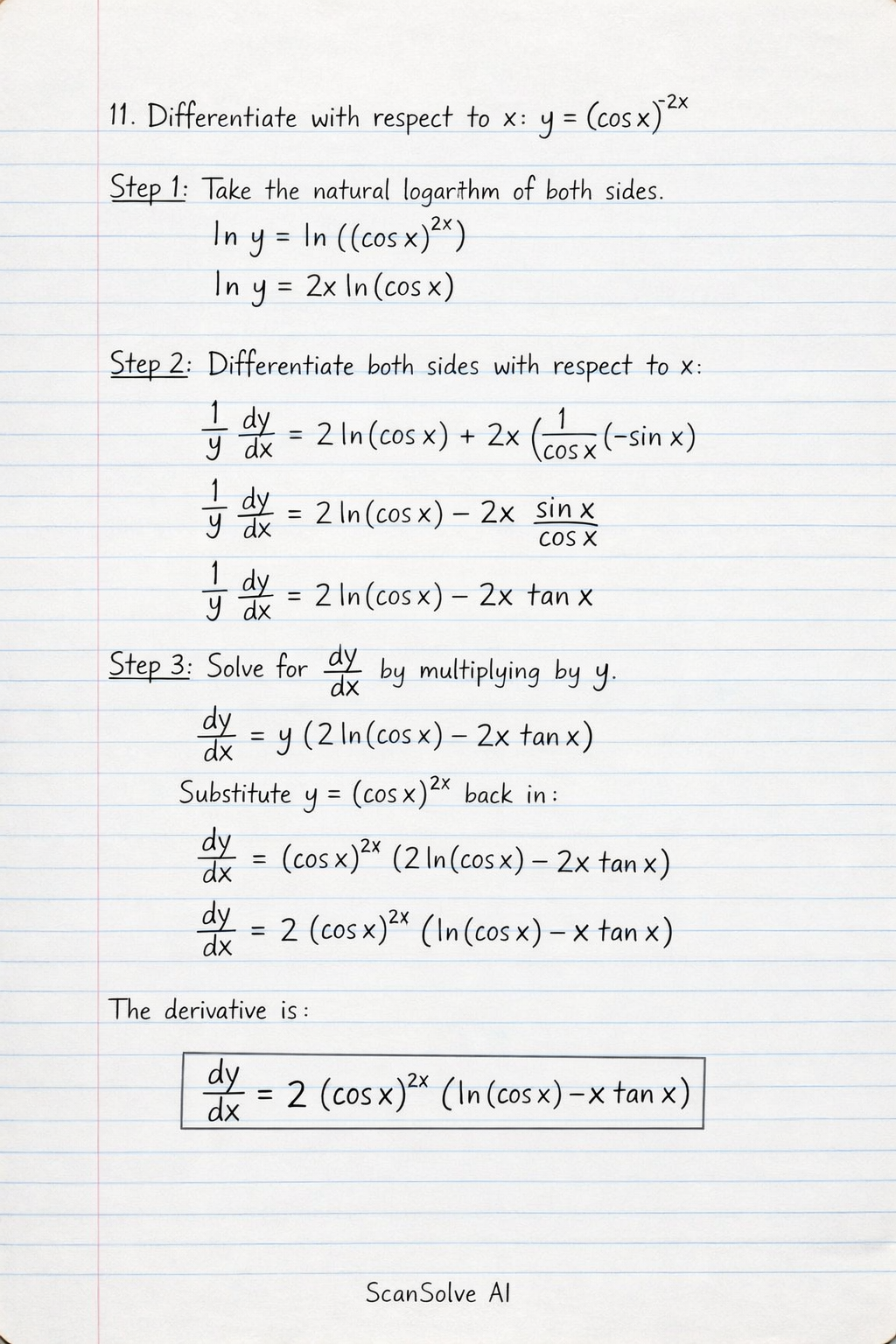
Step 1: Take the natural logarithm of both sides.
lny=ln((cosx)2x)lny=2xln(cosx)
Step 2: Differentiate both sides with respect to x using implicit differentiation and the product rule.
y1dxdy=2ln(cosx)+2x(cosx1⋅(−sinx))y1dxdy=2ln(cosx)−2xcosxsinxy1dxdy=2ln(cosx)−2xtanx
Step 3: Solve for dxdy by multiplying by y.
dxdy=y(2ln(cosx)−2xtanx)
Substitute y=(cosx)2x back into the equation.
dxdy=(cosx)2x(2ln(cosx)−2xtanx)dxdy=2(cosx)2x(ln(cosx)−xtanx)
The derivative is:
\frac{dy{dx} = 2 (\cos x)^{2x} (\ln(\cos x) - x \tan x)}
12. A curve passes through the point (1,7) and the gradient of the curve at the point (x,y) is given by (5−2x). Find the equation of the curve.
Step 1: Set up the differential equation.
The gradient is given by dxdy.
dxdy=5−2x
Step 2: Integrate both sides with respect to x to find the equation of the curve.
y=∫(5−2x)dxy=5x−22x2+Cy=5x−x2+C
Step 3: Use the given point (1,7) to find the constant of integration C.
Substitute x=1 and y=7 into the equation.
7=5(1)−(1)2+C7=5−1+C7=4+CC=7−4C=3
Step 4: Write the final equation of the curve.
y=5x−x2+3
13. Solve the equation z2=5−12i.
Step 1: Let z=x+iy, where x and y are real numbers.
(x+iy)2=5−12ix2+2ixy+(iy)2=5−12ix2+2ixy−y2=5−12i(x2−y2)+i(2xy)=5−12i
Step 2: Equate the real and imaginary parts.
x2−y2=5(1)2xy=−12(2)
Step 3: From equation (2), express y in terms of x.
y=2x−12=x−6
Step 4: Substitute y into equation (1).
x2−(x−6)2=5x2−x236=5
Multiply by x2 to clear the denominator.
x4−36=5x2
Rearrange into a quadratic form for x2.
x4−5x2−36=0
Step 5: Let u=x2. Solve the quadratic equation u2−5u−36=0.
Using the quadratic formula or factoring:
(u−9)(u+4)=0
So, u=9 or u=−4.
Since u=x2 and x is a real number, x2 must be non-negative.
Therefore, x2=9.
x=±3
Step 6: Find the corresponding values for y.
If x=3, then y=3−6=−2. So, z1=3−2i.
If x=−3, then y=−3−6=2. So, z2=−3+2i.
The solutions are:
z=3−2ior z = -3 + 2i
14. Evaluate ∫02(1−∣x−1∣)3dx.
Step 1: Split the integral based on the definition of the absolute value.
The expression ∣x−1∣ changes definition at x=1.
For 0≤x<1: ∣x−1∣=−(x−1)=1−x.
For 1≤x≤2: ∣x−1∣=x−1.
Step 2: Rewrite the integral as a sum of two integrals.
∫02(1−∣x−1∣)3dx=∫01(1−(1−x))3dx+∫12(1−(x−1))3dx=∫01(1−1+x)3dx+∫12(1−x+1)3dx=∫01x3dx+∫12(2−x)3dx
Step 3: Evaluate the first integral.
∫01x3dx=[4x4]01=414−404=41
Step 4: Evaluate the second integral. Let u=2−x, so du=−dx.
When x=1, u=2−1=1.
When x=2, u=2−2=0.
∫12(2−x)3dx=∫10u3(−du)=−∫10u3du=∫01u3du=[4u4]01=414−404=41
Step 5: Add the results of the two integrals.
∫02(1−∣x−1∣)3dx=41+41=42=21
The value of the integral is:
\frac{1{2}}
15. Use the substitution t=tan2θ to evaluate ∫02π3+5sinθ4dθ.
Step 1: Apply the Weierstrass substitution formulas.
Given t=tan2θ.
Then dθ=1+t22dt.
And sinθ=1+t22t.
Step 2: Change the limits of integration.
When θ=0, t=tan20=tan0=0.
When θ=2π, t=tan2π/2=tan4π=1.
Step 3: Substitute these into the integral.
∫02π3+5sinθ4dθ=∫013+5(1+t22t)4(1+t22)dt=∫011+t23(1+t2)+10t4⋅1+t22dt=∫013+3t2+10t4(1+t2)⋅1+t22dt=∫013t2+10t+38dt
Step 4: Factor the denominator.
3t2+10t+3=(3t+1)(t+3)
Step 5: Use partial fraction decomposition.
(3t+1)(t+3)8=3t+1A+t+3B8=A(t+3)+B(3t+1)
Set t=−3: 8=A(−3+3)+B(3(−3)+1)⟹8=B(−8)⟹B=−1.
Set t=−31: 8=A(−31+3)+B(3(−31)+1)⟹8=A(38)⟹A=3.
So, the integrand becomes:
3t+13−t+31
Step 6: Evaluate the integral.
∫01(3t+13−t+31)dt=[33ln∣3t+1∣−ln∣t+3∣]01=[ln∣3t+1∣−ln∣t+3∣]01=[lnt+33t+1]01
Now, apply the limits:
=ln(1+33(1)+1)−ln(0+33(0)+1)=ln(44)−ln(31)=ln(1)−ln(31)=0−(−ln3)=ln3
The value of the integral is:
ln3
Drop the next question!
Was this helpful?
Need help with your own homework?
Get instant step-by-step solutions to any question. Free to start.
Take the natural logarithm of both sides. y = (( x)^2x) y = 2x ( x) Step 2: Differentiate both sides with respect to x using implicit differentiation and the product rule.
This mathematics problem involves applying core mathematical principles and formulas. Below you will find a complete step-by-step solution with detailed explanations for each step, helping you understand not just the answer but the method behind it.
ScanSolve AI Answer
here are the solutions to your math problems. 11. Differentiate with respect to x. y = ( x)^2x Step 1: Take the natural logarithm of both sides. y = (( x)^2x) y = 2x ( x) Step 2: Differentiate both sides with respect to x using implicit differentiation and the product rule. (1)/(y) (dy)/(dx) = 2 ( x) + 2x ( (1)/( x) · (- x) ) (1)/(y) (dy)/(dx) = 2 ( x) - 2x ( x)/( x) (1)/(y) (dy)/(dx) = 2 ( x) - 2x x Step 3: Solve for (dy)/(dx) by multiplying by y. (dy)/(dx) = y (2 ( x) - 2x x) Substitute y = ( x)^2x back into the equation. (dy)/(dx) = ( x)^2x (2 ( x) - 2x x) (dy)/(dx) = 2 ( x)^2x (( x) - x x) The derivative is: (dy)/(dx) = 2 ( x)^2x (( x) - x x) 12. A curve passes through the point (1,7) and the gradient of the curve at the point (x,y) is given by (5-2x). Find the equation of the curve. Step 1: Set up the differential equation. The gradient is given by (dy)/(dx). (dy)/(dx) = 5 - 2x Step 2: Integrate both sides with respect to x to find the equation of the curve. y = (5 - 2x) \, dx y = 5x - 2 (x^2)/(2) + C y = 5x - x^2 + C Step 3: Use the given point (1,7) to find the constant of integration C. Substitute x=1 and y=7 into the equation. 7 = 5(1) - (1)^2 + C 7 = 5 - 1 + C 7 = 4 + C C = 7 - 4 C = 3 Step 4: Write the final equation of the curve. y = 5x - x^2 + 3 13. Solve the equation z^2 = 5 - 12i. Step 1: Let z = x + iy, where x and y are real numbers. (x + iy)^2 = 5 - 12i x^2 + 2ixy + (iy)^2 = 5 - 12i x^2 + 2ixy - y^2 = 5 - 12i (x^2 - y^2) + i(2xy) = 5 - 12i Step 2: Equate the real and imaginary parts. x^2 - y^2 = 5 (1) 2xy = -12 (2) Step 3: From equation (2), express y in terms of x. y = (-12)/(2x) = (-6)/(x) Step 4: Substitute y into equation (1). x^2 - ((-6)/(x))^2 = 5 x^2 - (36)/(x^2) = 5 Multiply by x^2 to clear the denominator. x^4 - 36 = 5x^2 Rearrange into a quadratic form for x^2. x^4 - 5x^2 - 36 = 0 Step 5: Let u = x^2. Solve the quadratic equation u^2 - 5u - 36 = 0. Using the quadratic formula or factoring: (u - 9)(u + 4) = 0 So, u = 9 or u = -4. Since u = x^2 and x is a real number, x^2 must be non-negative. Therefore, x^2 = 9. x = ± 3 Step 6: Find the corresponding values for y. If x = 3, then y = (-6)/(3) = -2. So, z_1 = 3 - 2i. If x = -3, then y = (-6)/(-3) = 2. So, z_2 = -3 + 2i. The solutions are: z = 3 - 2i or z = -3 + 2i 14. Evaluate _0^2 (1 - |x - 1|)^3 dx. Step 1: Split the integral based on the definition of the absolute value. The expression |x-1| changes definition at x=1. For 0 x < 1: |x-1| = -(x-1) = 1-x. For 1 x 2: |x-1| = x-1. Step 2: Rewrite the integral as a sum of two integrals. _0^2 (1 - |x - 1|)^3 dx = _0^1 (1 - (1-x))^3 dx + _1^2 (1 - (x-1))^3 dx = _0^1 (1 - 1 + x)^3 dx + _1^2 (1 - x + 1)^3 dx = _0^1 x^3 dx + _1^2 (2 - x)^3 dx Step 3: Evaluate the first integral. _0^1 x^3 dx = [ (x^4)/(4) ]_0^1 = (1^4)/(4) - (0^4)/(4) = (1)/(4) Step 4: Evaluate the second integral. Let u = 2-x, so du = -dx. When x=1, u=2-1=1. When x=2, u=2-2=0. _1^2 (2 - x)^3 dx = _1^0 u^3 (-du) = - _1^0 u^3 du = _0^1 u^3 du = [ (u^4)/(4) ]_0^1 = (1^4)/(4) - (0^4)/(4) = (1)/(4) Step 5: Add the results of the two integrals. _0^2 (1 - |x - 1|)^3 dx = (1)/(4) + (1)/(4) = (2)/(4) = (1)/(2) The value of the integral is: (1)/(2) 15. Use the substitution t = ()/(2) to evaluate _0^()/(2) (4)/(3 + 5 ) d. Step 1: Apply the Weierstrass substitution formulas. Given t = ()/(2). Then d = (2)/(1+t^2) dt. And = (2t)/(1+t^2). Step 2: Change the limits of integration. When = 0, t = (0)/(2) = 0 = 0. When = ()/(2), t = (/2)/(2) = ()/(4) = 1. Step 3: Substitute these into the integral. _0^()/(2) (4)/(3 + 5 ) d = _0^1 (4)/(3 + 5 (2t)1+t^2) ((2)/(1+t^2)) dt = _0^1 (4)/(3(1+t^2) + 10t)1+t^2 · (2)/(1+t^2) dt = _0^1 (4(1+t^2))/(3+3t^2 + 10t) · (2)/(1+t^2) dt = _0^1 (8)/(3t^2 + 10t + 3) dt Step 4: Factor the denominator. 3t^2 + 10t + 3 = (3t+1)(t+3) Step 5: Use partial fraction decomposition. (8)/((3t+1)(t+3)) = (A)/(3t+1) + (B)/(t+3) 8 = A(t+3) + B(3t+1) Set t = -3: 8 = A(-3+3) + B(3(-3)+1) 8 = B(-8) B = -1. Set t = -(1)/(3): 8 = A(-(1)/(3)+3) + B(3(-(1)/(3))+1) 8 = A((8)/(3)) A = 3. So, the integrand becomes: (3)/(3t+1) - (1)/(t+3) Step 6: Evaluate the integral. _0^1 ( (3)/(3t+1) - (1)/(t+3) ) dt = [ (3 |3t+1|)/(3) - |t+3| ]_0^1 = [ |3t+1| - |t+3| ]_0^1 = [ |(3t+1)/(t+3)| ]_0^1 Now, apply the limits: = ((3(1)+1)/(1+3)) - ((3(0)+1)/(0+3)) = ((4)/(4)) - ((1)/(3)) = (1) - ((1)/(3)) = 0 - (- 3) = 3 The value of the integral is: 3 Drop the next question!