We read your photo as:

यदि u = log (tan x + tan y) हो, तो sin 2x du/dx + sin 2y du/dy बराबर है -

Mathematics

ScanSolve AI Answer

Answer

(2) 2\text{(2) } 2

Step-by-step solution

3 steps

दिए गए फलन u=log⁡(tan⁡x+tan⁡y)u = \log(\tan x + \tan y) के लिए, हमें sin⁡2x∂u∂x+sin⁡2y∂u∂y\sin 2x \frac{\partial u}{\partial x} + \sin 2y \frac{\partial u}{\partial y} का मान ज्ञात करना है।

  1. ∂u∂x\frac{\partial u}{\partial x} ज्ञात करें।

    u=log⁡(tan⁡x+tan⁡y)u = \log(\tan x + \tan y)
    xx के सापेक्ष आंशिक अवकलन करने पर, yy को एक स्थिरांक मानते हुए:

    ∂u∂x=1tan⁡x+tan⁡y⋅ddx(tan⁡x+tan⁡y)\frac{\partial u}{\partial x} = \frac{1}{\tan x + \tan y} \cdot \frac{d}{dx}(\tan x + \tan y) ∂u∂x=1tan⁡x+tan⁡y⋅(sec⁡2x+0)\frac{\partial u}{\partial x} = \frac{1}{\tan x + \tan y} \cdot (\sec^2 x + 0) ∂u∂x=sec⁡2xtan⁡x+tan⁡y\frac{\partial u}{\partial x} = \frac{\sec^2 x}{\tan x + \tan y}
  2. ∂u∂y\frac{\partial u}{\partial y} ज्ञात करें।

    u=log⁡(tan⁡x+tan⁡y)u = \log(\tan x + \tan y)
    yy के सापेक्ष आंशिक अवकलन करने पर, xx को एक स्थिरांक मानते हुए:

    ∂u∂y=1tan⁡x+tan⁡y⋅ddy(tan⁡x+tan⁡y)\frac{\partial u}{\partial y} = \frac{1}{\tan x + \tan y} \cdot \frac{d}{dy}(\tan x + \tan y) ∂u∂y=1tan⁡x+tan⁡y⋅(0+sec⁡2y)\frac{\partial u}{\partial y} = \frac{1}{\tan x + \tan y} \cdot (0 + \sec^2 y) ∂u∂y=sec⁡2ytan⁡x+tan⁡y\frac{\partial u}{\partial y} = \frac{\sec^2 y}{\tan x + \tan y}
  3. दिए गए व्यंजक में मान प्रतिस्थापित करें और सरल करें।

    हमें sin⁡2x∂u∂x+sin⁡2y∂u∂y\sin 2x \frac{\partial u}{\partial x} + \sin 2y \frac{\partial u}{\partial y} का मान ज्ञात करना है।

    sin⁡2x(sec⁡2xtan⁡x+tan⁡y)+sin⁡2y(sec⁡2ytan⁡x+tan⁡y)\sin 2x \left( \frac{\sec^2 x}{\tan x + \tan y} \right) + \sin 2y \left( \frac{\sec^2 y}{\tan x + \tan y} \right) =1tan⁡x+tan⁡y(sin⁡2xsec⁡2x+sin⁡2ysec⁡2y)= \frac{1}{\tan x + \tan y} (\sin 2x \sec^2 x + \sin 2y \sec^2 y)

    अब, sin⁡2xsec⁡2x\sin 2x \sec^2 x और sin⁡2ysec⁡2y\sin 2y \sec^2 y को सरल करें।
    हम जानते हैं कि sin⁡2θ=2sin⁡θcos⁡θ\sin 2\theta = 2\sin\theta\cos\theta और sec⁡2θ=1cos⁡2θ\sec^2\theta = \frac{1}{\cos^2\theta}।

    sin⁡2xsec⁡2x=(2sin⁡xcos⁡x)⋅1cos⁡2x=2sin⁡xcos⁡x=2tan⁡x\sin 2x \sec^2 x = (2\sin x \cos x) \cdot \frac{1}{\cos^2 x} = \frac{2\sin x}{\cos x} = 2\tan x

    इसी प्रकार,

    sin⁡2ysec⁡2y=(2sin⁡ycos⁡y)⋅1cos⁡2y=2sin⁡ycos⁡y=2tan⁡y\sin 2y \sec^2 y = (2\sin y \cos y) \cdot \frac{1}{\cos^2 y} = \frac{2\sin y}{\cos y} = 2\tan y

    इन मानों को व्यंजक में वापस प्रतिस्थापित करने पर:

    =1tan⁡x+tan⁡y(2tan⁡x+2tan⁡y)= \frac{1}{\tan x + \tan y} (2\tan x + 2\tan y) =1tan⁡x+tan⁡y⋅2(tan⁡x+tan⁡y)= \frac{1}{\tan x + \tan y} \cdot 2(\tan x + \tan y) =2= 2

    अतः, दिए गए व्यंजक का मान 2 है।

    सही विकल्प है:

    (2) 2\text{(2) } 2
Was this helpful?

Try one yourself

A new problem that tests the same skill.

Still stuck on this one?

Ask a follow-up, and the answer starts from this question.

Got a different question?Ask your own question
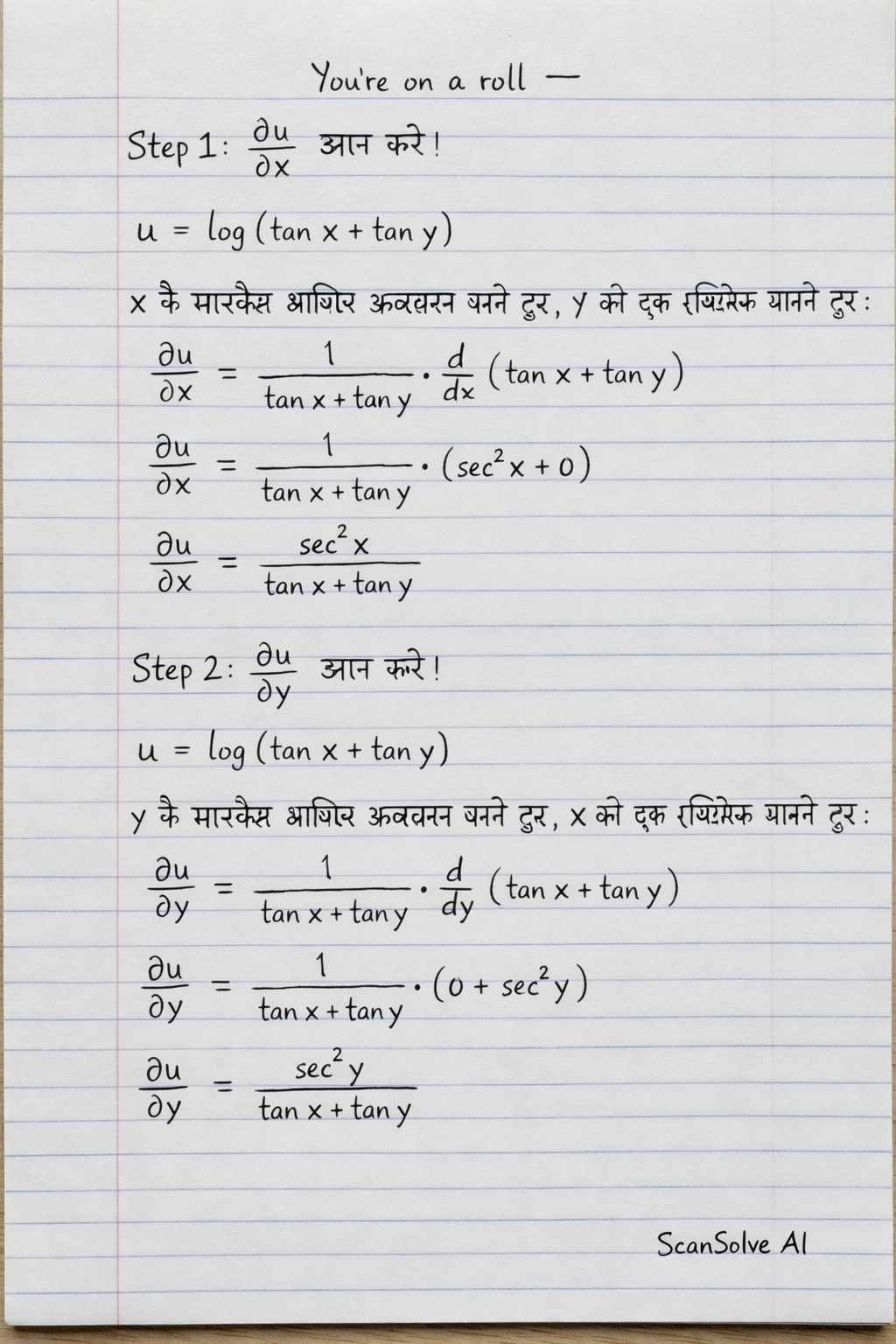
Handwritten step-by-step solution preview

Handwritten Step-by-Step Solution

Get this as a handwritten image on WhatsApp — like a tutor wrote it for you.

Try on WhatsApp