
We read your photo as:
Write the four inequalities that define the unshaded region R on the XOY plane below.
ScanSolve AI Answer
Step-by-step solution
3 stepslet's define the unshaded region R with inequalities.
To define the unshaded region R, we need to identify the four boundary lines and determine the correct inequality for each.
Identify the vertical boundary line.
There is a solid vertical line at . The unshaded region R is to the right of this line.
The inequality is .Identify the horizontal boundary lines.
There is a solid horizontal line at . The unshaded region R is below this line.
The inequality is .
There is another solid horizontal line at . The unshaded region R is above this line.
The inequality is .Identify the slanted boundary line.
This solid line passes through the points and . We can find its equation.
The slope .
The y-intercept is 9.
So, the equation of the line is , which can be rewritten as .
The unshaded region R is below this line. To confirm the inequality, pick a point in region R, for example, .
Substitute into : . Since , the inequality is .The four inequalities that define the unshaded region R are:
Still stuck on this one?
Ask a follow-up, and the answer starts from this question.
More Mathematics Questions
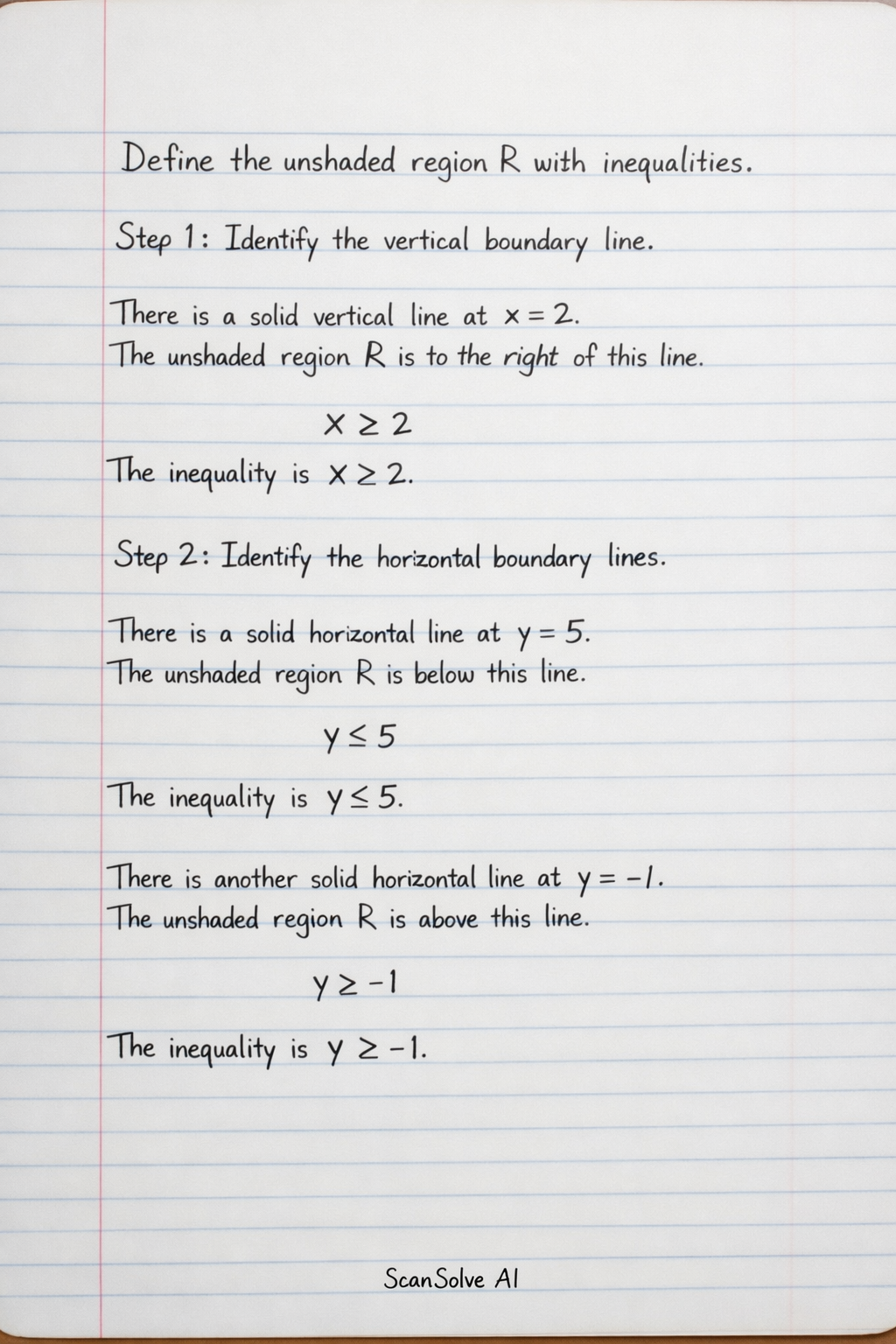
Handwritten Step-by-Step Solution
Get this as a handwritten image on WhatsApp — like a tutor wrote it for you.
Try on WhatsApp