
We read your photo as:
Write down four inequalities which fully describe the unshaded region R in the figure S below.
ScanSolve AI Answer
Step-by-step solution
7 steps8. Write down four inequalities which fully describe the unshaded region R in the figure S below.
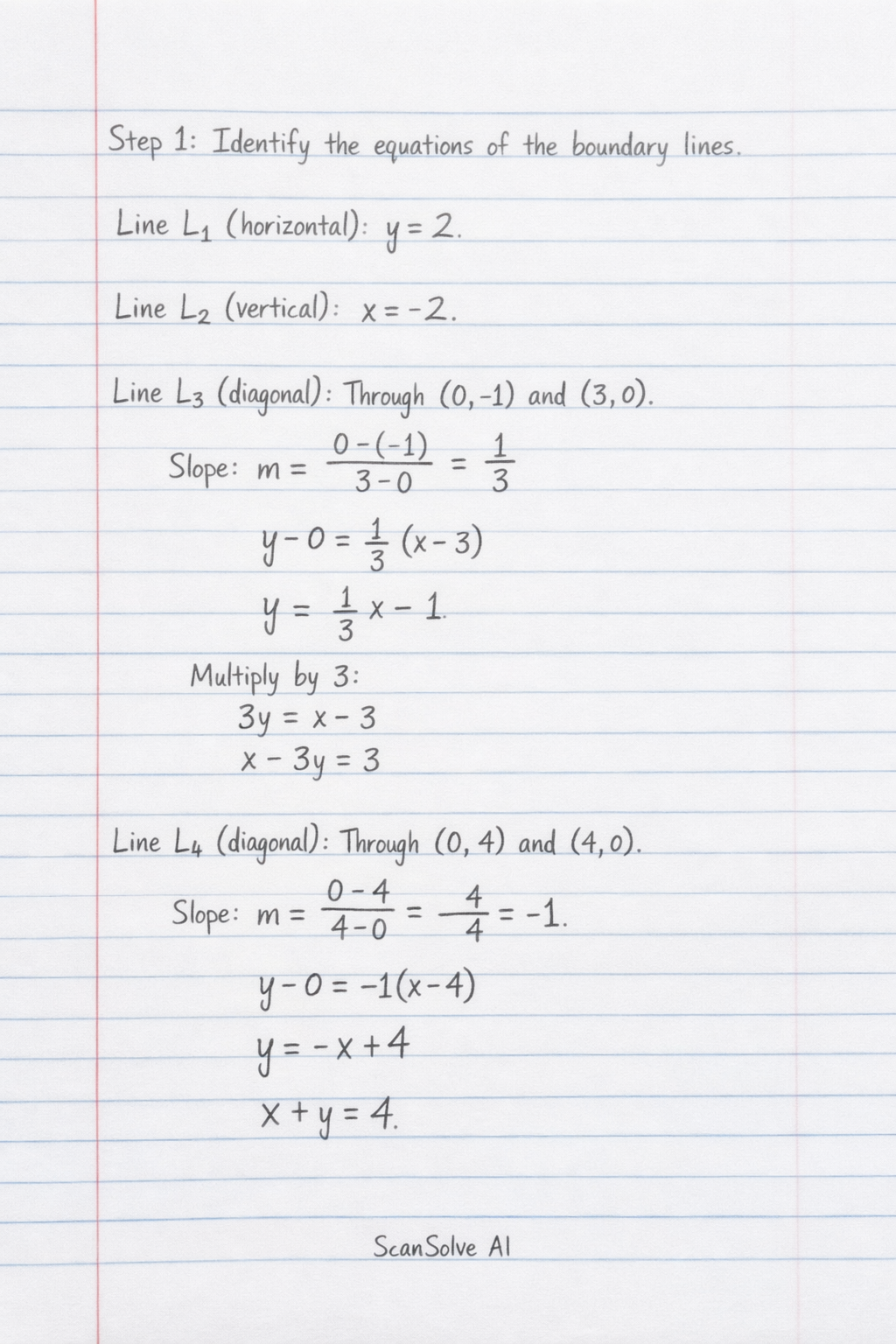
Identify the equations of the boundary lines.
- Line L1 (horizontal line): This line passes through . Its equation is .
- Line L2 (vertical line): This line passes through . Its equation is .
- Line L3 (diagonal line): This line passes through points and . The slope . Using the point-slope form with : Multiply by 3: , which can be written as .
- Line L4 (diagonal line): This line passes through points and . The slope . Using the point-slope form with : , which can be written as .
Determine the inequalities for the unshaded region R.
- For L1 (): The unshaded region R is below or on the line. So, .
- For L2 (): The unshaded region R is to the right of or on the line. So, .
- For L3 (): The unshaded region R is above or on the line. Test a point in R, e.g., . . Since , and R is above the line, the inequality is .
- For L4 (): The unshaded region R is below or on the line. Test a point in R, e.g., . . Since , the inequality is .
The four inequalities are:
9. A line PQ = 12.5cm. By using another line, divide PQ into nine equal parts.
This is a geometric construction problem.
Draw a line segment PQ of length 12.5 cm.
From point P, draw a ray PX at any convenient acute angle to PQ.
Using a compass, mark off 9 equal segments along the ray PX.
Label the points such that . The length of these segments is arbitrary, but they must be equal to each other.
Join the last point to point Q, forming line segment .
From each of the points , draw lines parallel to .
These parallel lines will intersect the line segment PQ at points that divide PQ into nine equal parts.
The points of intersection on PQ will divide PQ into 9 equal segments.
Still stuck on this one?
Ask a follow-up, and the answer starts from this question.
More Mathematics Questions
Handwritten Step-by-Step Solution
Get this as a handwritten image on WhatsApp — like a tutor wrote it for you.
Try on WhatsApp