
We read your photo as:
Find the inequalities that satisfy the region labeled R in the figure below.
ScanSolve AI Answer
Step-by-step solution
9 steps5. Find the inequalities that satisfy the region labeled R in the figure below.
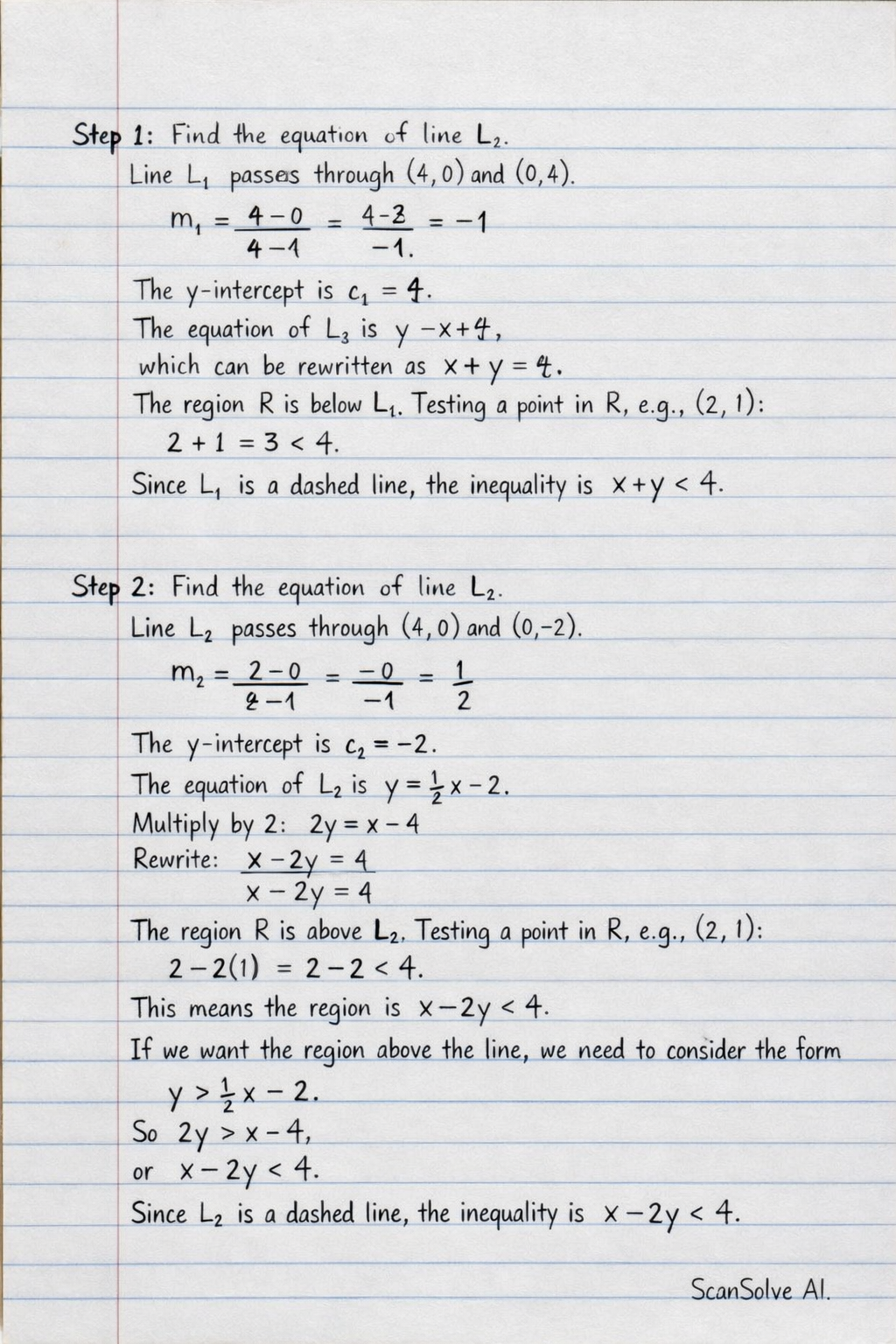
Find the equation of line L1.
Line L1 passes through and .
The slope .
The y-intercept is .
The equation of L1 is , which can be rewritten as .
The region R is below L1. Testing a point in R, e.g., : . Since L1 is a dashed line, the inequality is .Find the equation of line L2.
Line L2 passes through and .
The slope .
The y-intercept is .
The equation of L2 is .
Multiply by 2: , which can be rewritten as .
The region R is above L2. Testing a point in R, e.g., : . This means the region is . If we want the region above the line, we need to consider the form . So , or . Since L2 is a dashed line, the inequality is .Find the equation of line L3.
Line L3 is a vertical line passing through .
The region R is to the right of L3. Testing a point in R, e.g., : . Since L3 is a dashed line, the inequality is .The inequalities that satisfy the region R are:
6. Rodi walked from Kisian to Otonglo, a distance of 8 km for hours. He then took a motorbike to Rabuor that travel at a speed of 80 km/h and took 15 minutes. From Rabuor, he boarded a car to Kendu Bay, 60 km away and took 45 minutes to arrive in Kendu Bay. Calculate his average velocity for the whole journey.
Calculate the total distance covered.
- Segment 1 (Walk): Distance km.
- Segment 2 (Motorbike): Speed km/h, Time minutes hours hours. Distance km.
- Segment 3 (Car): Distance km. Total distance km.
Calculate the total time taken.
- Segment 1 (Walk): Time hours hours.
- Segment 2 (Motorbike): Time minutes hours.
- Segment 3 (Car): Time minutes hours hours. Total time hours.
Calculate the average velocity.
Average velocity is defined as total displacement divided by total time. Assuming the journey is in a straight line, total displacement equals total distance.
The average velocity for the whole journey is .
7. Simplify the expression
Rewrite the numerator using the difference of squares formula, .
Let and .
The numerator becomes .
Substitute the simplified numerator back into the expression.
Simplify the expression by canceling common terms.
Assuming :
The simplified expression is .
*8. A saleslady earns a commission of 3% and 5% for sale of goods up to Kshs. 100,000 and above Kshs. 100,000 respectively. In a certain month, Sarah's total commission was Kshs. 15,
Still stuck on this one?
Ask a follow-up, and the answer starts from this question.
More Mathematics Questions
Handwritten Step-by-Step Solution
Get this as a handwritten image on WhatsApp — like a tutor wrote it for you.
Try on WhatsApp