
We read your photo as:
A box contains 2 green balls and 3 blue balls. A ball is selected at random from the box and not replaced. A second ball is then selected. What is the probability of selecting two balls of different colours?
ScanSolve AI Answer
Answer
Step-by-step solution
4 stepsHere's how to solve this probability problem:
Determine the initial probabilities.
There are 2 green balls (G) and 3 blue balls (B), making a total of balls.
The probability of selecting a green ball first is .
The probability of selecting a blue ball first is .Draw a tree diagram to illustrate the outcomes.
Since the first ball is not replaced, there will be 4 balls remaining for the second selection.
- First Selection:
- Branch 1: Green (G)
- Probability:
- Remaining balls: 1 Green, 3 Blue (Total 4)
- Second Selection (after G1):
- Sub-branch 1.1: Green (G)
- Probability:
- Combined outcome: GG
- Combined probability:
- Sub-branch 1.2: Blue (B)
- Probability:
- Combined outcome: GB
- Combined probability:
- Sub-branch 1.1: Green (G)
- Branch 2: Blue (B)
- Probability:
- Remaining balls: 2 Green, 2 Blue (Total 4)
- Second Selection (after B1):
- Sub-branch 2.1: Green (G)
- Probability:
- Combined outcome: BG
- Combined probability:
- Sub-branch 2.2: Blue (B)
- Probability:
- Combined outcome: BB
- Combined probability:
- Sub-branch 2.1: Green (G)
- Branch 1: Green (G)
- First Selection:
Identify the outcomes for selecting two balls of different colours.
The outcomes where two balls of different colours are selected are:
- Green then Blue (GB)
- Blue then Green (BG)
Calculate the total probability for selecting two balls of different colours.
We sum the probabilities of the identified outcomes:
The probability of selecting two balls of different colours is .
Try one yourself
A new problem that tests the same skill.
Still stuck on this one?
Ask a follow-up, and the answer starts from this question.
More Mathematics Questions
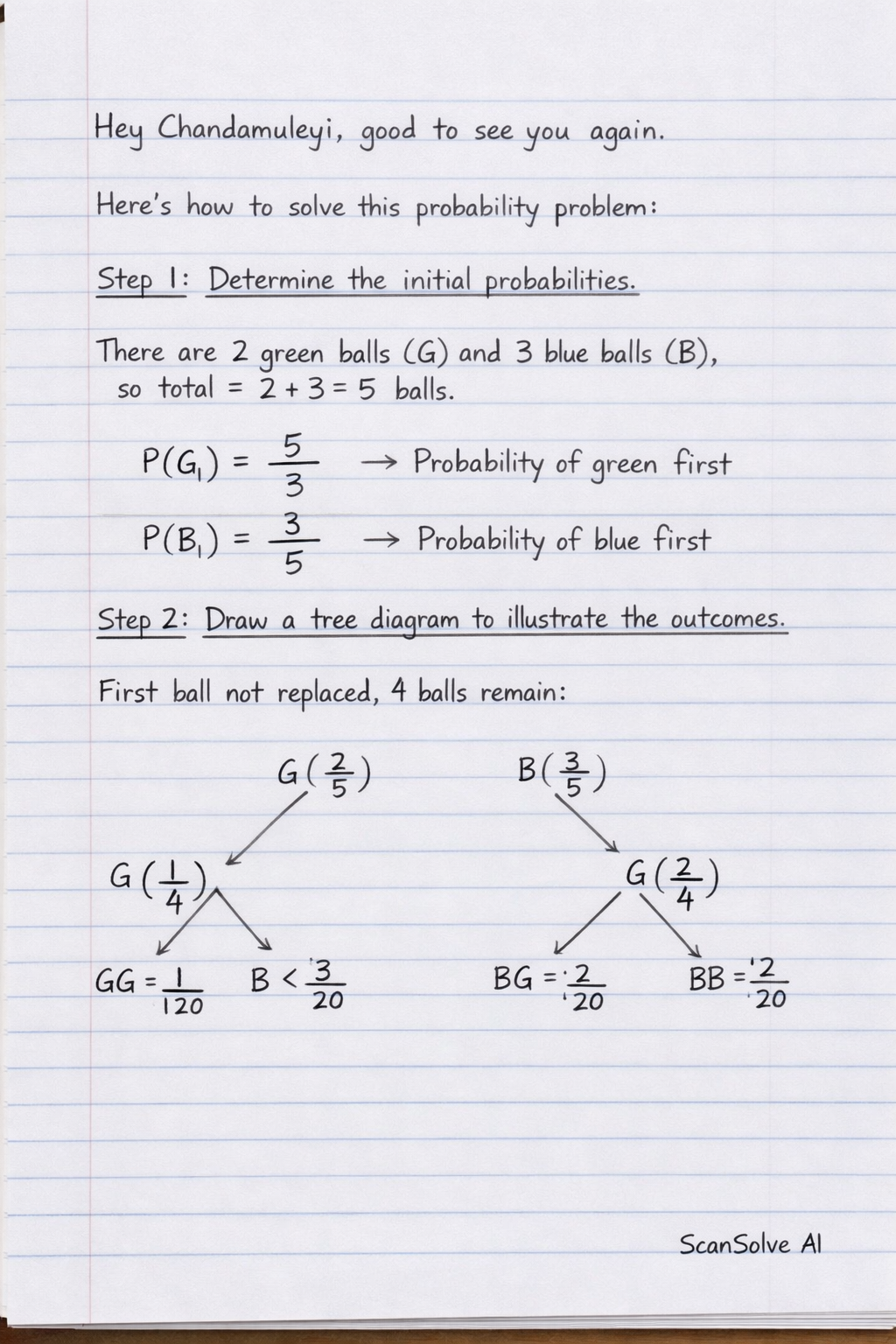
Handwritten Step-by-Step Solution
Get this as a handwritten image on WhatsApp — like a tutor wrote it for you.
Try on WhatsApp