
We read your photo as:
A building is viewed from two points on the ground. From point S, the angle of elevation to the top is 70 degrees. Point T is 30m directly above S. From T, the angle of elevation to the top is 20 degr
ScanSolve AI Answer
Answer
Step-by-step solution
5 stepsDefine variables and set up the diagram based on the problem description.
Let be the height of the building (from the ground level at S to the top of the building, B).
Let be the horizontal distance from point S (and T) to the base of the building.
Let P be the base of the building, so BP = .
Point T is vertically above S, with m.
Draw a horizontal line from T to the building, meeting it at point Q.
Then m.
The height from Q to the top of the building B is .Formulate equations using trigonometry for the angle of elevation from S.
From point S, the angle of elevation to the top of the building B is .
In the right-angled triangle formed by B, P, and S:This gives us our first equation:
Formulate equations using trigonometry for the angle of elevation from T.
From point T, the angle of elevation to the top of the building B is .
In the right-angled triangle formed by B, Q, and T:This gives us our second equation:
Solve the system of equations for .
From equation (1), we can express in terms of :
Substitute this expression for into equation (2):
Rearrange the equation to solve for :
Factor out :
To simplify the term in the parenthesis, find a common denominator:
Now, isolate :
Calculate the numerical value of .
Using a calculator:
Substitute these values into the equation for :
Rounding to two decimal places:
The height of the building is .
Try one yourself
A new problem that tests the same skill.
Still stuck on this one?
Ask a follow-up, and the answer starts from this question.
More Mathematics Questions
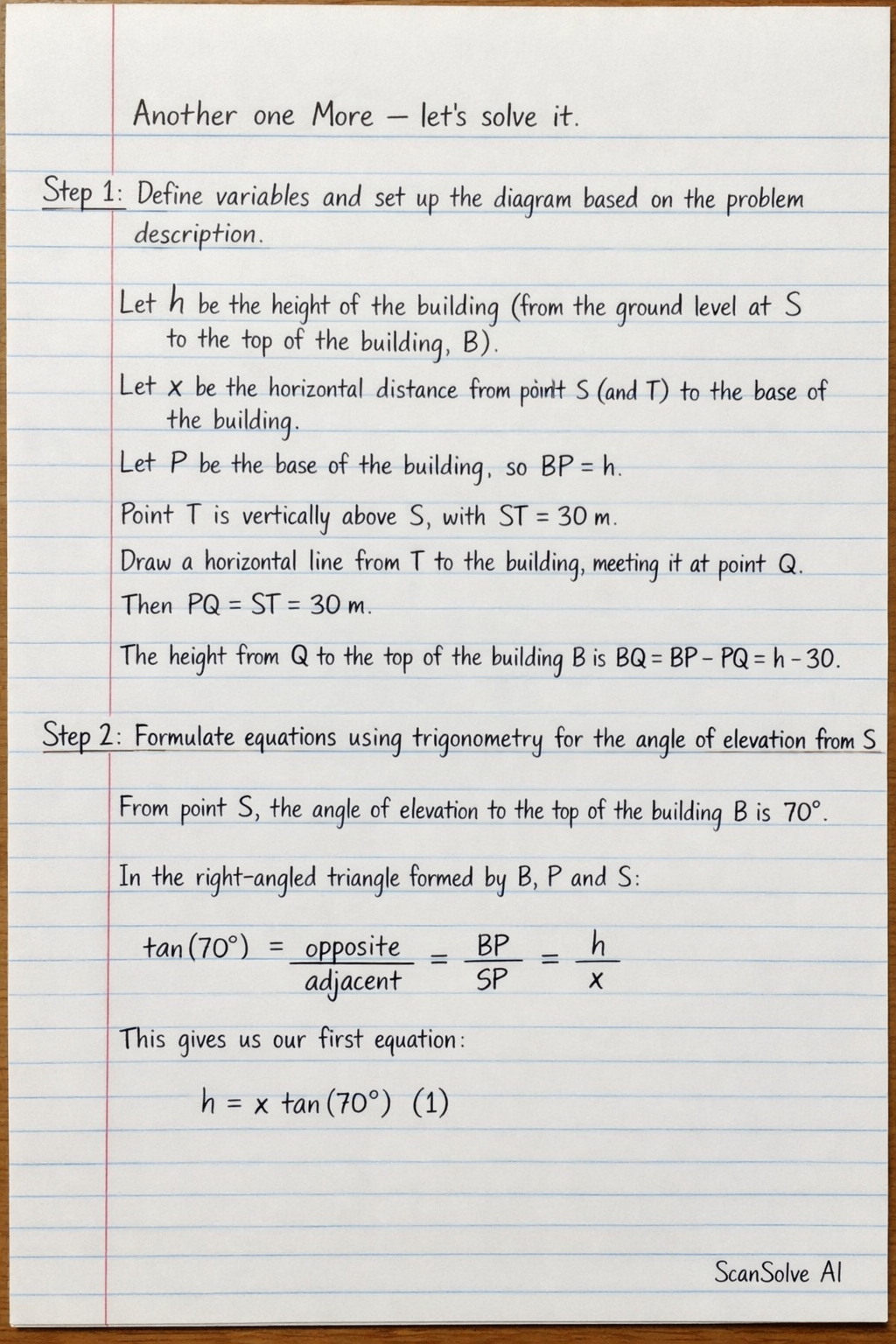
Handwritten Step-by-Step Solution
Get this as a handwritten image on WhatsApp — like a tutor wrote it for you.
Try on WhatsApp