
We read your photo as:
A class has 50 pupils. 20 like Math only, 15 like English only, and 5 like neither subject. Find the number of pupils who like Math.
ScanSolve AI Answer
Step-by-step solution
6 stepsHere are the solutions to the questions:
Question 21:
- Total pupils = 50
- Pupils who like Mathematics (M) only = 20
- Pupils who like English (E) only = 15
- Pupils who do not like any of the two subjects = 5
- Let be the number of pupils who like both subjects.
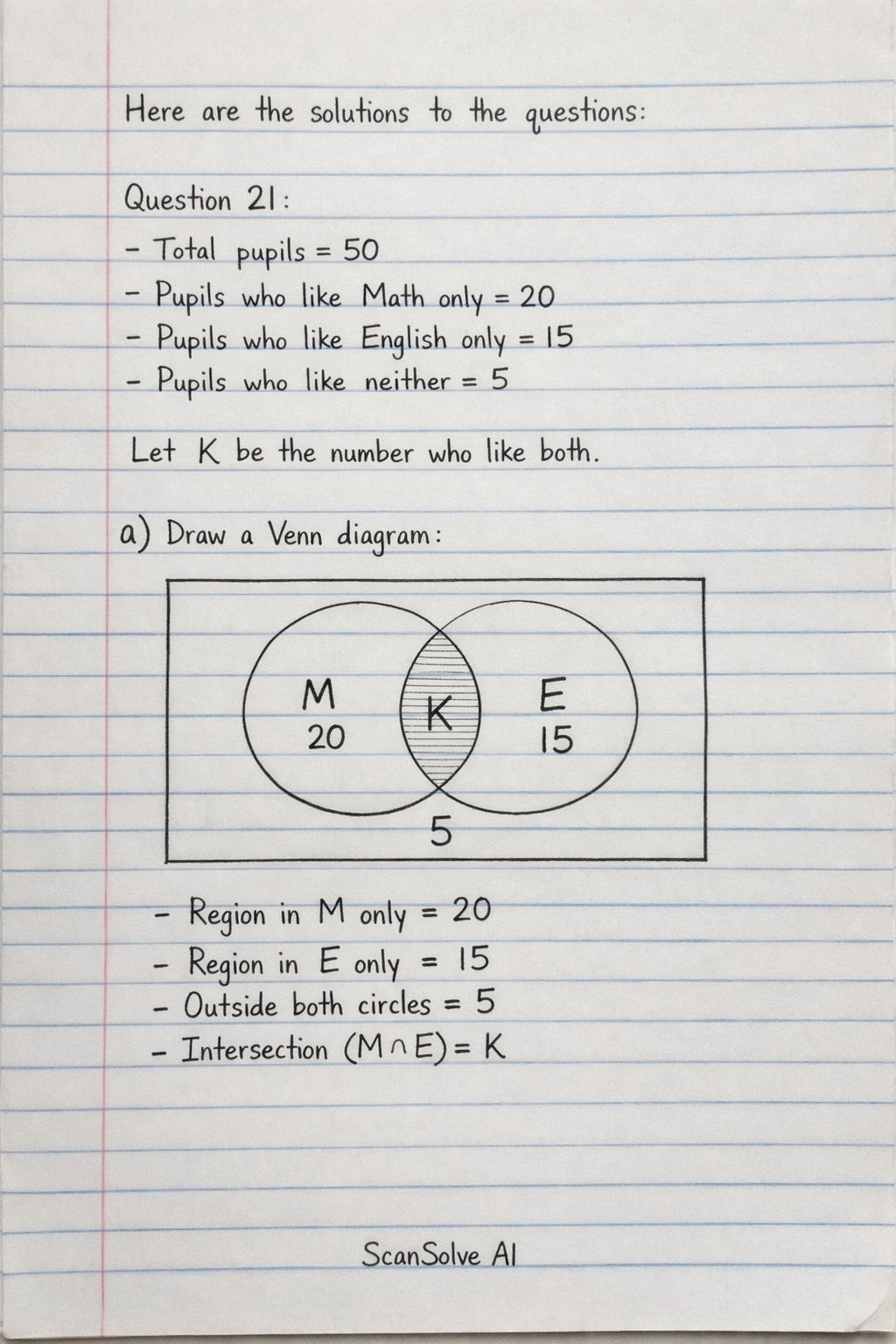
a) Draw a Venn diagram and represent the above information.
A Venn diagram would consist of a rectangle representing the universal set (50 pupils). Inside this rectangle, there would be two overlapping circles, one labeled 'M' for Mathematics and the other 'E' for English.
- The region of circle M only (not overlapping with E) would contain the number 20.
- The region of circle E only (not overlapping with M) would contain the number 15.
- The region outside both circles (but inside the rectangle) would contain the number 5.
- The overlapping region (intersection of M and E) would contain the variable .
b) Find the number of pupils who like Mathematics.
Calculate the number of pupils who like both subjects ().
The total number of pupils is the sum of pupils in all regions:
Calculate the number of pupils who like Mathematics.
Pupils who like Mathematics include those who like Mathematics only and those who like both subjects.
The number of pupils who like Mathematics is .
Question 22:
The figure shows a triangle KLM with angles:a) Find the value of y.
Use the property that the sum of angles in a triangle is .
Combine like terms.
Solve for .
The value of is .
b) Work out the size of angle KLM.
Substitute the value of into the expression for (which is ).
The size of angle KLM is .
Question 23:
a) Write the integer represented by the arrow on the number line above.
i) a =
ii) b =
iii) c =
b) Write down the mathematical statement shown on the number line above.
The number line shows a segment from -3 to 2, inclusive.
The mathematical statement is .Question 24:
The table shows marks scored by some pupils in a Mathematics test.
Marks: 80, 70, 60, 90
Number of pupils: (empty row)No questions are provided for this table, and the "Number of pupils" row is empty. Therefore, this question cannot be answered with the given information.
Still stuck on this one?
Ask a follow-up, and the answer starts from this question.
More Mathematics Questions
Handwritten Step-by-Step Solution
Get this as a handwritten image on WhatsApp — like a tutor wrote it for you.
Try on WhatsApp