
We read your photo as:
A) Construction of PQR and SQR:
Mathematics
ScanSolve AI Answer
Answer
b
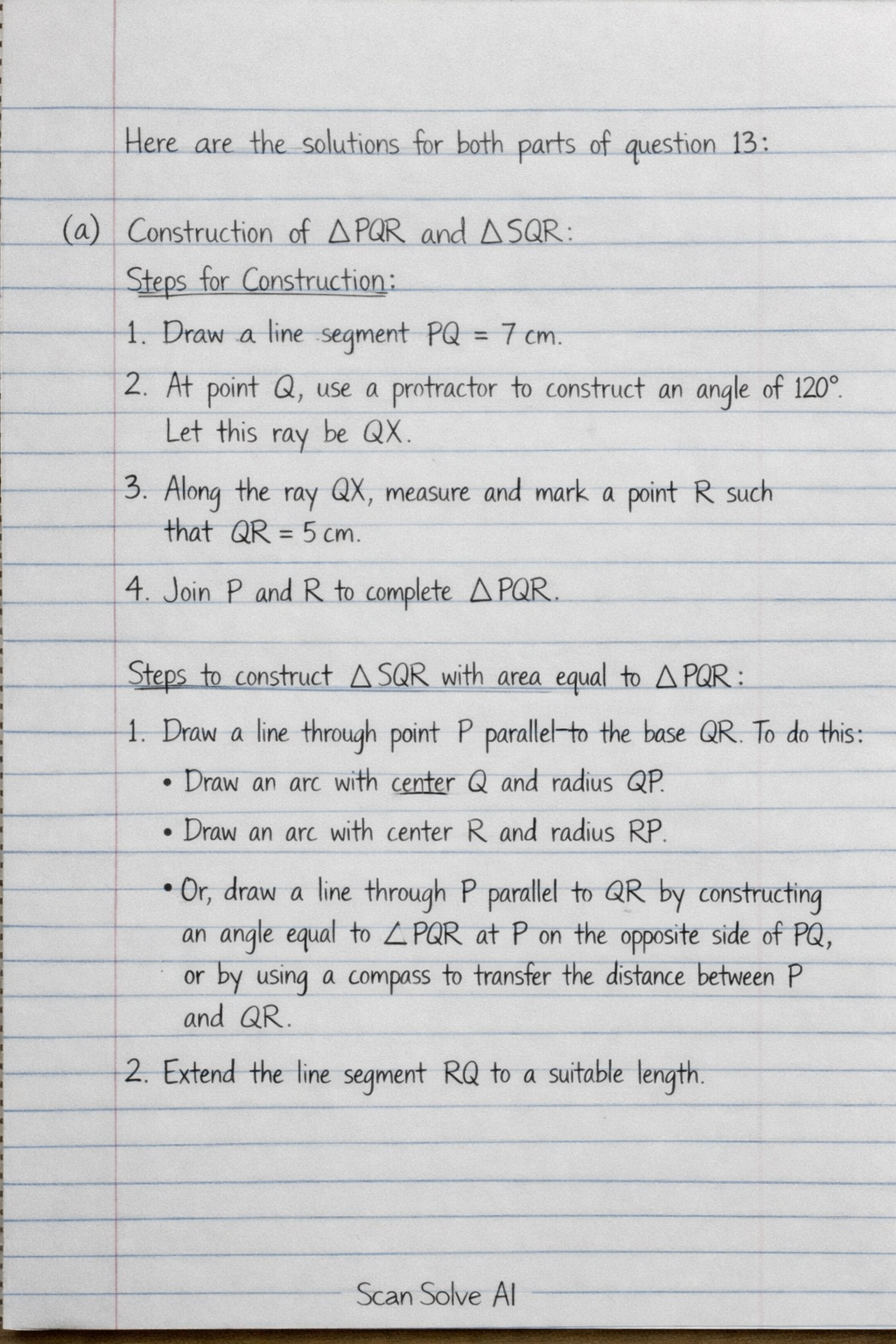
Here are the solutions for both parts of question 13:
a) Construction of and :
Steps for Construction:
- Draw a line segment cm.
- At point , use a protractor to construct an angle of . Let this ray be .
- Along the ray , measure and mark a point such that cm.
- Join and to complete .
Steps to construct with area equal to :
- Draw a line through point parallel to the base . To do this:
- Draw an arc with center and radius .
- Draw an arc with center and radius .
- Alternatively, draw a line through parallel to by constructing an angle equal to at on the opposite side of , or by using a compass to transfer the distance between and .
- Extend the line segment to a suitable length.
- Choose any point on the line drawn parallel to (from step 1) such that is not and is not on the line . For example, you can extend the parallel line and pick a point on it.
- Join to and .
- is the required triangle.
Reason: Triangles on the same base (or equal bases) and between the same parallel lines have equal areas. Here, and share the same base and their vertices and lie on a line parallel to . Therefore, Area() = Area().
b) Relationship between and :
Given:
Relationship:
Area() = Area()
Reason:
- Since , point is the midpoint of the line segment .
- In , is a median to the side . A median divides a triangle into two triangles of equal area. Therefore, Area() = Area(). This implies Area() = Area() + Area() = 2 Area().
- Given that .
- Consider and . They share the same base .
- Since their vertices and lie on a line parallel to their common base , their areas are equal. Therefore, Area() = Area().
- From steps 2 and 5, we can conclude: 2 Area() = Area() Area() = Area()
The final answer is .
Was this helpful?
Try one yourself
A new problem that tests the same skill.
Still stuck on this one?
Ask a follow-up, and the answer starts from this question.
Got a different question?Ask your own question
More Mathematics Questions
Handwritten Step-by-Step Solution
Get this as a handwritten image on WhatsApp — like a tutor wrote it for you.
Try on WhatsApp