
We read your photo as:
Determine the constant difference or the constant ratio of the following sequences and state whether the sequence is numeric or geometric.
Mathematics
ScanSolve AI Answer
Step-by-step solution
11 stepsThanks for sending the image again, Blessing. Let's finish up this worksheet.
4. The following structures are made of toothpicks and sweets. Complete the table below that describes the relationship between the pattern number and the number of sweets used to keep the structures together.
- a) The pattern number and the number of sweets used to keep the structures together.
Count the number of sweets for each pattern.
* Pattern 1: 6 sweets * Pattern 2: 10 sweets * Pattern 3: 14 sweetsDetermine the rule for the sequence of sweets.
The constant difference is $10-6=4$. The rule for the $n$-th term is $T_n = a_1 + (n-1)d = 6 + (n-1)4 = 6 + 4n - 4 = 4n + 2$.Calculate the number of sweets for pattern numbers 10 and 48.
* For Pattern 10: $T_{10} = 4(10) + 2 = 40 + 2 = 42$ * For Pattern 48: $T_{48} = 4(48) + 2 = 192 + 2 = 194$- b) The pattern number and the number of toothpicks the structure is made of.
Count the number of toothpicks for each pattern.
* Pattern 1: 11 toothpicks (3 bottom, 2 top, 4 vertical, 2 slanted) * Pattern 2: 20 toothpicks (6 bottom, 4 top, 6 vertical, 4 slanted) * Pattern 3: 29 toothpicks (9 bottom, 6 top, 8 vertical, 6 slanted)Determine the rule for the sequence of toothpicks.
The constant difference is $20-11=9$. The rule for the $n$-th term is $T_n = a_1 + (n-1)d = 11 + (n-1)9 = 11 + 9n - 9 = 9n + 2$.Calculate the number of toothpicks for pattern numbers 10 and 48.
* For Pattern 10: $T_{10} = 9(10) + 2 = 90 + 2 = 92$ * For Pattern 48: $T_{48} = 9(48) + 2 = 432 + 2 = 434$Complete the table.
$$\begin{array}{|c|c|c|c|c|c|} \hline \text{Pattern number} & 1 & 2 & 3 & 10 & 48 \\ \hline \text{Number of sweets} & \textbf{6} & \textbf{10} & \textbf{14} & \textbf{42} & \textbf{194} \\ \hline \text{Number of toothpicks} & \textbf{11} & \textbf{20} & \textbf{29} & \textbf{92} & \textbf{434} \\ \hline \end{array}$$5. Use number sentences to describe the rule and the term of the following patterns.
- a) 9; 12; 15; 18; ...; n
Determine the rule.
The difference between consecutive terms is $12-9=3$, $15-12=3$. The rule is to **add 3 to the previous term**.Find the -th term.
This is an arithmetic sequence with first term $a_1=9$ and common difference $d=3$. The formula for the $n$-th term is $T_n = a_1 + (n-1)d$. $$ T_n = 9 + (n-1)3 $$ $$ T_n = 9 + 3n - 3 $$ $$ T_n = \boxed{\textbf{3n + 6}} $$- b) -5; -7; -9; -11; ...; n
Determine the rule.
The difference between consecutive terms is $-7 - (-5) = -2$, $-9 - (-7) = -2$. The rule is to **subtract 2 from the previous term**.Find the -th term.
    This is an arithmetic sequence with first term $a_1=-5$ and common difference $d=-2$.
    The formula for the $n$-th term is $T_n = a_1 + (n-1)d$.
    $$
    T_n = -5 + (n-1)(-2)
    $$
    $$
    T_n = -5 - 2n + 2
    $$
    $$
    T_n = \boxed{\textbf{-2n - 3}}
    $$
Was this helpful?
Still stuck on this one?
Ask a follow-up, and the answer starts from this question.
Got a different question?Ask your own question
More Mathematics Questions
QQuestion 1: Write the next three numbers in each of the following sequences. Say whether each…QFor the given number sequences, find the common difference or ratio and calculate the next two terms…QTo determine if a sequence is arithmetic, we check if the difference between consecutive terms is…QIdentify the common ratio of the geometric series.QDetermine the general term for each arithmetic sequence.
Browse by topic:Pre-Algebra
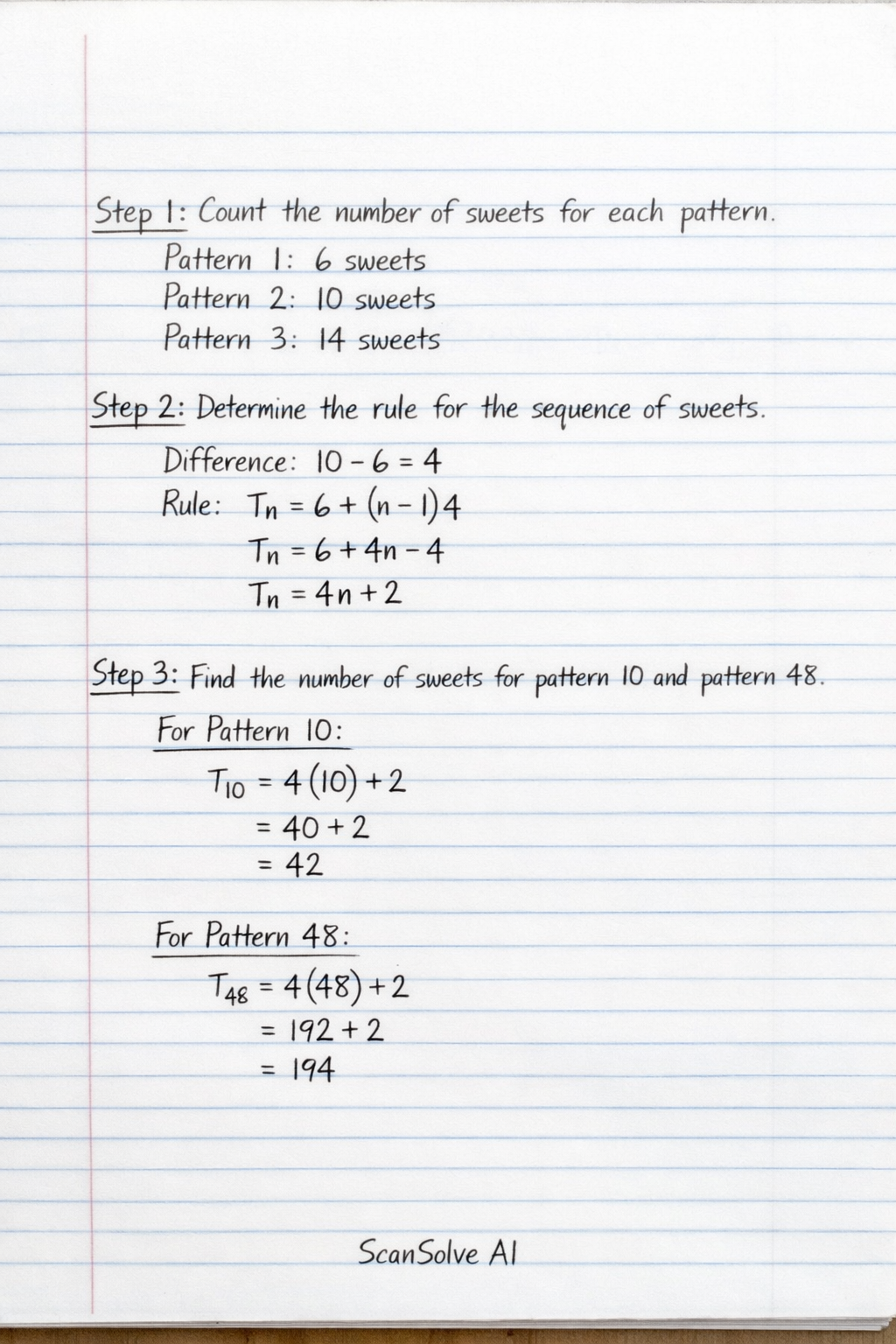
Handwritten Step-by-Step Solution
Get this as a handwritten image on WhatsApp — like a tutor wrote it for you.
Try on WhatsApp