
We read your photo as:
How many times is: FG longer than BC? EF longer than AB? JK
ScanSolve AI Answer
Step-by-step solution
6 stepsHere are the solutions to your questions:
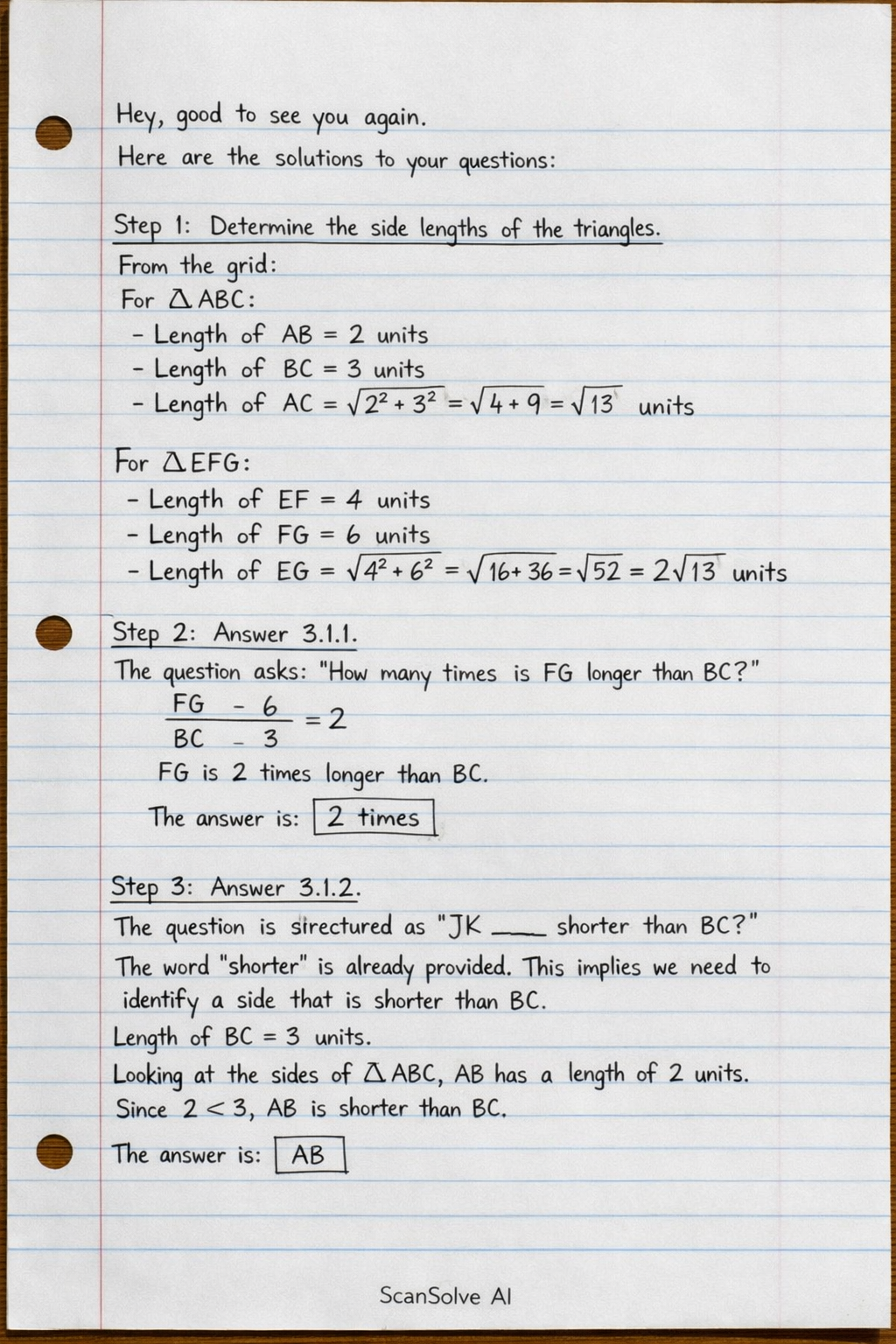
Determine the side lengths of the triangles.
From the grid:
For ABC:- Length of AB = 2 units
- Length of BC = 3 units
- Length of AC = units
For EFG:
- Length of EF = 4 units
- Length of FG = 6 units
- Length of EG = units
Answer 3.1.1.
The question asks: "How many times is FG longer than BC?"
FG is 2 times longer than BC.
The answer is:Answer 3.1.2.
The question is structured as "JK ______ shorter than BC?". The word "shorter" is already provided. This implies we need to identify a side that is shorter than BC.
Length of BC = 3 units.
Looking at the sides of ABC, AB has a length of 2 units.
Since , AB is shorter than BC.
The answer is:Answer 3.1.3.
The question asks: "EF longer than AB?"
EF is 2 times longer than AB.
The answer is:Answer 3.1.4.
The question is structured as "IJ ______ shorter than AB?". The word "shorter" is already provided. This implies we need to identify a side that is shorter than AB.
Length of AB = 2 units.
Looking at all sides in both triangles:- AB = 2 units
- BC = 3 units
- AC = units
- EF = 4 units
- FG = 6 units
- EG = units There is no side in either triangle that is shorter than AB. The answer is:
Answer 3.1.5.
The question asks: "Is EFG an enlargement of ABC? Explain your answer."
To determine if EFG is an enlargement of ABC, we compare the ratios of their corresponding sides:Since the ratios of all corresponding sides are equal (the scale factor is 2), EFG is an enlargement of ABC.
The answer is:
Still stuck on this one?
Ask a follow-up, and the answer starts from this question.
More Mathematics Questions
Handwritten Step-by-Step Solution
Get this as a handwritten image on WhatsApp — like a tutor wrote it for you.
Try on WhatsApp