
We read your photo as:
Look at the following triangles and answer the questions that following: How many times is: FG longer than BC? JK shorter than BC? EF longer than AB? IJ shorter than AB? Is EFG an enlargement of ABC? Explain your answer. Is IJK a reduction of ABC? Explain your answer.
Mathematics
ScanSolve AI Answer
Step-by-step solution
9 stepslet's continue with these geometry problems.
Part 3.1· 6 steps
Transformation Geometry
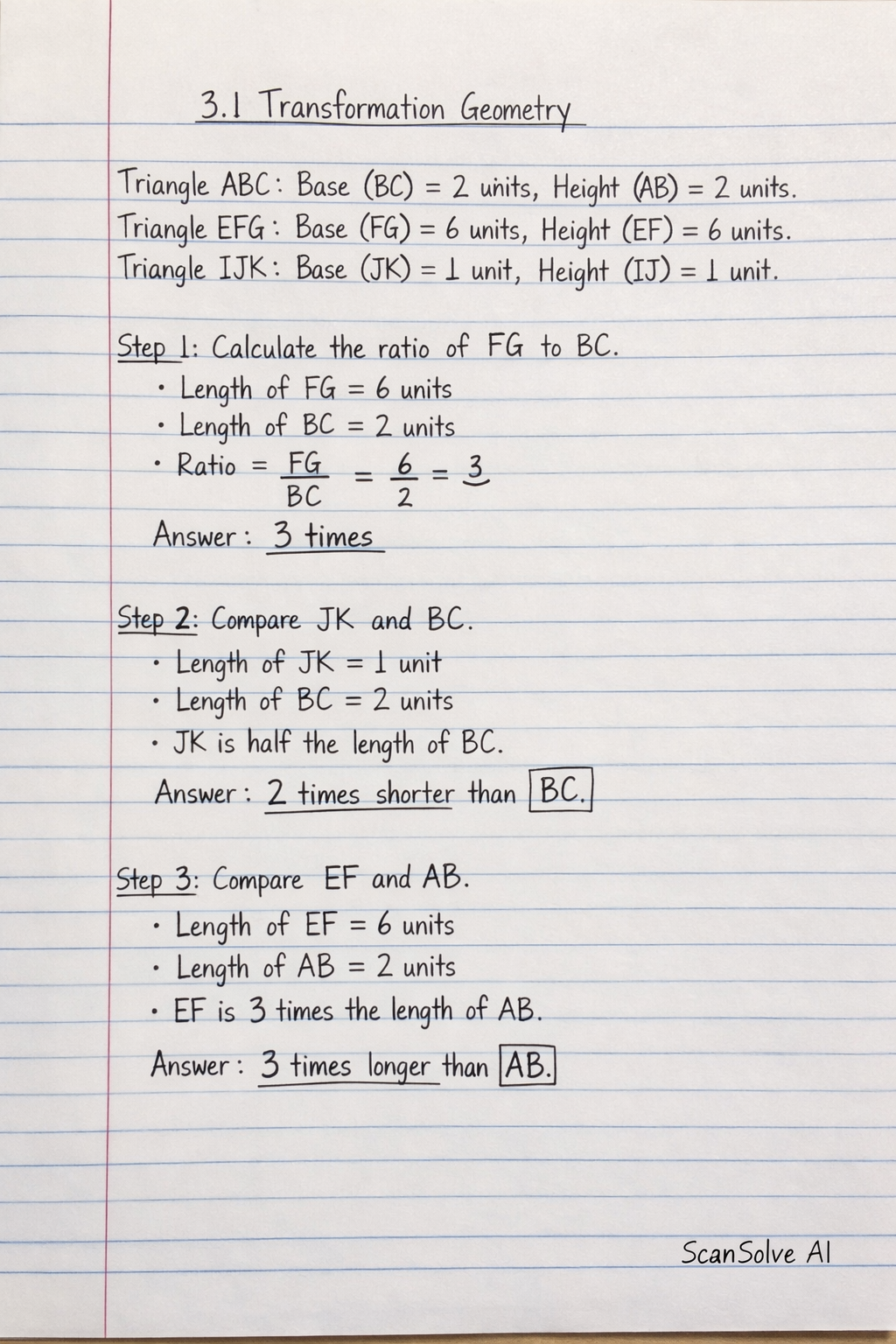
First, let's determine the dimensions of each triangle by counting the grid squares:
- Triangle ABC: Base (BC) = 2 units, Height (AB) = 2 units.
- Triangle EFG: Base (FG) = 6 units, Height (EF) = 6 units.
- Triangle IJK: Base (JK) = 1 unit, Height (IJ) = 1 unit.
Calculate the ratio of FG to BC.
- 3.1.1
- Length of FG units
- Length of BC units
- Ratio
- Answer:
- 3.1.1
Compare JK and BC.
- 3.1.2
- Length of JK unit
- Length of BC units
- JK is half the length of BC, meaning it is 2 times shorter.
- Answer: shorter than
- 3.1.2
Compare EF and AB.
- 3.1.3
- Length of EF units
- Length of AB units
- EF is 3 times the length of AB.
- Answer: longer than
- 3.1.3
Compare IJ and AB.
- 3.1.4
- Length of IJ unit
- Length of AB units
- IJ is half the length of AB, meaning it is 2 times shorter.
- Answer: shorter than
- 3.1.4
Determine if EFG is an enlargement of ABC.
- 3.1.5
- Compare corresponding sides: and .
- Since all corresponding sides are scaled by the same factor (3), EFG is an enlargement of ABC.
- Answer:
- Explanation: All corresponding sides of EFG are 3 times longer than the corresponding sides of ABC.
- 3.1.5
Determine if IJK is a reduction of ABC.
- 3.1.6
- Compare corresponding sides: and .
- Since all corresponding sides are scaled by the same factor (), IJK is a reduction of ABC.
- Answer:
- Explanation: All corresponding sides of IJK are half the length of the corresponding sides of ABC.
- 3.1.6
Part 3.2· 3 steps
Reflection
Identify the vertices of the given trapezium and their distance from the vertical mirror line.
- Let's label the vertices of the trapezium from left to right, top to bottom.
- The top-left vertex is 2 squares to the left of the mirror line.
- The bottom-left vertex is 2 squares to the left of the mirror line.
- The top-right vertex is 1 square to the left of the mirror line.
- The bottom-right vertex is 4 squares to the left of the mirror line.
- Let's label the vertices of the trapezium from left to right, top to bottom.
Reflect each vertex across the mirror line.
- To reflect a point across a vertical mirror line, its horizontal distance from the line remains the same, but its position shifts to the opposite side of the line. The vertical position (height) remains unchanged.
- The reflected top-left vertex will be 2 squares to the right of the mirror line.
- The reflected bottom-left vertex will be 2 squares to the right of the mirror line.
- The reflected top-right vertex will be 1 square to the right of the mirror line.
- The reflected bottom-right vertex will be 4 squares to the right of the mirror line.
- To reflect a point across a vertical mirror line, its horizontal distance from the line remains the same, but its position shifts to the opposite side of the line. The vertical position (height) remains unchanged.
Connect the reflected vertices to form the reflected shape.
- The reflected shape will be a trapezium, identical in size and shape to the original, but flipped horizontally.
- The reflected trapezium will have its top-left vertex 1 square right of the mirror line, its top-right vertex 2 squares right of the mirror line, its bottom-left vertex 4 squares right of the mirror line, and its bottom-right vertex 2 squares right of the mirror line.
Answer:
- To reflect the trapezium, plot the new vertices by counting the horizontal distance from each original vertex to the mirror line and then plotting the new vertex the same distance on the opposite side of the mirror line.
- The vertex that is 2 squares left of the mirror line will be 2 squares right.
- The vertex that is 1 square left of the mirror line will be 1 square right.
- The vertex that is 4 squares left of the mirror line will be 4 squares right.
- Connect these new points to form the reflected trapezium.
- The reflected shape will be a trapezium, identical in size and shape to the original, but flipped horizontally.
Was this helpful?
Still stuck on this one?
Ask a follow-up, and the answer starts from this question.
Got a different question?Ask your own question
More Mathematics Questions
QUse the triangle above to answer the questions that follow. (a) Is this triangle scalene, isosceles…QHow many times is: FG longer than BC? EF longer than AB? JKQTwo triangles, ABC and DEF, are similar. Side AB = 12 cm, BC = 9 cm, and AC = 15 cm. Side DE = 8 cm…QQuadrilateral ABCD is similar to quadrilateral EFGH. Given AB=4cm and EF=6cm, FG=4.5cm, find the…QGraph △ABC with vertices A(1, 2), B(3, 4), and C(2, 0). Perform the following sequence of…
Browse by topic:Geometry
Handwritten Step-by-Step Solution
Get this as a handwritten image on WhatsApp — like a tutor wrote it for you.
Try on WhatsApp