
We read your photo as:
Identify and name the lines in the figure below.
Mathematics
ScanSolve AI Answer
Step-by-step solution
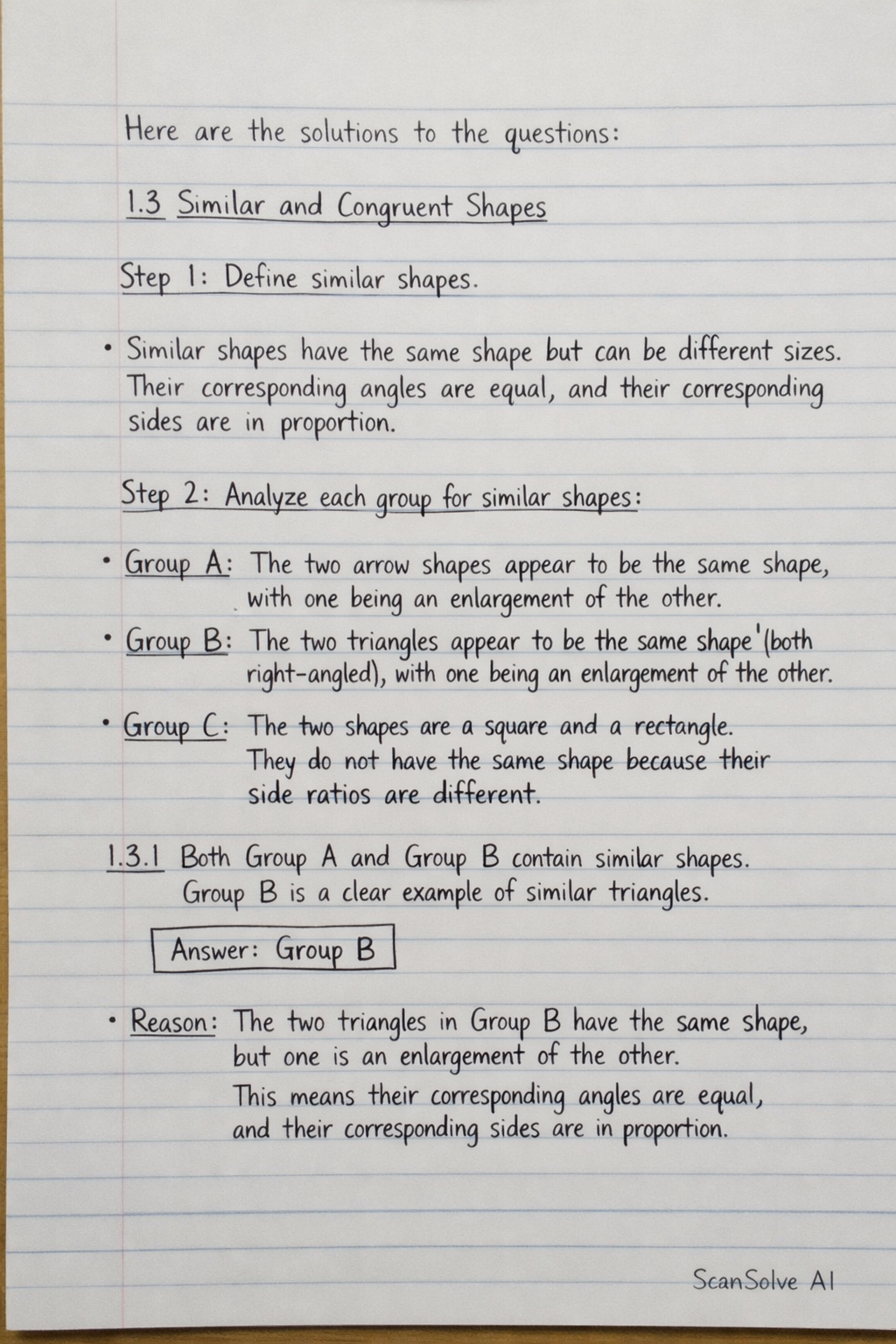
6 stepsHere are the solutions to the questions:
Part 1.3· 4 steps
Similar and Congruent Shapes
Define similar shapes.
- Similar shapes have the same shape but can be different sizes. Their corresponding angles are equal, and their corresponding sides are in proportion.
Analyze each group for similar shapes.
- Group A: The two arrow shapes appear to be the same shape, with one being an enlargement of the other.
- Group B: The two triangles appear to be the same shape (both right-angled), with one being an enlargement of the other.
- Group C: The two shapes are a square and a rectangle. They do not have the same shape because their side ratios are different.
- 1.3.1 Both Group A and Group B contain similar shapes. Group B is a clear example of similar triangles.
- Answer:
- Reason: The two triangles in Group B have the same shape, but one is an enlargement of the other. This means their corresponding angles are equal, and their corresponding sides are in proportion.
Define congruent shapes.
- Congruent shapes are identical in both shape and size. If one shape can be perfectly superimposed on another, they are congruent.
Analyze each group for congruent shapes.
- Group A: The two arrow shapes are clearly different sizes.
- Group B: The two triangles are clearly different sizes.
- Group C: The two shapes (a square and a rectangle) are different sizes and different shapes.
- 1.3.2 Based on the visual representation, none of the groups contain a pair of congruent 2D shapes.
- Answer:
- Reason: For shapes to be congruent, they must be exactly the same size and shape. In all three groups (A, B, and C), the shapes shown are either different sizes or different shapes (or both), meaning none are identical.
Part 2.1· 2 steps
Geometry of Straight Lines
Identify and name the different types of lines in the figure.
- A line extends infinitely in both directions (indicated by arrows at both ends).
- A ray starts at a point and extends infinitely in one direction (indicated by an arrow at one end).
- A line segment has two distinct endpoints.
List the identified lines, rays, and line segments.
- Line BD: This is a straight line passing through points B, C, O, and D, extending infinitely in both directions.
- Line FE: This is a straight line passing through points F and O, extending infinitely in both directions.
- Ray OE: This is a ray starting at point O and extending infinitely in the direction of E.
- Line segment AC: This is a line segment connecting point A to point C.
- Line segment AO: This is a line segment connecting point A to point O.
- Line segment OC: This is a line segment connecting point O to point C.
Answer:
Was this helpful?
Still stuck on this one?
Ask a follow-up, and the answer starts from this question.
Got a different question?Ask your own question
More Mathematics Questions
QCan you identify the types of lines in the image and label them?QIdentify the parts labelled in the figure belowQIdentify the names of the triangles drawn below.QWhich of the following lines is a line of symmetry on the figure below?QIdentify the following diagram and completely labelled features by writing the correct name in empty…
Handwritten Step-by-Step Solution
Get this as a handwritten image on WhatsApp — like a tutor wrote it for you.
Try on WhatsApp