
We read your photo as:
What is the probability of selecting a number that is (m) even, (q) a multiple of 2, (n) odd, (p) prime, (r) composite, (s) a prime factor of 4.
ScanSolve AI Answer
Answer
Step-by-step solution
4 stepsTo answer this question, we need to know the set of numbers from which a selection is made. Since this information is not provided in the image, we will assume the standard context for such problems: selecting a number from a fair six-sided die.
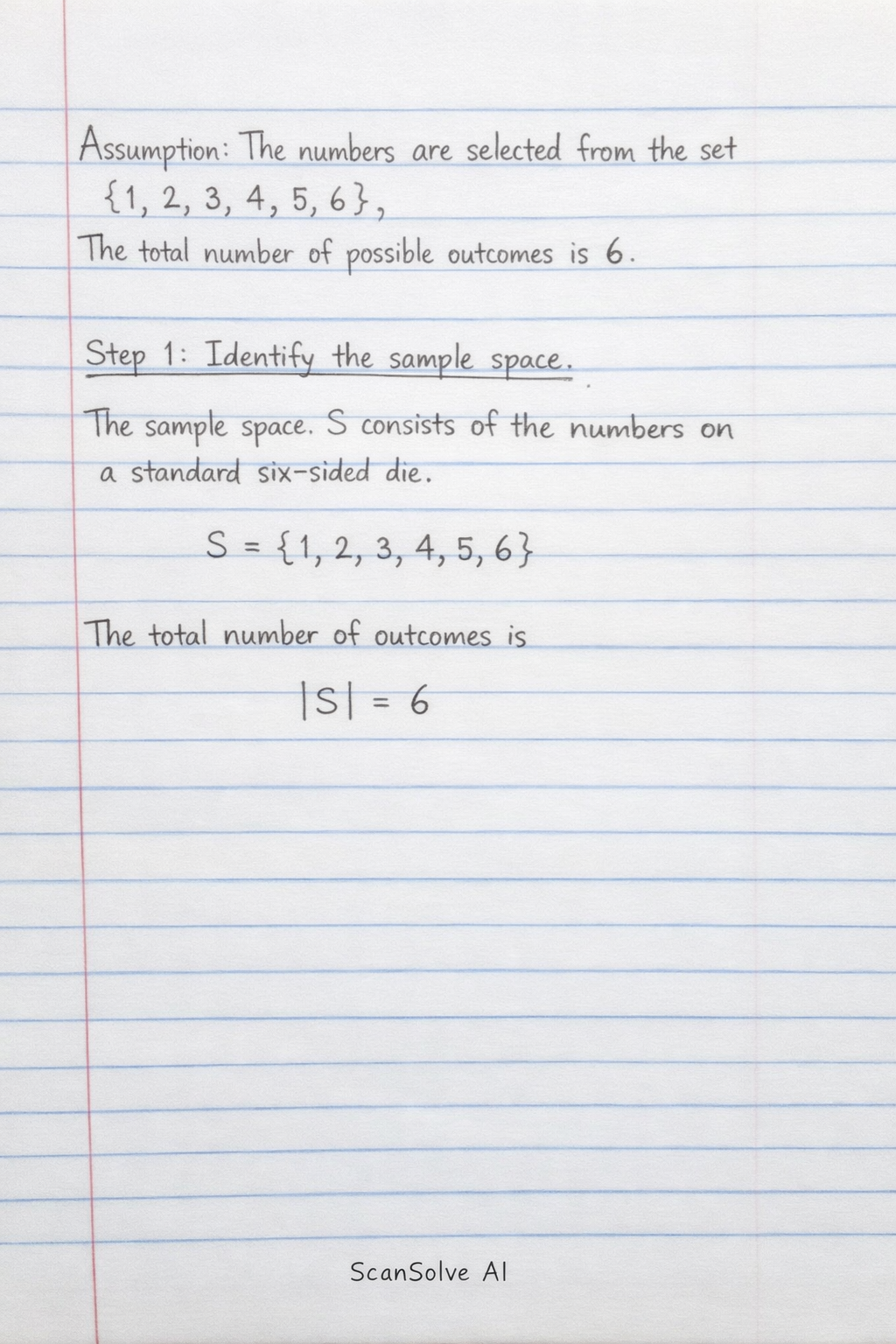
Assumption: The numbers are selected from the set .
The total number of possible outcomes is 6.
The question asks for the probability of selecting a number that is "prime", as indicated by the checkmark next to option (p).
Identify the sample space.
The sample space consists of the numbers on a standard six-sided die:
The total number of outcomes is .
Identify the favorable outcomes for selecting a prime number.
A prime number is a natural number greater than 1 that has no positive divisors other than 1 and itself.
From the sample space :- 1 is not a prime number.
- 2 is a prime number (divisors: 1, 2).
- 3 is a prime number (divisors: 1, 3).
- 4 is not a prime number (divisors: 1, 2, 4).
- 5 is a prime number (divisors: 1, 5).
- 6 is not a prime number (divisors: 1, 2, 3, 6). The prime numbers in the sample space are . The number of favorable outcomes is 3.
Calculate the probability.
The probability of an event is given by the formula:
Simplify the probability.
The probability of selecting a prime number is .
Try one yourself
A new problem that tests the same skill.
Still stuck on this one?
Ask a follow-up, and the answer starts from this question.
More Mathematics Questions
Handwritten Step-by-Step Solution
Get this as a handwritten image on WhatsApp — like a tutor wrote it for you.
Try on WhatsApp