
We read your photo as:
From the set S = 3, 5, 6, 8, 11, 14, 17, find the probability that a randomly selected number is even, prime, greater than 10, or a multiple of 3.
ScanSolve AI Answer
Step-by-step solution
2 stepsAnalyze the given set for question 11(a).
The set is .
The total number of elements in the set is .(i) Probability that the number is even.
The even numbers in are .
The number of even numbers is .
The probability is:The probability that the number is even is .
(ii) Probability that the number is prime.
The prime numbers in are numbers greater than 1 with only two divisors: 1 and themselves.
The prime numbers in are .
The number of prime numbers is .
The probability is:The probability that the number is prime is .
(iii) Probability that the number is greater than 10.
The numbers in greater than 10 are .
The number of elements greater than 10 is .
The probability is:The probability that the number is greater than 10 is .
(iv) Probability that the number is a multiple of 3.
The multiples of 3 in are .
The number of multiples of 3 is .
The probability is:The probability that the number is a multiple of 3 is .
Analyze the bag contents for question 11(b).
A bag contains:
- 4 blue balls (B)
- 3 green balls (G)
- 3 yellow balls (Y) Total number of balls = . One ball is drawn and not replaced, then a second ball is drawn.
(i) Probability of obtaining two yellow balls.
Probability of drawing a yellow ball first ():After drawing one yellow ball, there are 2 yellow balls left and 9 total balls.
Probability of drawing a second yellow ball () given the first was yellow:Probability of two yellow balls:
The probability of obtaining two yellow balls is .
(ii) Probability of obtaining two blue balls or two green balls.
This is .
Probability of two blue balls ( and ):Probability of two green balls ( and ):
Probability of two blue balls or two green balls:
The probability of obtaining two blue balls or two green balls is .
(iii) Probability of obtaining one blue ball and one green ball in any order.
This means .
Probability of drawing a blue ball first, then a green ball ( and ):After drawing one blue ball, there are 3 green balls left and 9 total balls.
Probability of drawing a green ball first, then a blue ball ( and ):
After drawing one green ball, there are 4 blue balls left and 9 total balls.
Probability of one blue ball and one green ball in any order:
The probability of obtaining one blue ball and one green ball in any order is .
Still stuck on this one?
Ask a follow-up, and the answer starts from this question.
More Mathematics Questions
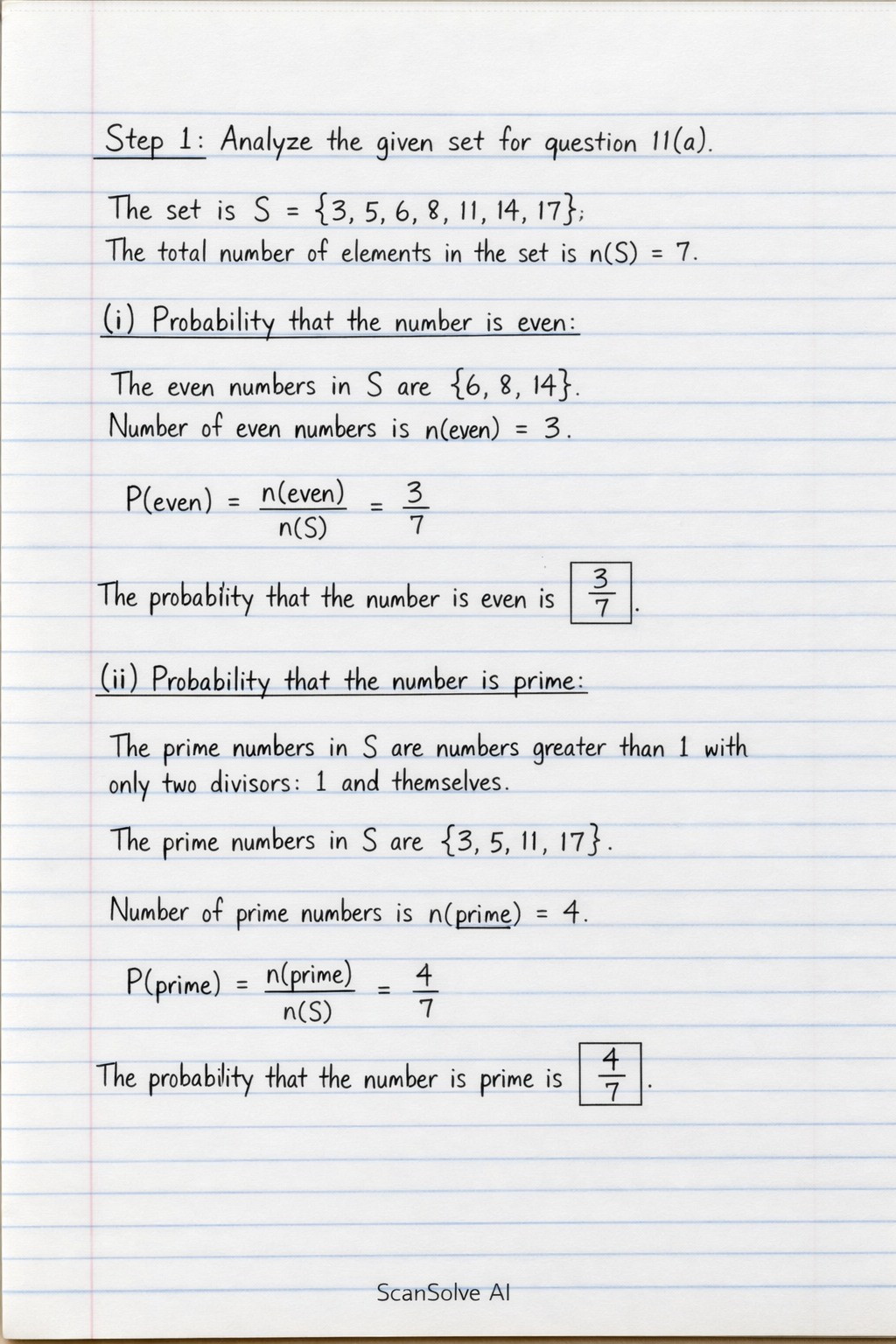
Handwritten Step-by-Step Solution
Get this as a handwritten image on WhatsApp — like a tutor wrote it for you.
Try on WhatsApp