The bearing of P from Q is 072°. Find the bearing of Q from P. A number is selected at random from the set M=2 x < 16. Find the probability that the number is a multiple of 5.
|Mathematics
The bearing of P from Q is 072°. Find the bearing of Q from P. A number is selected at random from the set M=2 x < 16. Find the probability that the number is a multiple of 5.
ScanSolve AI Answer
Answer
A. 51.8∘
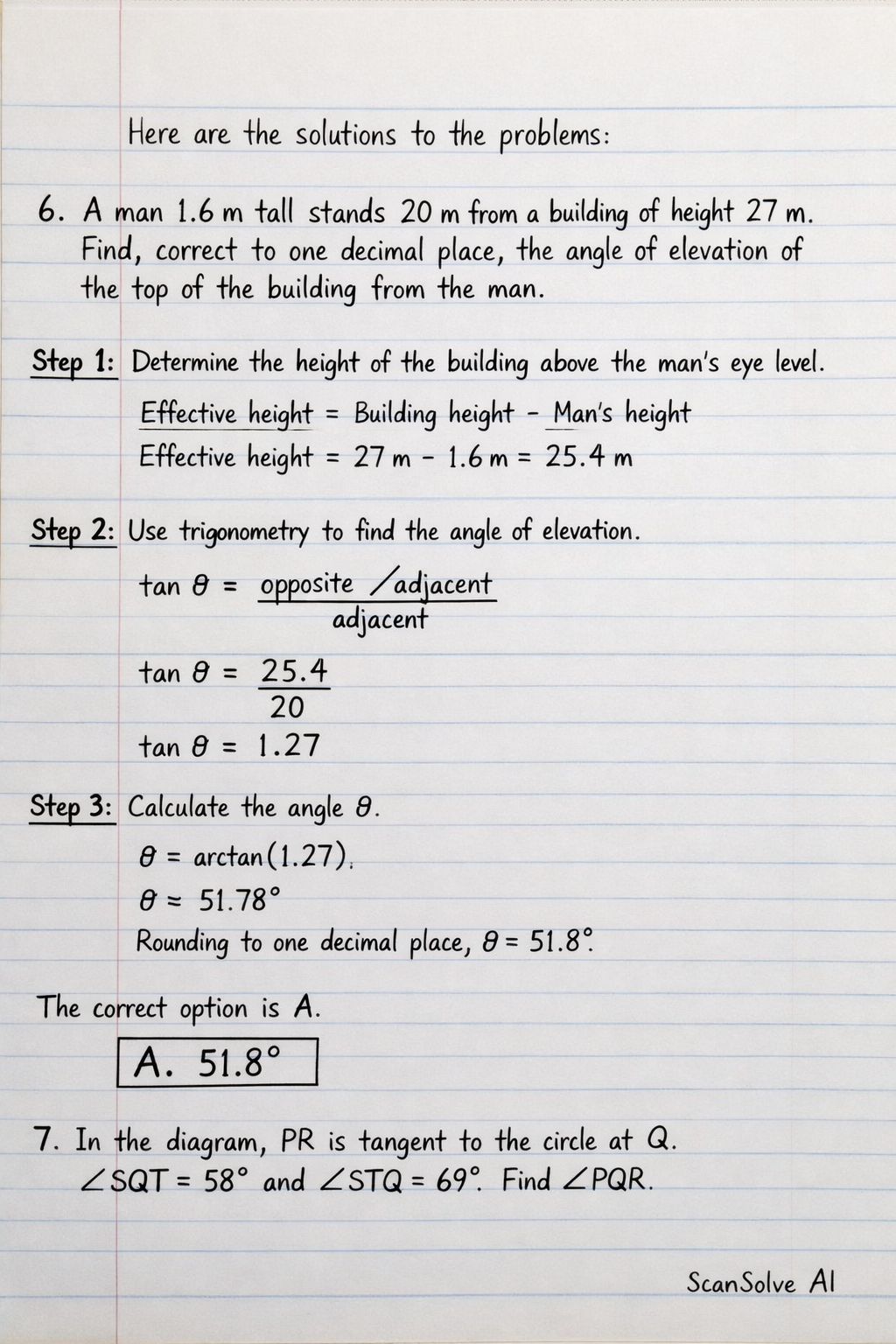
Here are the solutions to the problems:
6. A man 1.6 m tall stands 20 m from a building of height 27 m. Find, correct to one decimal place, the angle of elevation of the top of the building from the man.
Step 1: Determine the height of the building above the man's eye level.
Effective height=Buildingheight−Man’s heightEffective height=27m−1.6m=25.4 m
Step 2: Use trigonometry to find the angle of elevation. The distance from the building is the adjacent side, and the effective height is the opposite side.
tanθ=adjacentoppositetanθ=2025.4tanθ=1.27
Step 3: Calculate the angle θ.
θ=arctan(1.27)θ≈51.78∘
Rounding to one decimal place, θ≈51.8∘.
The correct option is A.
A.51.8∘
7. In the diagram, PR is tangent to the circle at Q. ∠SQT=58∘ and ∠STQ=69∘. Find ∠PQR.
Step 1: Find ∠QST in △SQT. The sum of angles in a triangle is 180∘.
∠QST+∠SQT+∠STQ=180∘∠QST+58∘+69∘=180∘∠QST+127∘=180∘∠QST=180∘−127∘=53∘
Step 2: Apply the Alternate Segment Theorem. The angle between a tangent (PR) and a chord (SQ) through the point of contact (Q) is equal to the angle in the alternate segment (∠QST).
∠PQR=∠QST∠PQR=53∘
The correct option is A.
A.53∘
8. Given that tanR=247, where 0∘<R<90∘, find sinR.
Step 1: Use the given tangent value to find the hypotenuse of a right-angled triangle.
tanR=adjacentopposite=247
Let the opposite side be 7 and the adjacent side be 24.
Using the Pythagorean theorem, the hypotenuse h is:
h=opposite2+adjacent2h=72+242h=49+576h=625h=25
9. The bearing of P from Q is 072∘. Find the bearing of Q from P.
Step 1: Understand the relationship between forward and back bearings.
The bearing of P from Q is 072∘. This is the forward bearing.
Step 2: Calculate the back bearing.
If the forward bearing is less than 180∘, add 180∘ to find the back bearing.
Bearing of QfromP=BearingofPfromQ+180∘Bearing of QfromP=072∘+180∘Bearing of QfromP=252∘
The correct option is B.
B.252∘
10. A number is selected at random from the set M={x:2<x<16}. Find the probability that the number is a multiple of 5.
Step 1: List the elements in set M.
The set M contains integers strictly greater than 2 and strictly less than 16.
M={3,4,5,6,7,8,9,10,11,12,13,14,15}
Step 2: Count the total number of elements in M.
Total number of elements=15−3+1=13
Step 3: Identify the multiples of 5 within set M.
The multiples of 5 in M are 5 and 10.
Number of multiples of 5=2
Step 4: Calculate the probability.
Probability=TotalnumberofoutcomesNumberoffavorableoutcomesProbability=132
The correct option is B.
B.132
11. Given that y=3x2−7x+10, find dxdy at x=3.
Step 1: Differentiate y with respect to x.
dxdy=dxd(3x2)−dxd(7x)+dxd(10)dxdy=3(2x2−1)−7(1x1−1)+0dxdy=6x−7
Step 2: Substitute x=3 into the derivative.
dxdyx=3=6(3)−7dxdyx=3=18−7dxdyx=3=11
The correct option is B.
B.11
12. The interior angle of a regular polygon is 140∘. Calculate the sum of the interior angles of the polygon.
Step 1: Find the number of sides (n) of the polygon using the formula for an interior angle of a regular polygon.
Interior angle=n(n−2)×180∘140∘=n(n−2)×180∘140n=180(n−2)140n=180n−360360=180n−140n360=40nn=40360n=9
The polygon has 9 sides.
Step 2: Calculate the sum of the interior angles using the formula (n−2)×180∘.
Sum of interior angles=(9−2)×180∘Sum of interior angles=7×180∘Sum of interior angles=1260∘
The correct option is B.
B.1260∘
13. Given that ba=p1−q1, make p the subject.(Assuming the question intended to ask to make p the subject, as 'C' is not present in the equation and the options are for p.)
Step 1: Isolate the term containing p.
ba=p1−q1
Add q1 to both sides:
ba+q1=p1
Step 2: Combine the terms on the left side by finding a common denominator, which is bq.
bqaq+bqb=p1bqaq+b=p1
Step 3: Invert both sides to solve for p.
p=aq+bbq
The correct option is B.
B.p=aq+bbq
That's 2 down. 3 left today — send the next one.
Was this helpful?
Need help with your own homework?
Get instant step-by-step solutions to any question. Free to start.
6. A man 1.6 m tall stands 20 m from a building of height 27 m.
The bearing of P from Q is 072°. Find the bearing of Q from P. A number is selected at random from the set M=2 x < 16. Find the probability that the number is a multiple of 5.
This mathematics problem involves applying core mathematical principles and formulas. Below you will find a complete step-by-step solution with detailed explanations for each step, helping you understand not just the answer but the method behind it.
ScanSolve AI Answer
Here are the solutions to the problems: 6. A man 1.6 m tall stands 20 m from a building of height 27 m. Find, correct to one decimal place, the angle of elevation of the top of the building from the man. Step 1: Determine the height of the building above the man's eye level. Effective height = Building height - Man's height Effective height = 27 m - 1.6 m = 25.4 m Step 2: Use trigonometry to find the angle of elevation. The distance from the building is the adjacent side, and the effective height is the opposite side. = oppositeadjacent = (25.4)/(20) = 1.27 Step 3: Calculate the angle . = (1.27) ≈ 51.78^ Rounding to one decimal place, ≈ 51.8^. The correct option is A. A. 51.8^ 7. In the diagram, PR is tangent to the circle at Q. SQT = 58^ and STQ = 69^. Find PQR. Step 1: Find QST in SQT. The sum of angles in a triangle is 180^. QST + SQT + STQ = 180^ QST + 58^ + 69^ = 180^ QST + 127^ = 180^ QST = 180^ - 127^ = 53^ Step 2: Apply the Alternate Segment Theorem. The angle between a tangent (PR) and a chord (SQ) through the point of contact (Q) is equal to the angle in the alternate segment ( QST). PQR = QST PQR = 53^ The correct option is A. A. 53^ 8. Given that R = (7)/(24), where 0^ < R < 90^, find R. Step 1: Use the given tangent value to find the hypotenuse of a right-angled triangle. R = oppositeadjacent = (7)/(24) Let the opposite side be 7 and the adjacent side be 24. Using the Pythagorean theorem, the hypotenuse h is: h = sqrt(opposite)^2 + adjacent^2 h = sqrt(7^2 + 24^2) h = sqrt(49 + 576) h = sqrt(625) h = 25 Step 2: Calculate R. R = oppositehypotenuse R = (7)/(25) The correct option is A. A. (7)/(25) 9. The bearing of P from Q is 072^. Find the bearing of Q from P. Step 1: Understand the relationship between forward and back bearings. The bearing of P from Q is 072^. This is the forward bearing. Step 2: Calculate the back bearing. If the forward bearing is less than 180^, add 180^ to find the back bearing. Bearing of Q from P = Bearing of P from Q + 180^ Bearing of Q from P = 072^ + 180^ Bearing of Q from P = 252^ The correct option is B. B. 252^ 10. A number is selected at random from the set M = \x: 2 < x < 16\. Find the probability that the number is a multiple of 5. Step 1: List the elements in set M. The set M contains integers strictly greater than 2 and strictly less than 16. M = \3, 4, 5, 6, 7, 8, 9, 10, 11, 12, 13, 14, 15\ Step 2: Count the total number of elements in M. Total number of elements = 15 - 3 + 1 = 13 Step 3: Identify the multiples of 5 within set M. The multiples of 5 in M are 5 and 10. Number of multiples of 5 = 2 Step 4: Calculate the probability. Probability = Number of favorable outcomesTotal number of outcomes Probability = (2)/(13) The correct option is B. B. (2)/(13) 11. Given that y = 3x^2 - 7x + 10, find (dy)/(dx) at x=3. Step 1: Differentiate y with respect to x. (dy)/(dx) = (d)/(dx)(3x^2) - (d)/(dx)(7x) + (d)/(dx)(10) (dy)/(dx) = 3(2x^2-1) - 7(1x^1-1) + 0 (dy)/(dx) = 6x - 7 Step 2: Substitute x=3 into the derivative. (dy)/(dx)|_x=3 = 6(3) - 7 (dy)/(dx)|_x=3 = 18 - 7 (dy)/(dx)|_x=3 = 11 The correct option is B. B. 11 12. The interior angle of a regular polygon is 140^. Calculate the sum of the interior angles of the polygon. Step 1: Find the number of sides (n) of the polygon using the formula for an interior angle of a regular polygon. Interior angle = ((n-2) × 180^)/(n) 140^ = ((n-2) × 180^)/(n) 140n = 180(n-2) 140n = 180n - 360 360 = 180n - 140n 360 = 40n n = (360)/(40) n = 9 The polygon has 9 sides. Step 2: Calculate the sum of the interior angles using the formula (n-2) × 180^. Sum of interior angles = (9-2) × 180^ Sum of interior angles = 7 × 180^ Sum of interior angles = 1260^ The correct option is B. B. 1260^ 13. Given that (a)/(b) = (1)/(p) - (1)/(q), make p the subject. (Assuming the question intended to ask to make p the subject, as 'C' is not present in the equation and the options are for p.) Step 1: Isolate the term containing p. (a)/(b) = (1)/(p) - (1)/(q) Add (1)/(q) to both sides: (a)/(b) + (1)/(q) = (1)/(p) Step 2: Combine the terms on the left side by finding a common denominator, which is bq. (aq)/(bq) + (b)/(bq) = (1)/(p) (aq + b)/(bq) = (1)/(p) Step 3: Invert both sides to solve for p. p = (bq)/(aq + b) The correct option is B. B. p = (bq)/(aq + b) That's 2 down. 3 left today — send the next one.