
We read your photo as:
A set of numbers is S = 3, 5, 6, 8, 11, 14, 17. Find the probability of choosing an even number, a prime number, a number greater than 10, and a multiple of 3.
ScanSolve AI Answer
Step-by-step solution
7 stepsHere is the solution to question 11.
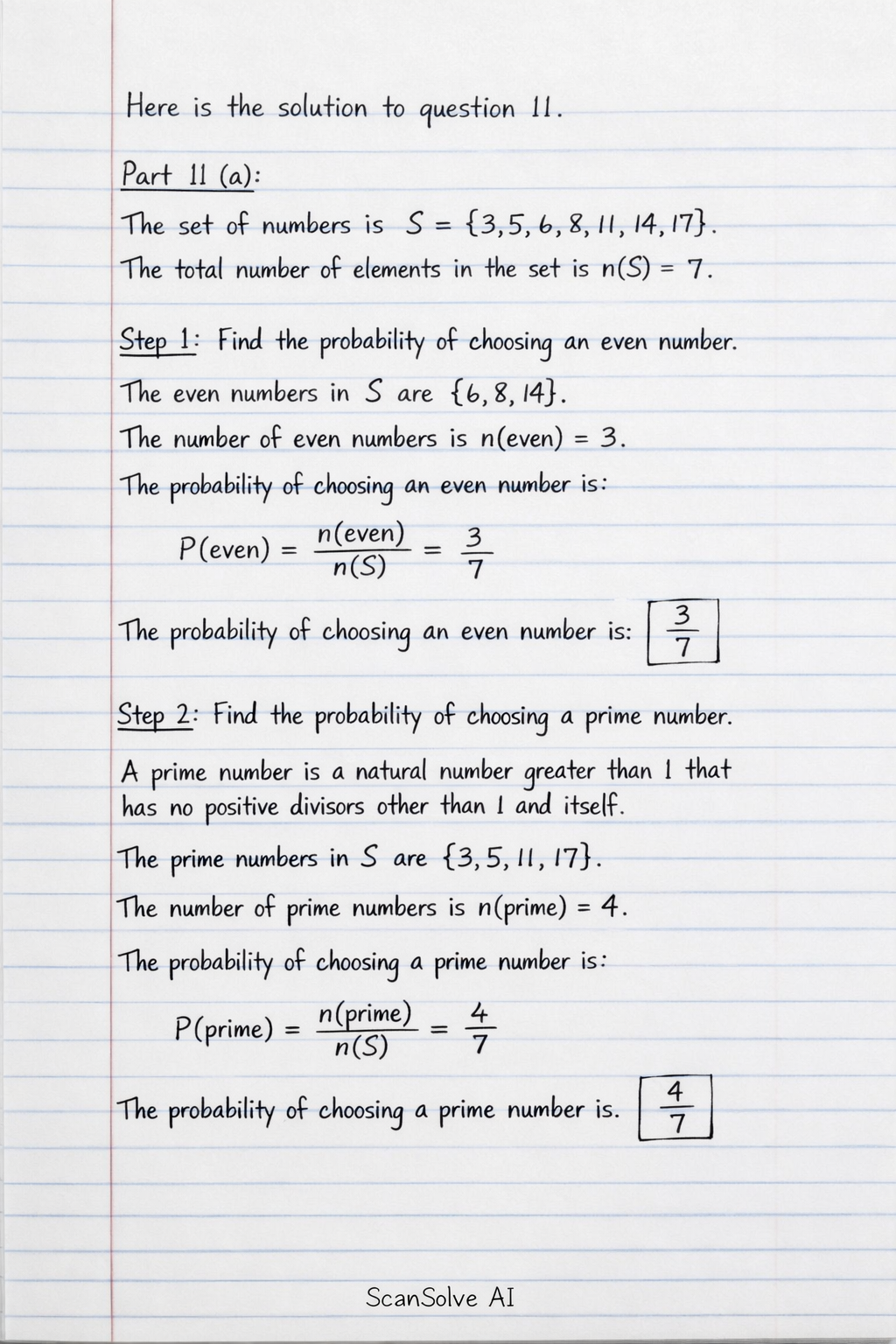
Part 11 (a):
The set of numbers is .
The total number of elements in the set is .
Find the probability of choosing an even number.
The even numbers in are .
The number of even numbers is .
The probability of choosing an even number is:The probability of choosing an even number is .
Find the probability of choosing a prime number.
A prime number is a natural number greater than 1 that has no positive divisors other than 1 and itself.
The prime numbers in are .
The number of prime numbers is .
The probability of choosing a prime number is:The probability of choosing a prime number is .
Find the probability of choosing a number greater than 10.
The numbers in greater than 10 are .
The number of elements greater than 10 is .
The probability of choosing a number greater than 10 is:The probability of choosing a number greater than 10 is .
Find the probability of choosing a multiple of 3.
The multiples of 3 in are .
The number of multiples of 3 is .
The probability of choosing a multiple of 3 is:The probability of choosing a multiple of 3 is .
Part 11 (b):
A bag contains 4 blue balls, 3 green balls, and 3 yellow balls.
The total number of balls is .
One ball is drawn at random and not replaced. A second ball is then drawn.Find the probability of obtaining two yellow balls.
The probability of drawing a yellow ball first is .
After drawing one yellow ball, there are 2 yellow balls left and 9 total balls left.
The probability of drawing a second yellow ball is .
The probability of drawing two yellow balls is:The probability of obtaining two yellow balls is .
Find the probability of obtaining two blue balls or two green balls.
The probability of drawing two blue balls is:
The probability of drawing two green balls is:
The probability of drawing two blue balls or two green balls is the sum of their individual probabilities:
The probability of obtaining two blue balls or two green balls is .
Find the probability of obtaining one blue ball and one green ball in any order.
This means either (blue first, then green) or (green first, then blue).
The probability of drawing a blue ball first, then a green ball:The probability of drawing a green ball first, then a blue ball:
The probability of obtaining one blue ball and one green ball in any order is the sum of these probabilities:
The probability of obtaining one blue ball and one green ball in any order is .
Still stuck on this one?
Ask a follow-up, and the answer starts from this question.
More Mathematics Questions
Handwritten Step-by-Step Solution
Get this as a handwritten image on WhatsApp — like a tutor wrote it for you.
Try on WhatsApp