
We read your photo as:
The set is K = \1, 2, 3, 4, 5, 6, 7, 8, 9, 10, 11\. (a) List the prime numbers in K. (b) Calculate the probability of selecting a non-prime number from K. (c) Factorize (x+y)(2m-n) - m(x+y).
ScanSolve AI Answer
Step-by-step solution
4 stepsSolve part (a)(i) by listing prime numbers.
The set .
A prime number is a natural number greater than 1 that has no positive divisors other than 1 and itself.
The prime numbers in set are:- 2 (divisors: 1, 2)
- 3 (divisors: 1, 3)
- 5 (divisors: 1, 5)
- 7 (divisors: 1, 7)
- 11 (divisors: 1, 11)
The list of prime numbers in is .
Solve part (a)(ii) by finding the probability of selecting a non-prime number.
Total number of elements in set is 11.
From part (a)(i), the number of prime numbers in is 5.
The number of non-prime numbers in is the total number of elements minus the number of prime numbers:The probability of selecting a non-prime number is the ratio of the number of non-prime numbers to the total number of elements:
The probability is .
Factorize the expression in part (b).
The expression is .
Notice that is a common factor in both terms. We can factor it out:Now, simplify the terms inside the square brackets:
Combine the terms:
The completely factorized expression is .
Calculate the amount earned by the typist in part (c).
The typist typed a total of 35 sheets.
The charge for the first 8 sheets is GH¢ 68.00.
The number of additional sheets is the total sheets minus the first 8 sheets:The charge for each additional sheet is GH¢ 11.00.
The cost for the additional sheets is:The total amount earned is the sum of the charge for the first 8 sheets and the charge for the additional sheets:
The total amount earned is .
Still stuck on this one?
Ask a follow-up, and the answer starts from this question.
More Mathematics Questions
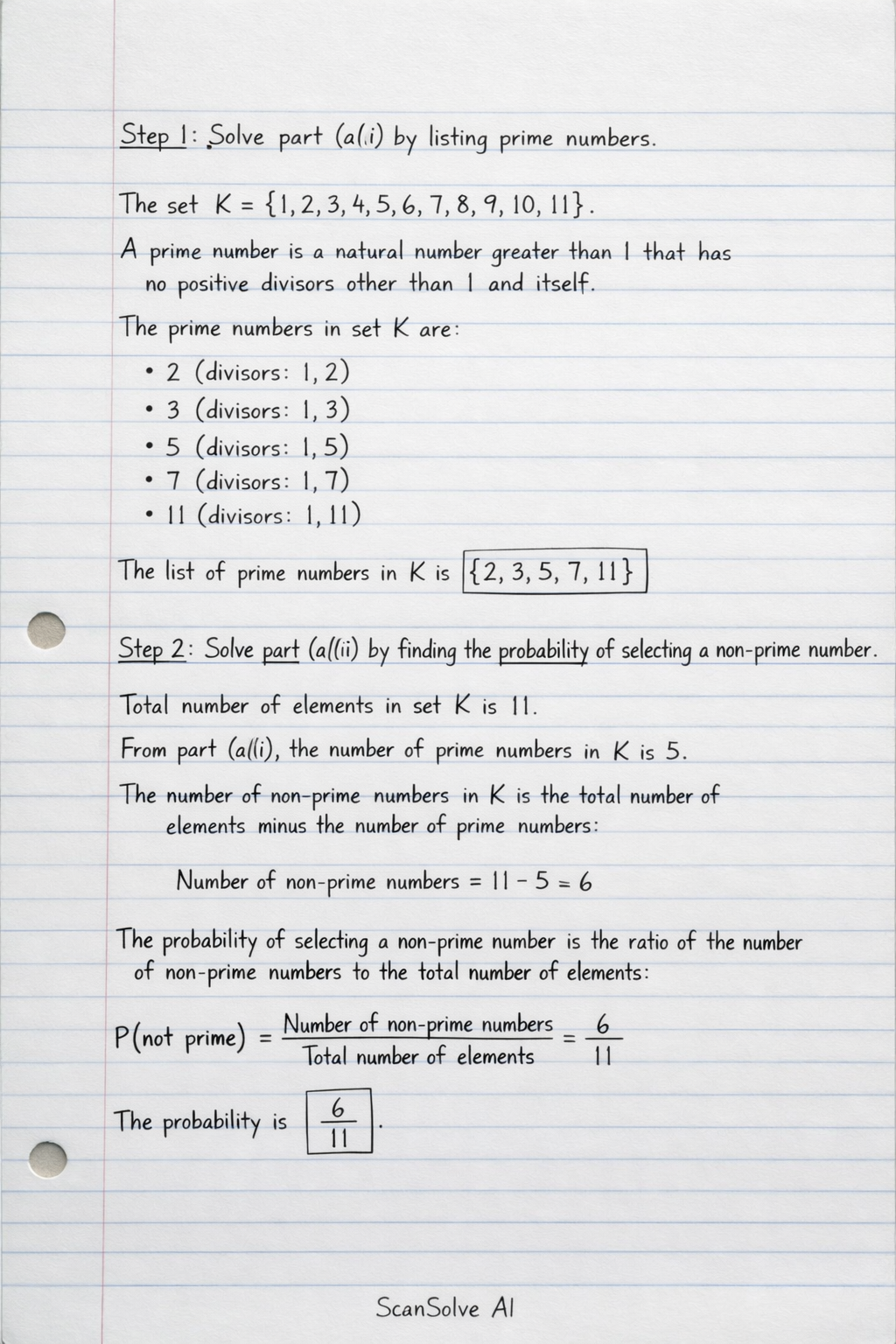
Handwritten Step-by-Step Solution
Get this as a handwritten image on WhatsApp — like a tutor wrote it for you.
Try on WhatsApp