
We read your photo as:
1(a) List prime numbers in K = \1, 2, 3, 4, 5, 6, 7, 8, 9, 10, 11\. Find the probability that a number selected from K is not prime. 1(b) Factorize completely (x+y)(2m-n) - m(x+y). 1(c) Calculate the
ScanSolve AI Answer
Step-by-step solution
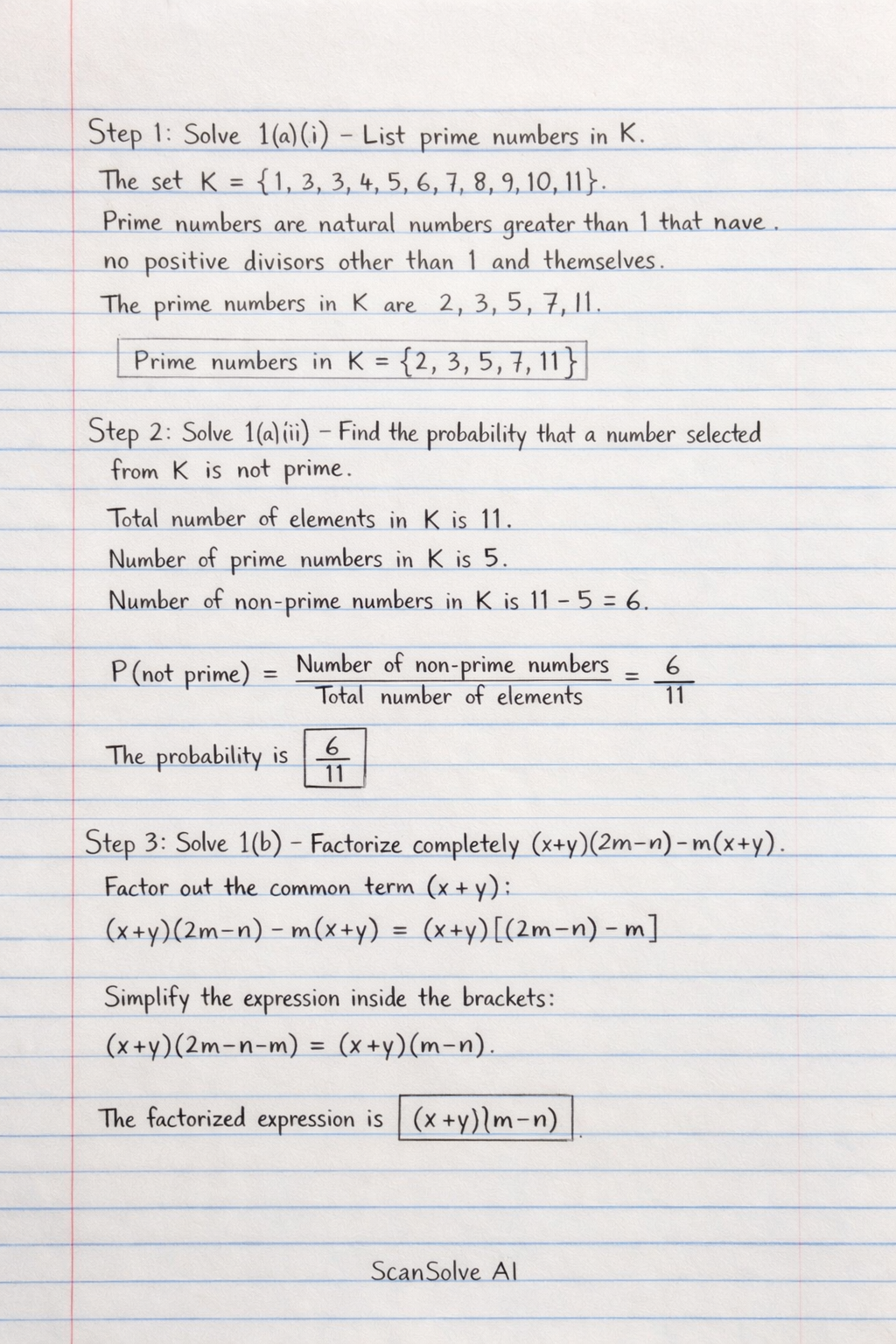
10 stepsSolve 1(a)(i) - List prime numbers in .
The set . Prime numbers are natural numbers greater than 1 that have no positive divisors other than 1 and themselves.
The prime numbers in are .Solve 1(a)(ii) - Find the probability that a number selected from is not prime.
The total number of elements in is 11.
The number of prime numbers in is 5.
The number of non-prime numbers in is .The probability is .
Solve 1(b) - Factorize completely .
Factor out the common term :
Simplify the expression inside the square brackets:
The factorized expression is .
Solve 1(c) - Calculate the total amount earned by the typist.
Total sheets typed = 35.
Cost for the first 8 sheets = GH¢ 68.00.
Number of additional sheets = sheets.
Cost per additional sheet = GH¢ 11.00.
Cost for additional sheets = .
Total amount earned = Cost for first 8 sheets + Cost for additional sheetsThe total amount earned is .
Solve 2(a)(i) - Find the image of translated by .
To find the image , add the components of the translation vector to the coordinates of .
The image of is .
Solve 2(a)(ii) - Find the image of translated by .
Similarly, add the components of the translation vector to the coordinates of .
The image of is .
Solve 2(b) - Calculate Joyce's and Richard's receipts.
Total profit = GH¢ 9,000.00.
Richard's manager's share = .
Remaining profit for distribution = GH¢ .
Joyce's contribution = GH¢ 10,000.00.
Richard's contribution = GH¢ 5,000.00.
Ratio of contributions (Joyce : Richard) = .
Total ratio parts = .-
2(b)(i) Joyce's receipt: Joyce's share from remaining profit = . Joyce received .
-
2(b)(ii) Richard's total receipt: Richard's share from remaining profit = . Richard's total receipt = Richard's manager's share + Richard's share from remaining profit
Richard received in total .
-
Solve 3(a) - Calculate Asana's total payment.
Original daily wage = GH¢ 25.00.
Increase in wage = of GH¢ .
New daily wage = GH¢ .
Number of days worked = 30 days.
Total payment = New daily wage Number of days workedAsana will be paid .
Solve 3(b)(i) - Find the perimeter of the room.
The dimensions of the L-shaped room are:
Outer top length = 8 m
Outer left length = 5 m
Outer right length = 3 m
Inner horizontal length = m
Inner vertical length = m
The perimeter is the sum of all outer side lengths:The perimeter is .
Solve 3(b)(ii) - Find the area of the room.
Divide the L-shaped room into two rectangles.
Rectangle 1 (top part): . Area.
Rectangle 2 (bottom-left part): $5 \text{
Still stuck on this one?
Ask a follow-up, and the answer starts from this question.
More Mathematics Questions
Handwritten Step-by-Step Solution
Get this as a handwritten image on WhatsApp — like a tutor wrote it for you.
Try on WhatsApp