
We read your photo as:
A piece of paper is drawn from a box containing slips of paper numbered 1 to 10. What is the experimental probability of drawing out 1, 6, an odd number, and a prime number?
ScanSolve AI Answer
Answers
4 partsStep-by-step solution
2 stepsIdentify the total number of possible outcomes.
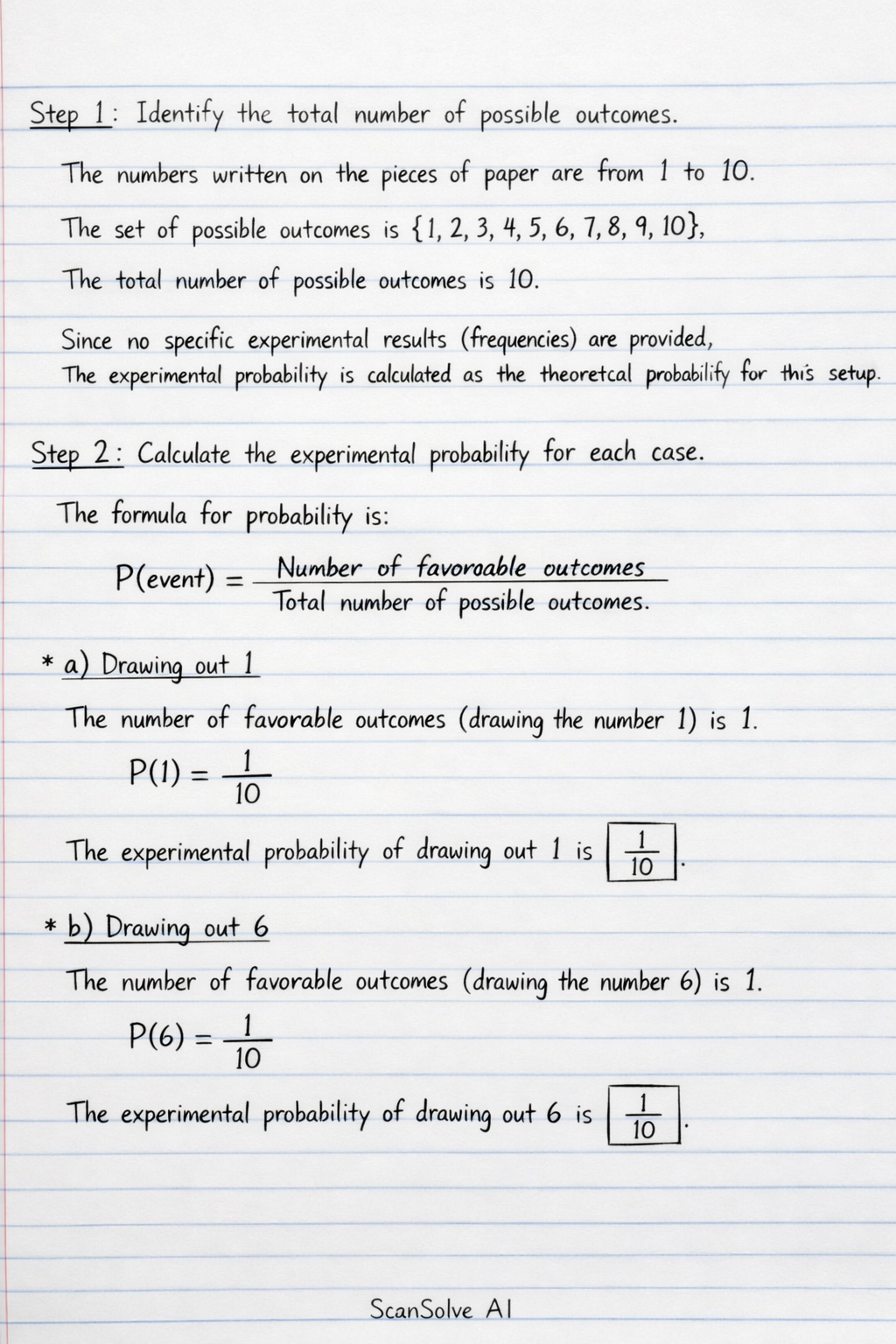
The numbers written on the pieces of paper are from 1 to 10.
The set of possible outcomes is .
The total number of possible outcomes is 10.
Since no specific experimental results (frequencies) are provided, the experimental probability is calculated as the theoretical probability for this fair setup.Calculate the experimental probability for each case.
The formula for probability is .
a) Drawing out 1
The number of favorable outcomes (drawing the number 1) is 1.The experimental probability of drawing out 1 is .
b) Drawing out 6
The number of favorable outcomes (drawing the number 6) is 1.The experimental probability of drawing out 6 is .
c) Drawing out an odd number
The odd numbers between 1 and 10 are .
The number of favorable outcomes is 5.The experimental probability of drawing out an odd number is .
d) Drawing out a prime number
The prime numbers between 1 and 10 are . (Note: 1 is not a prime number).
The number of favorable outcomes is 4.The experimental probability of drawing out a prime number is .
Try one yourself
A new problem that tests the same skill.
Still stuck on this one?
Ask a follow-up, and the answer starts from this question.
More Mathematics Questions
Handwritten Step-by-Step Solution
Get this as a handwritten image on WhatsApp — like a tutor wrote it for you.
Try on WhatsApp