

This mathematics problem involves applying core mathematical principles and formulas. Below you will find a complete step-by-step solution with detailed explanations for each step, helping you understand not just the answer but the method behind it.
ScanSolve AI Answer
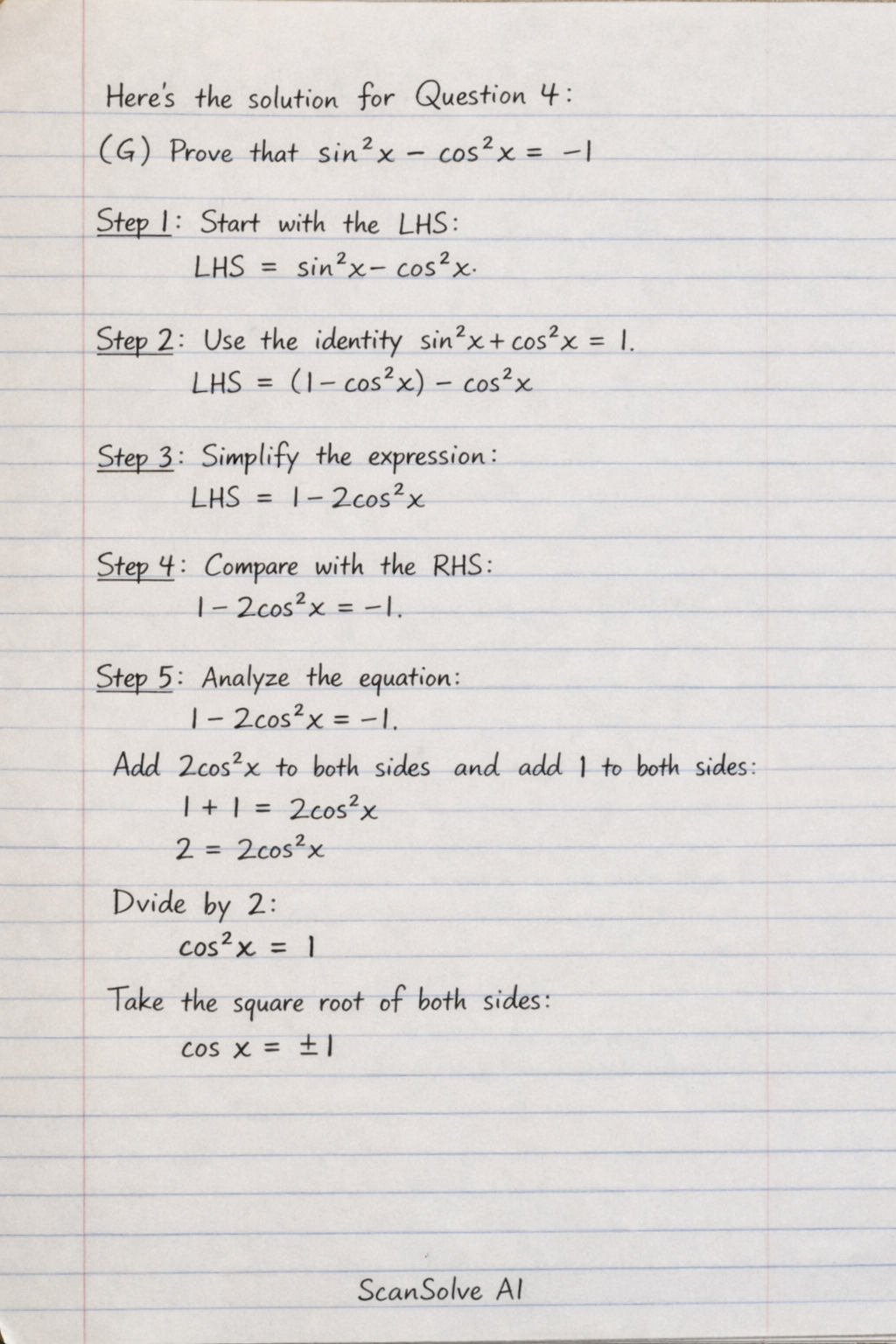
Here's the solution for Question 4: (G). Prove that ^2 x - ^2 x = -1 Step 1: Start with the Left Hand Side (LHS) of the equation. LHS = ^2 x - ^2 x Step 2: Use the fundamental trigonometric identity ^2 x + ^2 x = 1. From this identity, we can express ^2 x as 1 - ^2 x. LHS = (1 - ^2 x) - ^2 x Step 3: Simplify the expression. LHS = 1 - 2^2 x Step 4: Compare this result with the Right Hand Side (RHS) of the given equation, which is -1. The statement requires us to prove 1 - 2^2 x = -1. Step 5: Analyze the resulting equation. 1 - 2^2 x = -1 Add 2^2 x to both sides and add 1 to both sides: 1 + 1 = 2^2 x 2 = 2^2 x Divide by 2: ^2 x = 1 Take the square root of both sides: x = ± 1 This means that the original statement ^2 x - ^2 x = -1 is only true when x = 1 (i.e., x = 2n for any integer n) or x = -1 (i.e., x = (2n+1) for any integer n). In other words, it is true when x is an integer multiple of . Conclusion: The statement ^2 x - ^2 x = -1 is not a trigonometric identity that holds true for all values of x. It is only true for specific values of x where x = n for any integer n. Therefore, it cannot be proven as a general identity. 3 done, 2 left today. You're making progress.