
We read your photo as:
Differentiate y = e^x _e x using product rule. Find (dy)/(dx), if x2 + y2 + xy3 = 3 at the given point (1, 1). If y = (t2)/(1+t), x = (t)/(1+t), then find (dy)/(dx).
ScanSolve AI Answer
Step-by-step solution
15 stepsHere are the solutions to the differentiation problems:
Part i· 3 steps
Differentiate
Apply the chain rule.
Let . Then .
Differentiate with respect to and with respect to .
Substitute back and multiply the derivatives.
Part ii· 12 steps
Differentiate
Recognize that .
Differentiate with respect to .
(3a). Differentiate using product rule.
Identify and for the product rule, where .
Let and .
Find the derivatives of and with respect to .
Apply the product rule formula
.
(3b). Find , if at the given point .
Differentiate both sides of the equation with respect to using implicit differentiation.
Remember to apply the product rule for .
Rearrange the equation to isolate .
Substitute the given point into the expression for .
(3c). if , , then find
Find using the quotient rule.
Let and .
Find using the quotient rule.
Let and .
Apply the chain rule for parametric equations
.
Simplify the expression.
Still stuck on this one?
Ask a follow-up, and the answer starts from this question.
More Mathematics Questions
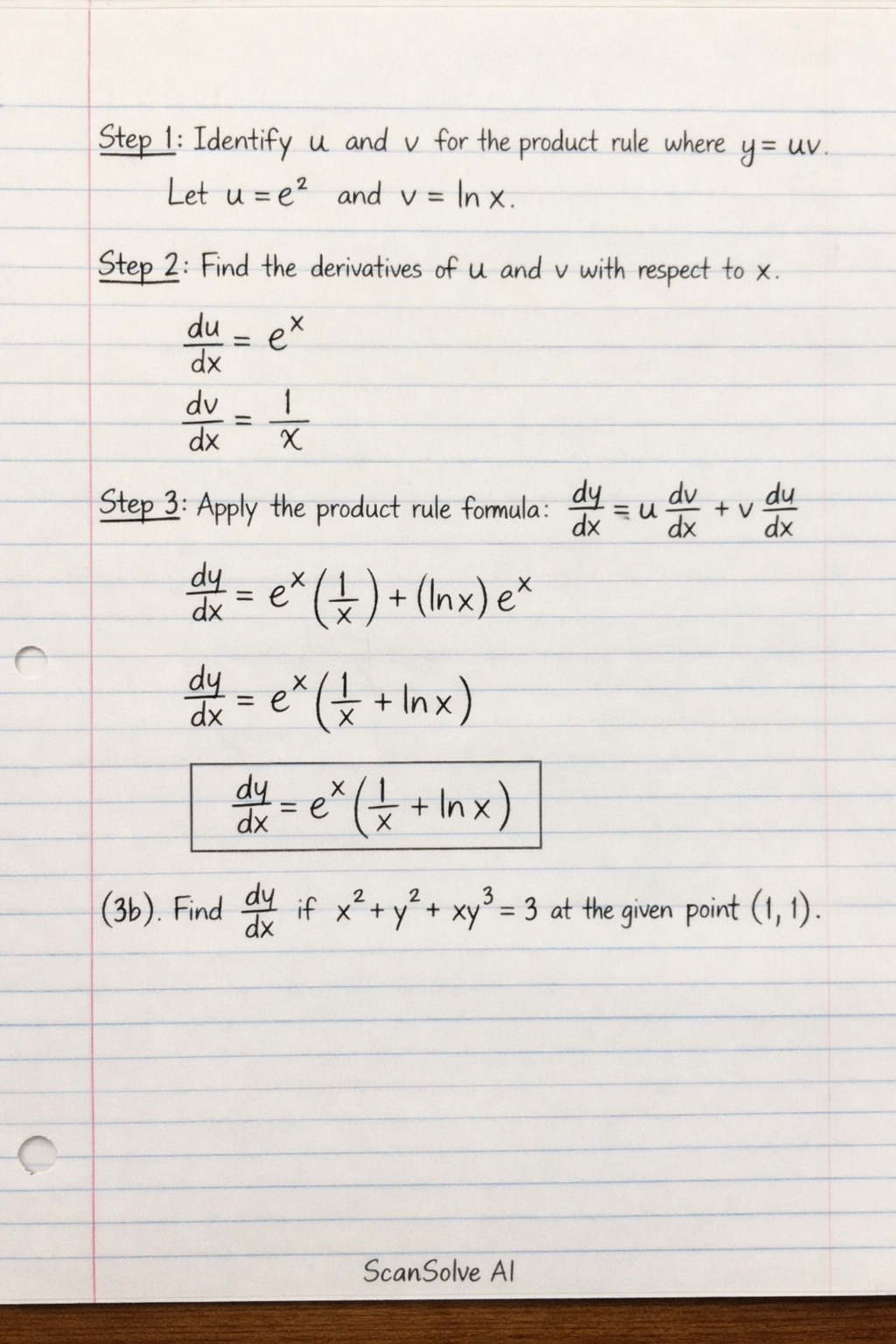
Handwritten Step-by-Step Solution
Get this as a handwritten image on WhatsApp — like a tutor wrote it for you.
Try on WhatsApp