
We read your photo as:
In the shapes below, work out the ratio of the area of the original shape to the area of the enlarged shape.
ScanSolve AI Answer
Step-by-step solution
29 stepsHere are the solutions to the problems:
1. a)
Identify the given dimensions of the original rectangle.
The length is and the width is .
Calculate the area of the original rectangle using the formula .
The area of the original rectangle is .
1. b)
Assume an enlargement factor.
The problem does not explicitly state the enlargement factor for the rectangle. Based on the context of the exercise and the following question (Q2) which uses an enlargement factor of 4, we will assume the rectangle is also enlarged by a factor of .
Calculate the new length and width of the larger rectangle.
New length
New widthCalculate the area of the larger rectangle.
The area of the larger rectangle is .
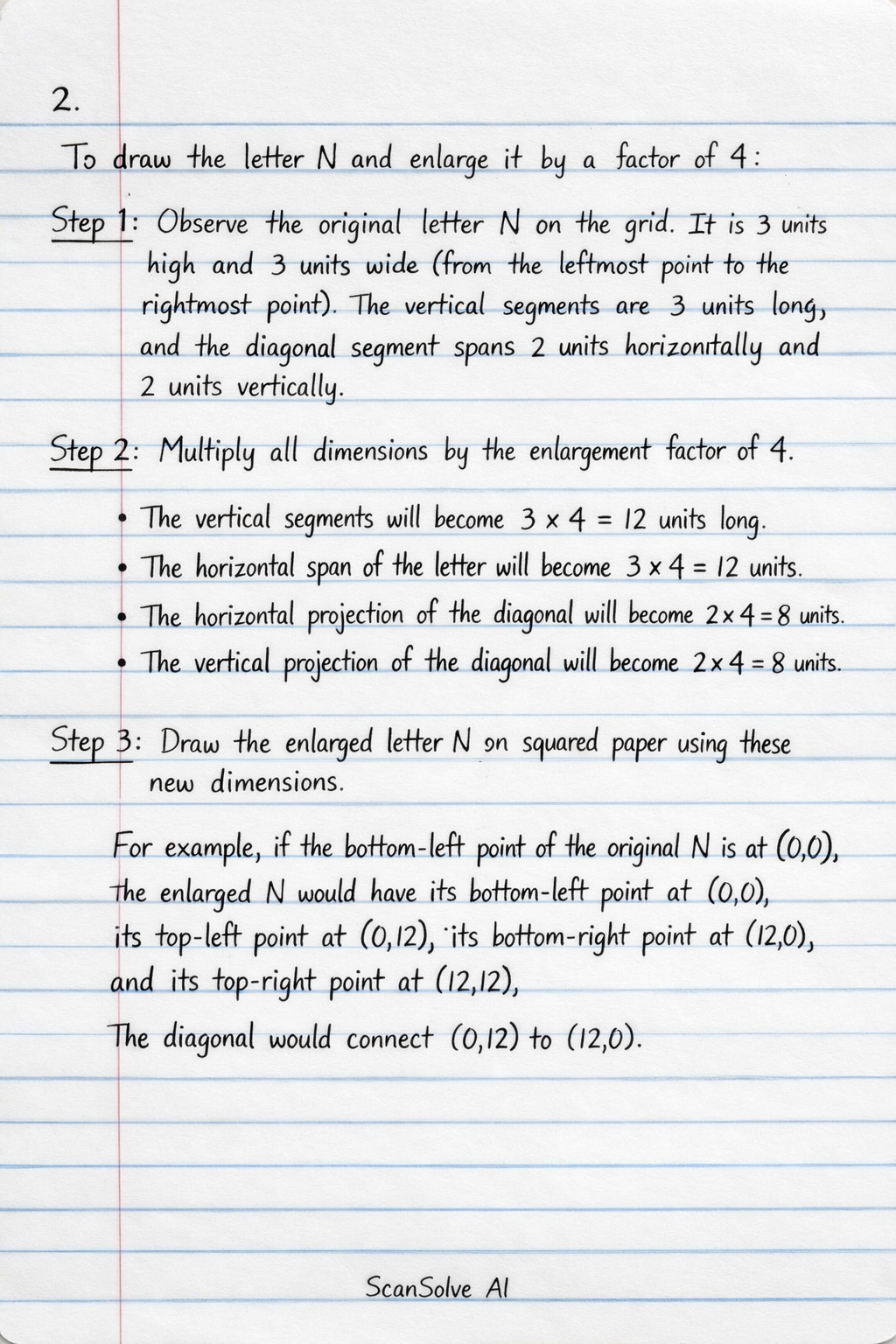
2.
To draw the letter N and enlarge it by a factor of 4:Observe the original letter N on the grid.
It is 3 units high and 3 units wide (from the leftmost point to the rightmost point). The vertical segments are 3 units long, and the diagonal segment spans 2 units horizontally and 2 units vertically.
Multiply all dimensions by the enlargement factor of 4.
- The vertical segments will become units long.
- The horizontal span of the letter will become units.
- The horizontal projection of the diagonal will become units.
- The vertical projection of the diagonal will become units.
Draw the enlarged letter N on squared paper using these new dimensions.
For example, if the bottom-left point of the original N is at (0,0), the enlarged N would have its bottom-left point at (0,0), its top-left point at (0,12), its bottom-right point at (12,0), and its top-right point at (12,12). The diagonal would connect (0,12) to (12,0).
3.
Identify the original radius and the factor of reduction.
Original radius .
Factor of reduction .Calculate the radius of the smaller circle.
The radius of the smaller circle is .
4.
Identify the original perimeter and the factor of enlargement.
Original perimeter .
Factor of enlargement .Calculate the perimeter of the larger square.
The perimeter of the larger square is .
5.
Identify the original perimeter and the factor of reduction.
Original perimeter .
Factor of reduction .Calculate the perimeter of the smaller square.
The perimeter of the smaller square is .
6. a)
Calculate the area of the original rectangle (solid lines).
Length = 2 units, Width = 1 unit.
Calculate the area of the enlarged rectangle (dashed lines).
Length = 4 units, Width = 2 units.
Determine the ratio of the area of the original shape to the area of the enlarged shape.
6. b)
Calculate the area of the original triangle (solid lines).
Base = 2 units, Height = 2 units.
Calculate the area of the enlarged triangle (dashed lines).
Base = 4 units, Height = 4 units.
Determine the ratio of the area of the original shape to the area of the enlarged shape.
7.
To draw these shapes and enlarge them by a factor of 2:
For each shape, identify the coordinates of its vertices (or key dimensions like base and height). Multiply each coordinate or dimension by the enlargement factor of 2 to get the new coordinates or dimensions for the enlarged shape. Then, draw the new shape on squared paper.7. a) Parallelogram:
- Original: Base is 3 units, height is 1 unit. The top-left vertex is 1 unit to the right of the bottom-left vertex.
- Enlarged: Base will be units, height will be units. The top-left vertex will be units to the right of the bottom-left vertex.
7. b) Kite:
- Original: Vertices can be identified relative to a grid. For example, if the bottom vertex is at (2,0), the other vertices are (0,2), (2,4), (4,2).
- Enlarged: Multiply all coordinates by 2. The new vertices would be (4,0), (0,4), (4,8), (8,4).
7. c) Irregular quadrilateral:
- Original: Vertices can be identified. For example, (0,0), (4,0), (5,2), (1,2).
- Enlarged: Multiply all coordinates by 2. The new vertices would be (0,0), (8,0), (10,4), (2,4).
8.
To find the factor of enlargement or reduction, compare corresponding lengths between the two shapes. We will assume the smaller shape is the original and the larger shape is the image, thus determining an enlargement factor.8. a) Kite:
Measure a corresponding length on the smaller (dashed) kite.
The vertical diagonal of the dashed kite is 2 units long.
Measure the corresponding length on the larger (solid) kite.
The vertical diagonal of the solid kite is 4 units long.
Calculate the factor of enlargement.
The factor of enlargement is .
8. b) Triangle:
Measure a corresponding length on the smaller (dashed) triangle.
The base of the dashed triangle is 1 unit long.
Measure the corresponding length on the larger (solid) triangle.
The base of the solid triangle is 3 units long.
Calculate the factor of enlargement.
The factor of enlargement is .
8. c) Triangle:
Measure a corresponding length on the smaller (solid) triangle.
The base of the solid triangle is 1 unit long.
Measure the corresponding length on the larger (dashed) triangle.
The base of the dashed triangle is 4 units long.
Calculate the factor of enlargement.
The factor of enlargement is .
Still stuck on this one?
Ask a follow-up, and the answer starts from this question.
More Mathematics Questions
Handwritten Step-by-Step Solution
Get this as a handwritten image on WhatsApp — like a tutor wrote it for you.
Try on WhatsApp