
We read your photo as:
Calculate the areas of the shapes.
Mathematics
ScanSolve AI Answer
Answers
2 partsStep-by-step solution
8 stepsHere are the areas of the shapes:
Part a· 4 steps
Decompose the shape into a rectangle and a triangle.
The rectangle has a width of and a height of .
The triangle has a base of and a height of .Calculate the area of the rectangle.
Calculate the area of the triangle.
Calculate the total area of shape (a).
Part b
Decompose the shape into a large trapezoid and a small rectangular cut-out.
The large trapezoid has parallel sides of and , and a height of .
The cut-out rectangle has a width of and a height of .Calculate the area of the large trapezoid.
Calculate the area of the cut-out rectangle.
Calculate the total area of shape (b).
Was this helpful?
Still stuck on this one?
Ask a follow-up, and the answer starts from this question.
Got a different question?Ask your own question
More Mathematics Questions
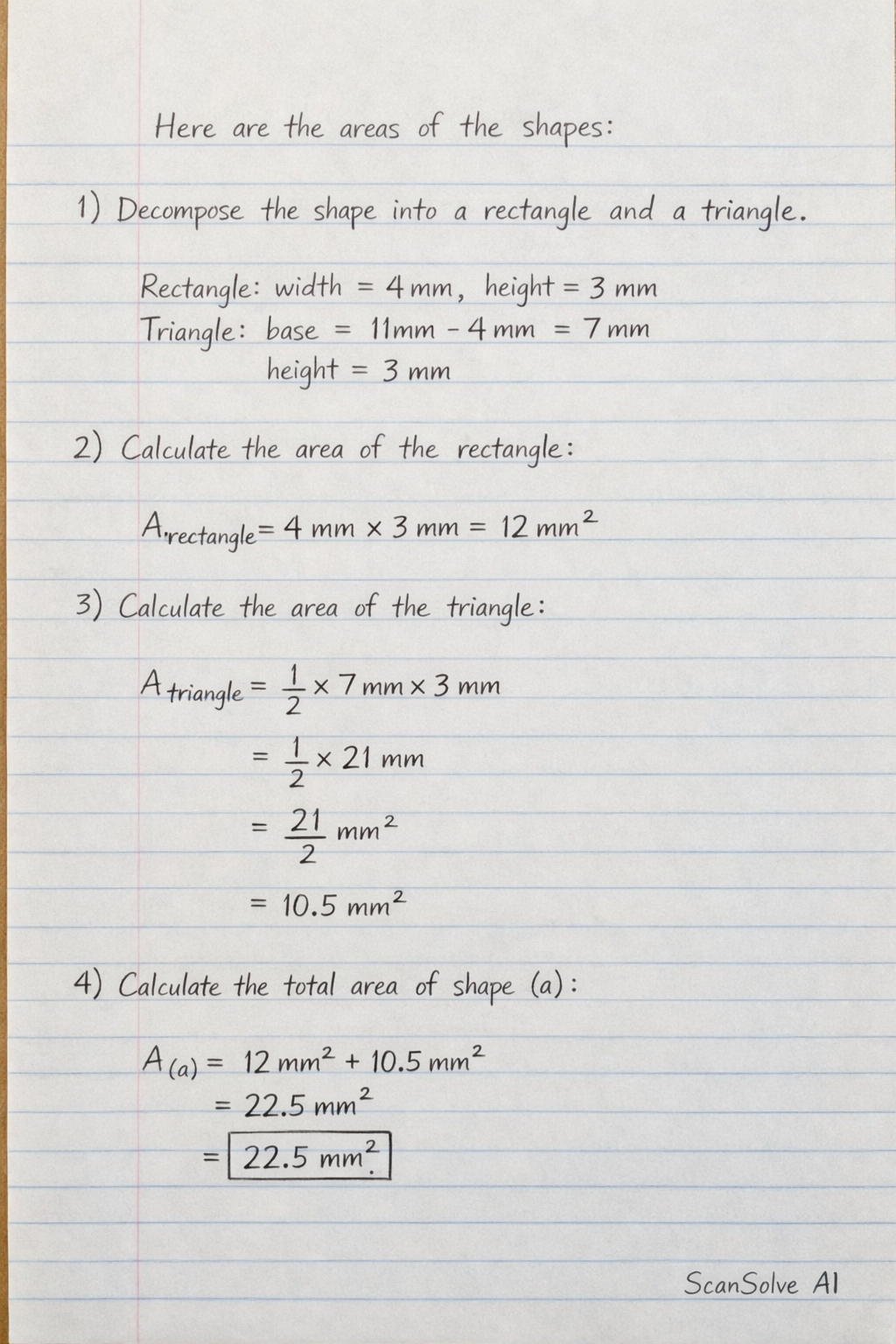
Handwritten Step-by-Step Solution
Get this as a handwritten image on WhatsApp — like a tutor wrote it for you.
Try on WhatsApp