
We read your photo as:
Find the area of each shape in square units.
Mathematics
ScanSolve AI Answer
Step-by-step solution
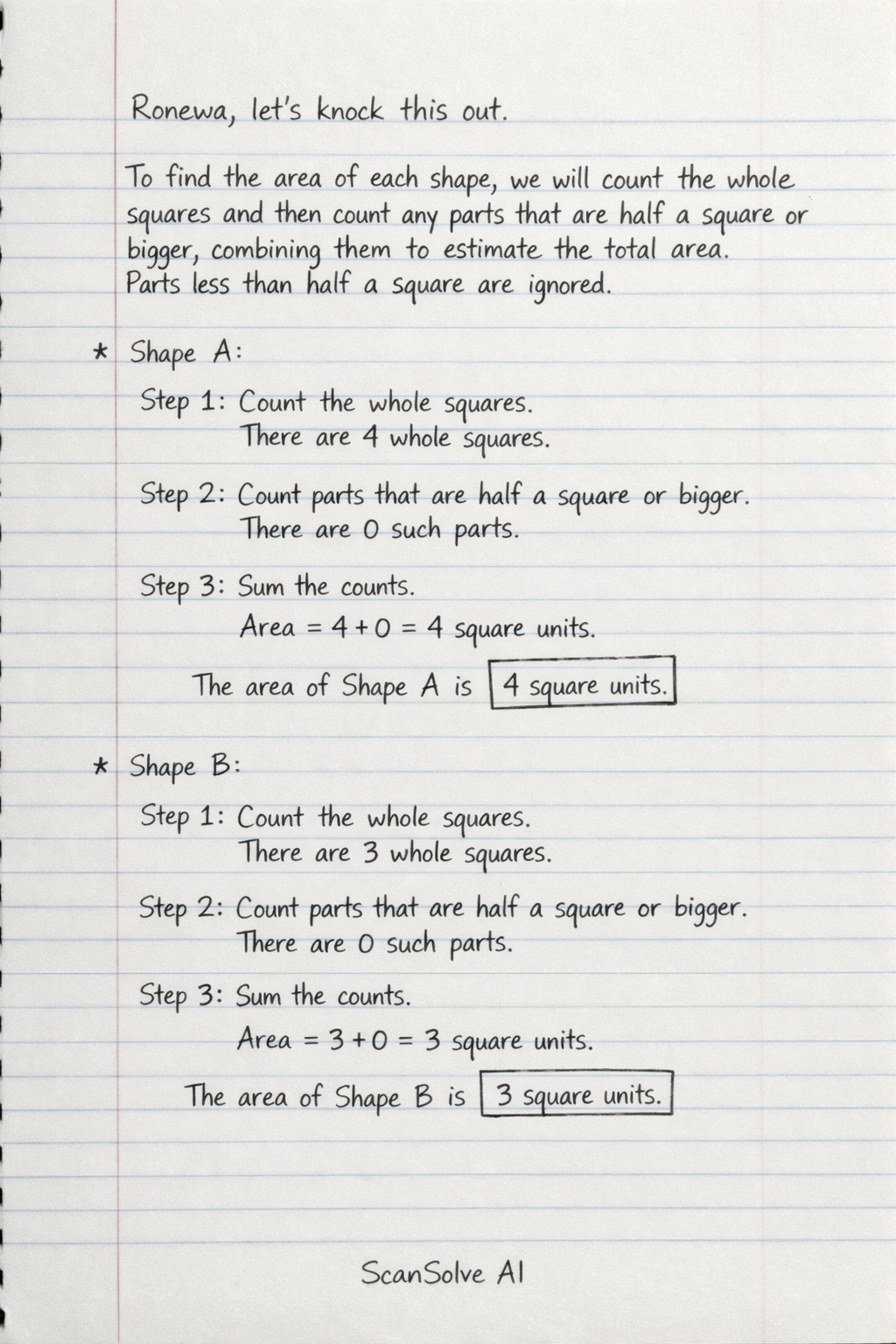
30 stepsTo find the area of each shape, we will count the whole squares and then count any parts that are half a square or bigger, combining them to estimate the total area. Parts less than half a square are ignored.
- Shape A:
Count the whole squares.
There are 4 whole squares.Count parts that are half a square or bigger.
There are 0 such parts.Sum the counts.
Area $= 4 + 0 = 4$ square units. The area of Shape A is $\boxed{\text{4 square units}}$.- Shape B:
Count the whole squares.
There are 3 whole squares.Count parts that are half a square or bigger.
There are 0 such parts.Sum the counts.
Area $= 3 + 0 = 3$ square units. The area of Shape B is $\boxed{\text{3 square units}}$.- Shape C:
Count the whole squares.
There are 2 whole squares.Count parts that are half a square or bigger.
There are 4 parts that are exactly half a square (one in the top row, one in the middle row, and two in the bottom row).Sum the counts.
Area $= 2 + 4 = 6$ square units. The area of Shape C is $\boxed{\text{6 square units}}$.- Shape D:
Count the whole squares.
There is 1 whole square.Count parts that are half a square or bigger.
There are 3 parts that are exactly half a square (one in each row on the right side).Sum the counts.
Area $= 1 + 3 = 4$ square units. The area of Shape D is $\boxed{\text{4 square units}}$.- Shape E:
Count the whole squares.
There are 4 whole squares.Count parts that are half a square or bigger.
There are 0 such parts.Sum the counts.
Area $= 4 + 0 = 4$ square units. The area of Shape E is $\boxed{\text{4 square units}}$.- Shape F:
Count the whole squares.
There are 2 whole squares.Count parts that are half a square or bigger.
There are 2 parts that are exactly half a square (one on each end).Sum the counts.
Area $= 2 + 2 = 4$ square units. The area of Shape F is $\boxed{\text{4 square units}}$.- Shape G:
Count the whole squares.
There is 1 whole square (in the center).Count parts that are half a square or bigger.
There are 4 parts that are exactly half a square (the four triangles pointing outwards).Sum the counts.
Area $= 1 + 4 = 5$ square units. The area of Shape G is $\boxed{\text{5 square units}}$.- Shape H:
Count the whole squares.
There are 4 whole squares.Count parts that are half a square or bigger.
There are 0 such parts.Sum the counts.
Area $= 4 + 0 = 4$ square units. The area of Shape H is $\boxed{\text{4 square units}}$.- Shape I:
Count the whole squares.
There are 0 whole squares.Count parts that are half a square or bigger.
There are 4 parts that are exactly half a square (the four triangles).Sum the counts.
Area $= 0 + 4 = 4$ square units. The area of Shape I is $\boxed{\text{4 square units}}$.- Shape J:
Count the whole squares.
There is 1 whole square (in the center).Count parts that are half a square or bigger.
There are 4 parts that are exactly half a square (the four triangles pointing outwards).Sum the counts.
Area $= 1 + 4 = 5$ square units.
The area of Shape J is $\boxed{\text{5 square units}}$.
Was this helpful?
Still stuck on this one?
Ask a follow-up, and the answer starts from this question.
Got a different question?Ask your own question
More Mathematics Questions
QCalculate the areas of the shapes.QCalculate the area of each of the following shapes:QConsider the diagrams below: Identify each of them. Find the area of each of the shape.QCalculate the perimeter of each shape. Find the measurement that is not in the same units as the…QFind the area and perimeter of the following shapes:
Browse by topic:Geometry
Handwritten Step-by-Step Solution
Get this as a handwritten image on WhatsApp — like a tutor wrote it for you.
Try on WhatsApp