
We read your photo as:
Calculate the perimeter of each shape. Find the measurement that is not in the same units as the others. Convert it to make it the same. Calculate the perimeter of each shape.
Mathematics
ScanSolve AI Answer
Step-by-step solution
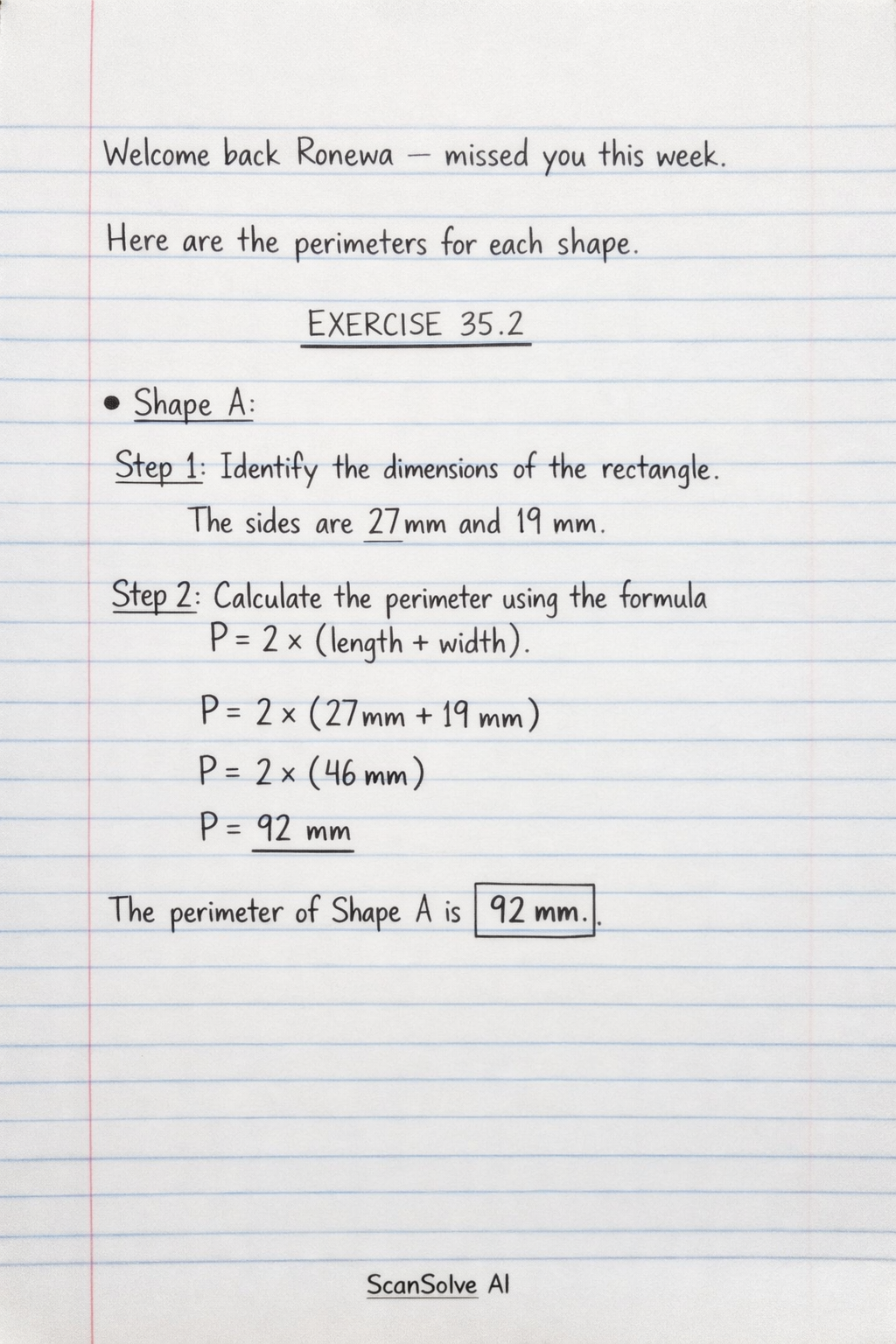
17 stepsHere are the perimeters for each shape.
.2
- Shape A:
Identify the dimensions of the rectangle.
The sides are $27 \text{ mm}$ and $19 \text{ mm}$.Calculate the perimeter using the formula .
$$ P = 2 \times (27 \text{ mm} + 19 \text{ mm}) $$ $$ P = 2 \times (46 \text{ mm}) $$ $$ P = 92 \text{ mm} $$ The perimeter of Shape A is $\boxed{\text{92 mm}}$.- Shape B:
Identify all side lengths.
The given sides are $2 \text{ cm}$, $2.5 \text{ cm}$, $2 \text{ cm}$, $1.5 \text{ cm}$, and $4 \text{ cm}$.Determine the lengths of the missing sides.
The total height is $2.5 \text{ cm} + 1.5 \text{ cm} = 4 \text{ cm}$. This is the length of the leftmost vertical side. The total width is $4 \text{ cm}$. The top horizontal segment is $2 \text{ cm}$. So the inner horizontal segment is $4 \text{ cm} - 2 \text{ cm} = 2 \text{ cm}$.Sum all side lengths to find the perimeter.
$$ P = 2 \text{ cm} + 2.5 \text{ cm} + 2 \text{ cm} + 1.5 \text{ cm} + 4 \text{ cm} + 4 \text{ cm} $$ $$ P = 16 \text{ cm} $$ The perimeter of Shape B is $\boxed{\text{16 cm}}$.- Shape C:
Identify the dimensions of the triangle.
The sides are $3.8 \text{ m}$, $5.3 \text{ m}$, and $4.9 \text{ m}$.Sum all side lengths to find the perimeter.
$$ P = 3.8 \text{ m} + 5.3 \text{ m} + 4.9 \text{ m} $$ $$ P = 14.0 \text{ m} $$ The perimeter of Shape C is $\boxed{\text{14.0 m}}$.- Shape D:
Identify the given side lengths.
Assuming it's a right-angled triangle with legs $12.4 \text{ cm}$ and $68.2 \text{ cm}$.Calculate the length of the hypotenuse using the Pythagorean theorem .
$$ c = \sqrt{(12.4 \text{ cm})^2 + (68.2 \text{ cm})^2} $$ $$ c = \sqrt{153.76 \text{ cm}^2 + 4651.24 \text{ cm}^2} $$ $$ c = \sqrt{4805 \text{ cm}^2} $$ $$ c \approx 69.318 \text{ cm} $$Sum all side lengths to find the perimeter.
$$ P = 12.4 \text{ cm} + 68.2 \text{ cm} + 69.318 \text{ cm} $$ $$ P \approx 149.918 \text{ cm} $$ Rounding to two decimal places: $$ P \approx 149.92 \text{ cm} $$ The perimeter of Shape D is $\boxed{\text{149.92 cm}}$.Shapes below .2
- Shape A:
Identify the side lengths and convert inconsistent units.
The sides are $2 \text{ m}$, $700 \text{ cm}$, $3 \text{ m}$, and $10 \text{ m}$. The measurement not in meters is $700 \text{ cm}$. Convert $700 \text{ cm}$ to meters: $700 \text{ cm} = 7 \text{ m}$.Determine the lengths of the missing sides for the L-shape.
The total width is $10 \text{ m}$. The top segment is $2 \text{ m}$. So the inner horizontal segment is $10 \text{ m} - 2 \text{ m} = 8 \text{ m}$. The total height is $7 \text{ m}$. The left segment is $3 \text{ m}$. So the inner vertical segment is $7 \text{ m} - 3 \text{ m} = 4 \text{ m}$.Sum all side lengths to find the perimeter.
$$ P = 2 \text{ m} + 7 \text{ m} + 10 \text{ m} + 3 \text{ m} + 8 \text{ m} + 4 \text{ m} $$ $$ P = 34 \text{ m} $$ The perimeter of Shape A is $\boxed{\text{34 m}}$.- Shape B:
Identify the side lengths and convert inconsistent units.
The sides are $270 \text{ cm}$, $3.5 \text{ m}$, $1.9 \text{ m}$, $8 \text{ cm}$, $2.8 \text{ m}$, and $2 \text{ m}$. The measurements not in meters are $270 \text{ cm}$ and $8 \text{ cm}$. Convert $270 \text{ cm}$ to meters: $270 \text{ cm} = 2.7 \text{ m}$. Convert $8 \text{ cm}$ to meters: $8 \text{ cm} = 0.08 \text{ m}$.Sum all side lengths to find the perimeter.
$$ P = 2.7 \text{ m} + 3.5 \text{ m} + 1.9 \text{ m} + 0.08 \text{ m} + 2.8 \text{ m} + 2 \text{ m} $$ $$ P = 12.98 \text{ m} $$ The perimeter of Shape B is $\boxed{\text{12.98 m}}$.- Shape C:
Identify the side lengths and convert inconsistent units.
The sides are $3.5 \text{ cm}$, $4 \text{ cm}$, $4.5 \text{ cm}$, $5 \text{ cm}$, $12 \text{ cm}$, $90 \text{ mm}$, $3.5 \text{ cm}$, $4 \text{ cm}$. The measurement not in centimeters is $90 \text{ mm}$. Convert $90 \text{ mm}$ to centimeters: $90 \text{ mm} = 9 \text{ cm}$.Sum all side lengths to find the perimeter.
$$
P = 9 \text{ cm} + 12 \text{ cm} + 9 \text{ cm} + 3.5 \text{ cm} + 4 \text{ cm} + 4.5 \text{ cm} + 5 \text{ cm} + 4.5 \text{ cm} + 4 \text{ cm} + 3.5 \text{ cm}
$$
$$
P = 59 \text{ cm}
$$
The perimeter of Shape C is $\boxed{\text{59 cm}}$.
Was this helpful?
Still stuck on this one?
Ask a follow-up, and the answer starts from this question.
Got a different question?Ask your own question
More Mathematics Questions
QFind the area of each shape in square units.QCalculate the perimeter of the following shapesQCalculate the perimeter of the given shape.QCalculate perimeter and area of the given shapes.QFind the perimeter of the given shapes: a trapezoid, an L-shaped polygon, a right-angled triangle…
Browse by topic:Geometry
Handwritten Step-by-Step Solution
Get this as a handwritten image on WhatsApp — like a tutor wrote it for you.
Try on WhatsApp