We read your photo as:

Find the area and perimeter of the following shapes:

Mathematics

ScanSolve AI Answer

Answers

4 parts
a

54 cm2\text{54 cm}^2

36 cm\text{36 cm}

b

75 cm2\text{75 cm}^2

40 cm\text{40 cm}

c

64π mm2≈201.06 mm264\pi \text{ mm}^2 \approx 201.06 \text{ mm}^2

16π mm≈50.27 mm16\pi \text{ mm} \approx 50.27 \text{ mm}

d

624 mm2\text{624 mm}^2

84 mm\text{84 mm}

Step-by-step solution

9 steps

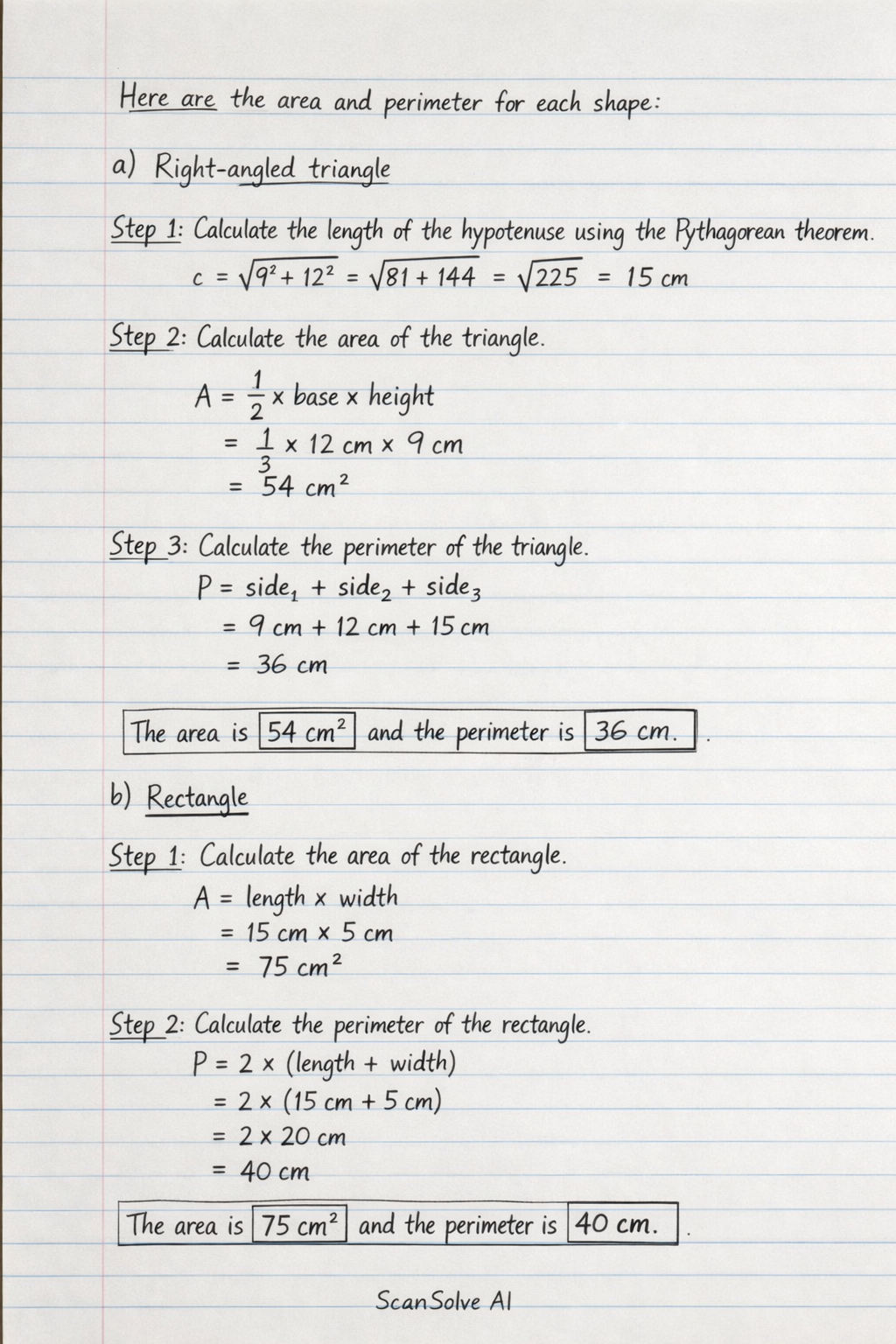
Here are the area and perimeter for each shape:

Part a· 3 steps

Right-angled triangle

  1. Calculate the length of the hypotenuse using the Pythagorean theorem.

    c=92+122=81+144=225=15 cmc = \sqrt{9^2 + 12^2} = \sqrt{81 + 144} = \sqrt{225} = 15 \text{ cm}
  2. Calculate the area of the triangle.

    A=12×base×height=12×12 cm×9 cm=54 cm2A = \frac{1}{2} \times \text{base} \times \text{height} = \frac{1}{2} \times 12 \text{ cm} \times 9 \text{ cm} = 54 \text{ cm}^2
  3. Calculate the perimeter of the triangle.

    P=side1+side2+side3=9 cm+12 cm+15 cm=36 cmP = \text{side}_1 + \text{side}_2 + \text{side}_3 = 9 \text{ cm} + 12 \text{ cm} + 15 \text{ cm} = 36 \text{ cm}

    The area is 54 cm2\boxed{\text{54 cm}^2} and the perimeter is 36 cm\boxed{\text{36 cm}}.

Part b

75 cm2\text{75 cm}^2

Rectangle

  1. Calculate the area of the rectangle.

    A=length×width=15 cm×5 cm=75 cm2A = \text{length} \times \text{width} = 15 \text{ cm} \times 5 \text{ cm} = 75 \text{ cm}^2
  2. Calculate the perimeter of the rectangle.

    P=2×(length+width)=2×(15 cm+5 cm)=2×20 cm=40 cmP = 2 \times (\text{length} + \text{width}) = 2 \times (15 \text{ cm} + 5 \text{ cm}) = 2 \times 20 \text{ cm} = 40 \text{ cm}

    The area is 75 cm2\boxed{\text{75 cm}^2} and the perimeter is 40 cm\boxed{\text{40 cm}}.

Part c

64π mm2≈201.06 mm264\pi \text{ mm}^2 \approx 201.06 \text{ mm}^2

Circle

  1. Calculate the area of the circle.

    A=πr2=π(8 mm)2=64π mm2≈201.06 mm2A = \pi r^2 = \pi (8 \text{ mm})^2 = 64\pi \text{ mm}^2 \approx 201.06 \text{ mm}^2
  2. Calculate the perimeter (circumference) of the circle.

    C=2πr=2π(8 mm)=16π mm≈50.27 mmC = 2\pi r = 2\pi (8 \text{ mm}) = 16\pi \text{ mm} \approx 50.27 \text{ mm}

    The area is 64π mm2≈201.06 mm2\boxed{64\pi \text{ mm}^2 \approx 201.06 \text{ mm}^2} and the perimeter is 16π mm≈50.27 mm\boxed{16\pi \text{ mm} \approx 50.27 \text{ mm}}.

Part d

624 mm2\text{624 mm}^2

Rhombus

  1. Calculate the area of the rhombus.

    A=12×d1×d2=12×24 mm×52 mm=12 mm×52 mm=624 mm2A = \frac{1}{2} \times d_1 \times d_2 = \frac{1}{2} \times 24 \text{ mm} \times 52 \text{ mm} = 12 \text{ mm} \times 52 \text{ mm} = 624 \text{ mm}^2
  2. Calculate the perimeter of the rhombus.

    P=4×side=4×21 mm=84 mmP = 4 \times \text{side} = 4 \times 21 \text{ mm} = 84 \text{ mm}

    The area is 624 mm2\boxed{\text{624 mm}^2} and the perimeter is 84 mm\boxed{\text{84 mm}}.

Was this helpful?

Try one yourself

A new problem that tests the same skill.

Still stuck on this one?

Ask a follow-up, and the answer starts from this question.

Got a different question?Ask your own question
Handwritten step-by-step solution preview

Handwritten Step-by-Step Solution

Get this as a handwritten image on WhatsApp — like a tutor wrote it for you.

Try on WhatsApp