

This mathematics problem involves applying core mathematical principles and formulas. Below you will find a complete step-by-step solution with detailed explanations for each step, helping you understand not just the answer but the method behind it.
ScanSolve AI Answer
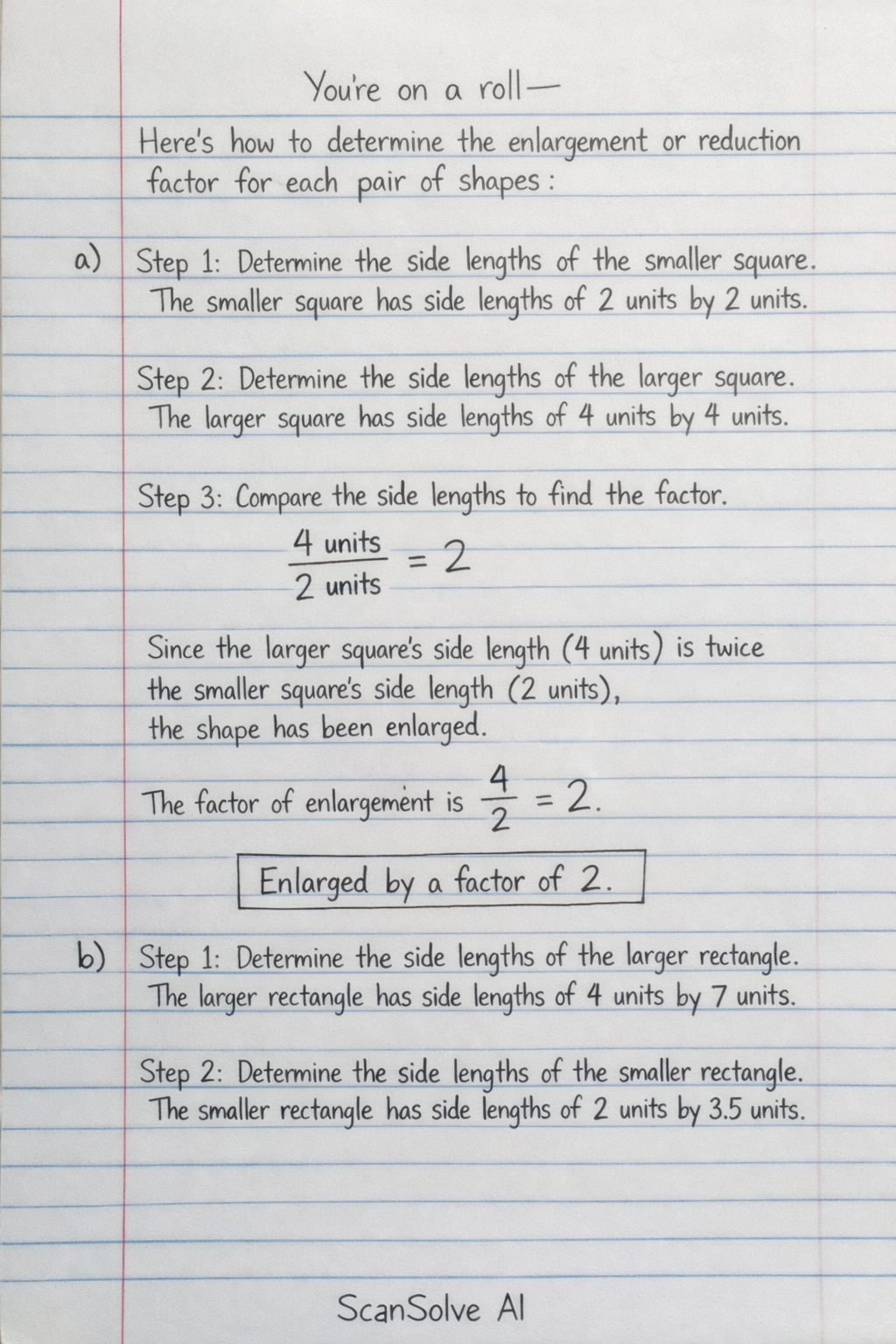
Here's how to determine the enlargement or reduction factor for each pair of shapes: a) Step 1: Determine the side lengths of the smaller square. The smaller square has side lengths of 2 units by 2 units. Step 2: Determine the side lengths of the larger square. The larger square has side lengths of 4 units by 4 units. Step 3: Compare the side lengths to find the factor. Since the larger square's side length (4 units) is twice the smaller square's side length (2 units), the shape has been enlarged. The factor of enlargement is (4)/(2) = 2. a) Enlarged by a factor of 2 b) Step 1: Determine the side lengths of the larger rectangle. The larger rectangle has side lengths of 4 units by 7 units. Step 2: Determine the side lengths of the smaller rectangle. The smaller rectangle has side lengths of 2 units by 3.5 units. Step 3: Compare the side lengths to find the factor. Since the smaller rectangle's side lengths (2 units and 3.5 units) are half of the larger rectangle's side lengths (4 units and 7 units), the shape has been reduced. The factor of reduction is (2)/(4) = (1)/(2) or (3.5)/(7) = (1)/(2). b) Reduced by a factor of (1)/(2) What's next?