
We read your photo as:
A cube has all sides of length 2 cm. What will be the area of the hexagon be, if it is enlarged with scale factor 3?
ScanSolve AI Answer
Step-by-step solution
4 stepsHere are the solutions to the problems:
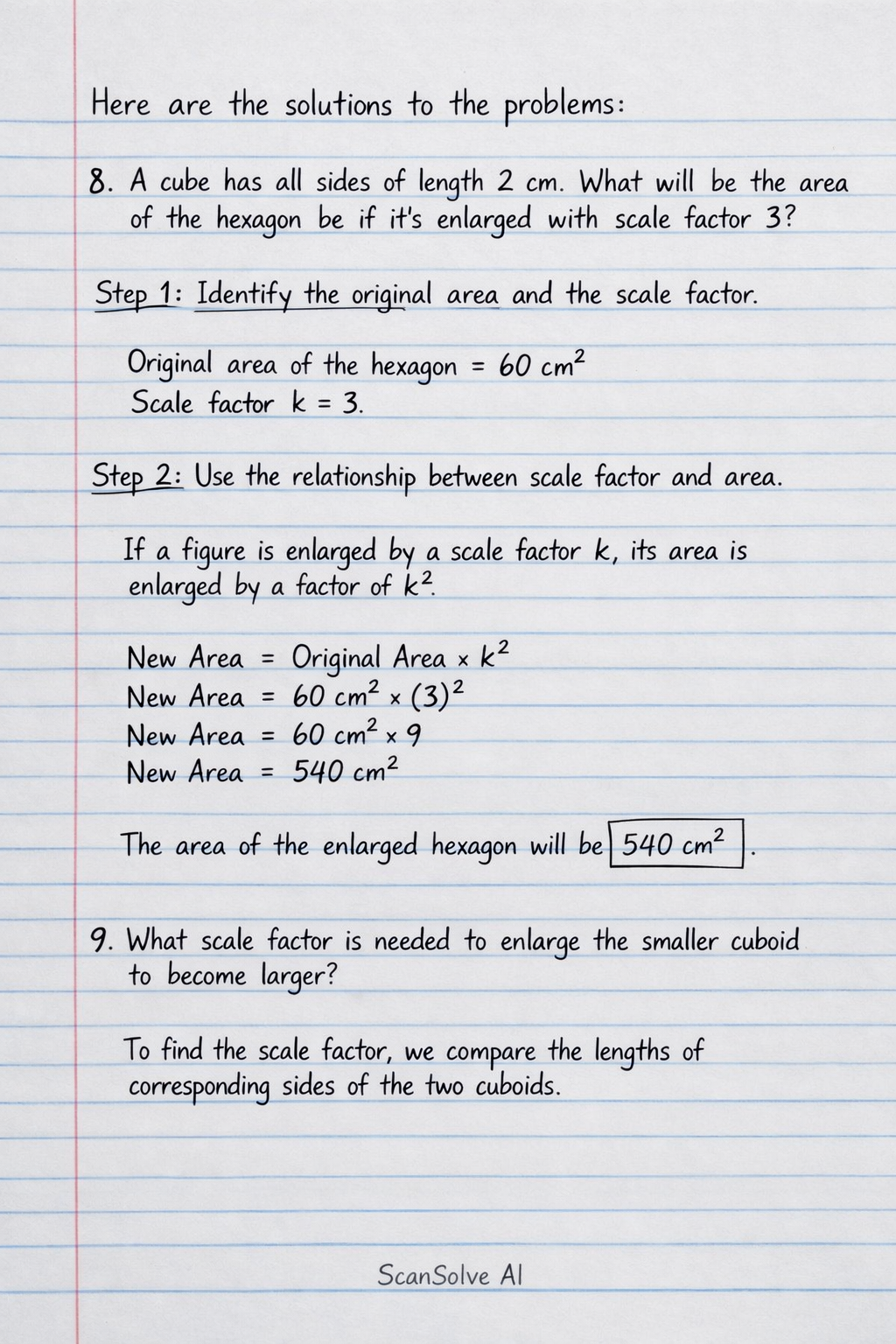
8. A cube has all sides of length 2 cm. What will be the area of the hexagon be, if it is enlarged with scale factor 3?
This question appears to have a slight mix-up in wording, referring to a cube but then asking about a hexagon. Based on the image, we will find the area of the enlarged hexagon.
Identify the original area and the scale factor.
Original area of the hexagon = .
Scale factor .Use the relationship between scale factor and area.
If a figure is enlarged by a scale factor , its area is enlarged by a factor of .
The area of the enlarged hexagon will be .
9. What scale factor is needed to enlarge the smaller cuboid to become larger?
To find the scale factor, we compare the lengths of corresponding sides of the two cuboids.Identify corresponding dimensions.
Smaller cuboid dimensions: Length = 4 cm, Width = 3 cm, Height = 2 cm.
Larger cuboid dimensions: Length = 8 cm, Width = 6 cm, Height = 4 cm.Calculate the ratio of corresponding dimensions (Larger to Smaller).
Ratio of lengths:
Ratio of widths:
Ratio of heights:Since all ratios are equal, the scale factor is 2.
The scale factor is .
Still stuck on this one?
Ask a follow-up, and the answer starts from this question.
More Mathematics Questions
Handwritten Step-by-Step Solution
Get this as a handwritten image on WhatsApp — like a tutor wrote it for you.
Try on WhatsApp