
We read your photo as:
A cube of sides 6 cm is divided into smaller cubes of sides 1 cm. Determine: a) The total surface area of the larger cube. b) The total surface area of one smaller cube. c) Number of cubes that will b
ScanSolve AI Answer
Step-by-step solution
3 stepsHere's the solution for question 5.
Question 5: A cube of sides 6 cm is divided into smaller cubes of sides 1 cm. Determine:
a) The total surface area of the larger cube.
b) The total surface area of one smaller cube.
c) Number of cubes that will be made.
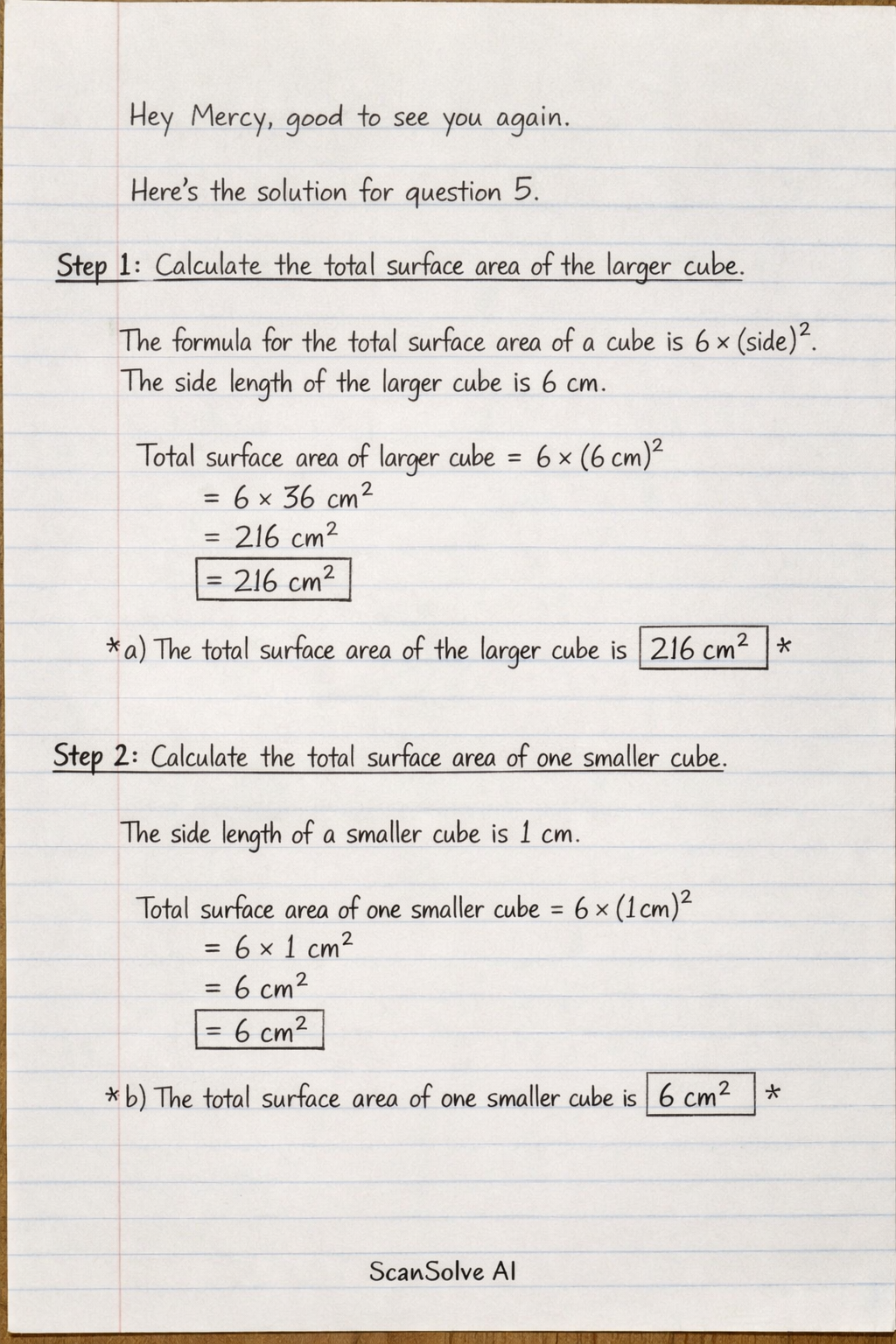
Calculate the total surface area of the larger cube.
The formula for the total surface area of a cube is .
The side length of the larger cube is 6 cm.a) The total surface area of the larger cube is .
Calculate the total surface area of one smaller cube.
The side length of a smaller cube is 1 cm.
b) The total surface area of one smaller cube is .
Calculate the number of smaller cubes that can be made.
First, find the volume of the larger cube.
Next, find the volume of one smaller cube.
To find the number of smaller cubes, divide the volume of the larger cube by the volume of one smaller cube.
c) The number of cubes that will be made is .
Still stuck on this one?
Ask a follow-up, and the answer starts from this question.
More Mathematics Questions
Handwritten Step-by-Step Solution
Get this as a handwritten image on WhatsApp — like a tutor wrote it for you.
Try on WhatsApp