
We read your photo as:
A cyclist travels from point A to point B, a distance of 12 km, in 30 minutes. They then stop at point B for 1.5 hours before cycling to point C, 20 km from A, in another 30 minutes. Draw a distance-t
ScanSolve AI Answer
This answer stops before the end.
It was cut off when it was first written. Ask ScanSolve this question again for the full working.
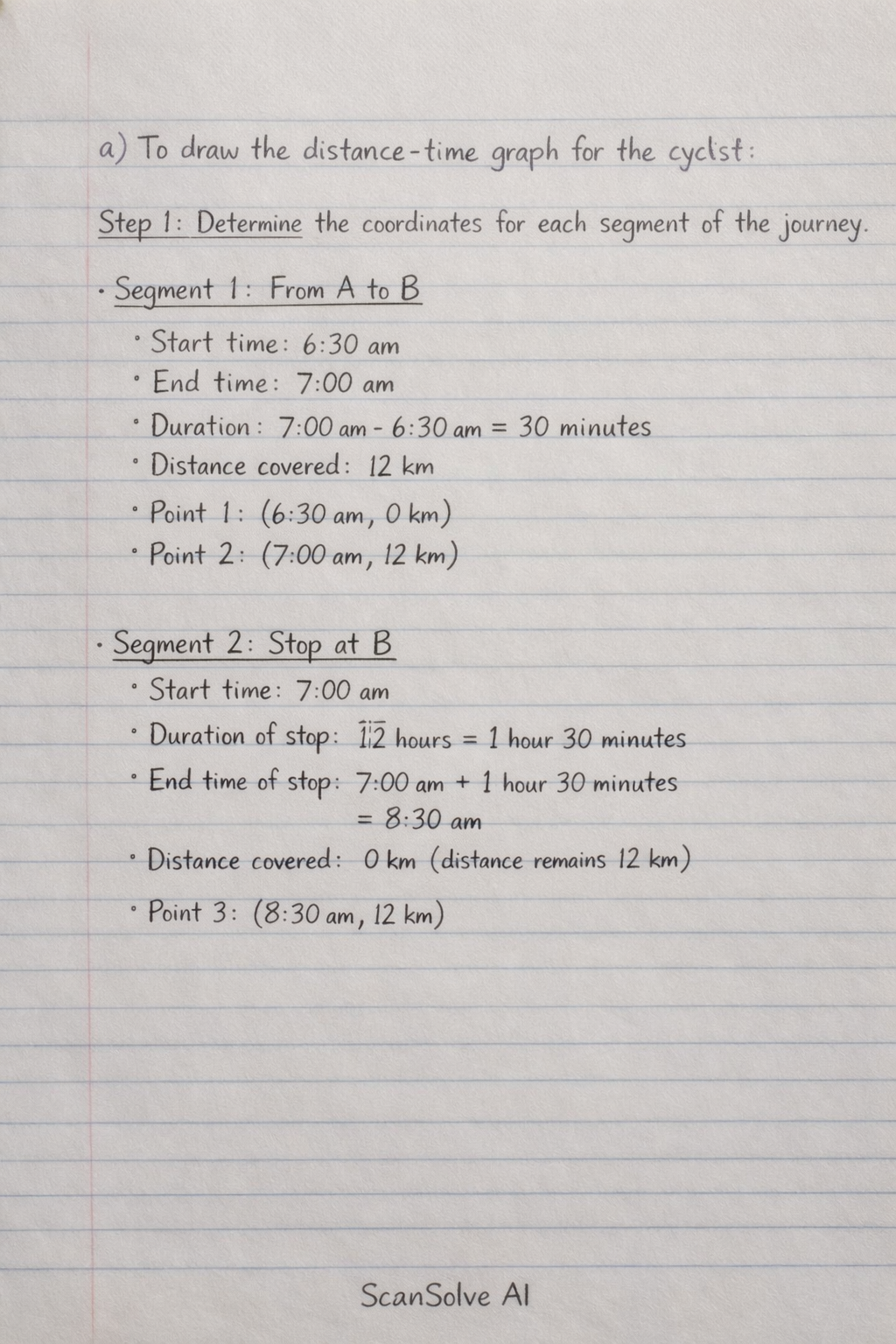
a) To draw the distance-time graph for the cyclist:
Step 1: Determine the coordinates for each segment of the journey.
-
Segment 1: From A to B
- Start time: 6:30 am
- End time: 7:00 am
- Duration:
- Distance covered: 12 km
- Point 1:
- Point 2:
-
Segment 2: Stop at B
- Start time: 7:00 am
- Duration of stop:
- End time of stop:
- Distance covered: 0 km (distance remains 12 km)
- Point 3:
-
Segment 3: From B to C
- Start time: 8:30 am
- Starting distance: 12 km
- Destination C is 20 km away.
- Distance to cover:
- Speed: 16 km/h
- Time taken:
- End time:
- End distance: 20 km
- Point 4:
Step 2: Set up the graph axes according to the given scale.
- Vertical axis (Distance): 2 cm represents 4 km. If each grid square is 1 cm, then 2 squares represent 4 km. Label the axis from 0 km to 20 km (e.g., 0, 4, 8, 12, 16, 20).
- Horizontal axis (Time): 2 cm represents 30 minutes. If each grid square is 1 cm, then 2 squares represent 30 minutes. Label the axis starting from 6:30 am (e.g., 6:30 am, 7:00 am, 7:30 am, 8:00 am, 8:30 am, 9:00 am).
Step 3: Plot the points and draw the graph.
- Plot the starting point: .
- Draw a straight line from to .
- Draw a horizontal line from to to represent the stop.
- Draw a straight line from to .
b) To find the time taken for the cyclist to reach the destination using the graph:
Step 1: Locate the destination distance on the vertical axis.
The destination is 20 km. Find 20 km on the vertical axis.
Step 2: Read the corresponding time on the horizontal axis.
Follow horizontally from 20 km to the graph line, then vertically down to the time axis. This point corresponds to 9:00 am.
Step 3: Calculate the total time taken.
The journey started at 6:30 am and ended at 9:00 am.
Still stuck on this one?
Ask a follow-up, and the answer starts from this question.
More Mathematics Questions
Handwritten Step-by-Step Solution
Get this as a handwritten image on WhatsApp — like a tutor wrote it for you.
Try on WhatsApp