We read your photo as:

A cylindrical tank has a radius of 1.4 m and a height of 2.4 m. (d) What is the volume of water needed to fill the tank in litres? (e) How many buckets are needed to fill the tank?

Mathematics

ScanSolve AI Answer

Answers

2 parts
d

14778.1 litres\text{14778.1 litres}

e

6000\text{6000}

Step-by-step solution

6 steps

Here are the calculations for the volume of water and the number of buckets.

Part d· 4 steps

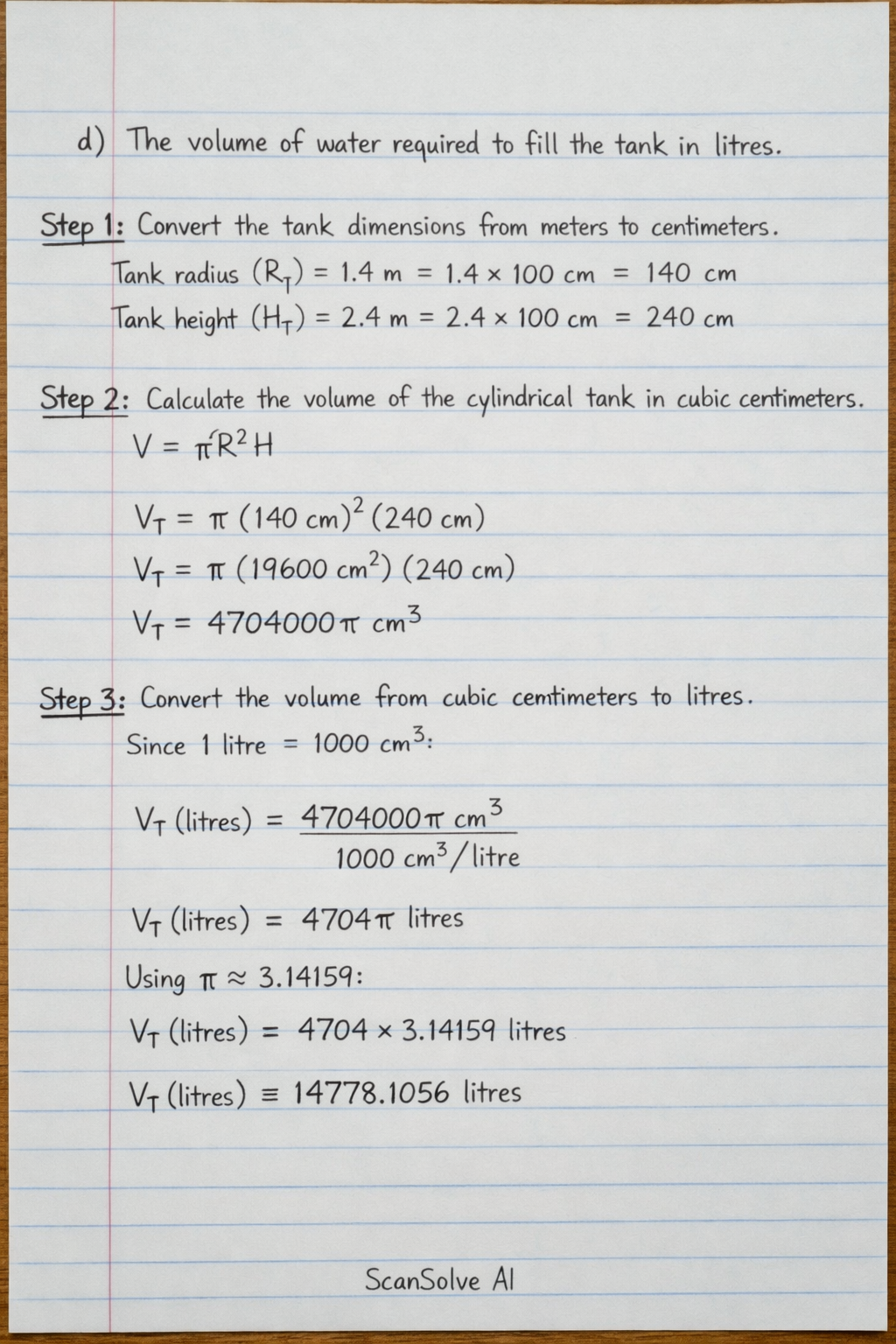
The volume of water required to fill the tank in litres.

  1. Convert the tank dimensions from meters to centimeters.

    Tank radius (RTR_T) = 1.4 m=1.4×100 cm=140 cm1.4 \text{ m} = 1.4 \times 100 \text{ cm} = 140 \text{ cm}
    Tank height (HTH_T) = 2.4 m=2.4×100 cm=240 cm2.4 \text{ m} = 2.4 \times 100 \text{ cm} = 240 \text{ cm}

  2. Calculate the volume of the cylindrical tank in cubic centimeters.

    The formula for the volume of a cylinder is V=πR2HV = \pi R^2 H.

    VT=π(140 cm)2(240 cm)V_T = \pi (140 \text{ cm})^2 (240 \text{ cm}) VT=π(19600 cm2)(240 cm)V_T = \pi (19600 \text{ cm}^2) (240 \text{ cm}) VT=4704000π cm3V_T = 4704000 \pi \text{ cm}^3
  3. Convert the volume from cubic centimeters to litres.

    Since 1 litre=1000 cm31 \text{ litre} = 1000 \text{ cm}^3:

    VT(litres)=4704000π cm31000 cm3/litreV_T (\text{litres}) = \frac{4704000 \pi \text{ cm}^3}{1000 \text{ cm}^3/\text{litre}} VT(litres)=4704π litresV_T (\text{litres}) = 4704 \pi \text{ litres}

    Using π≈3.14159\pi \approx 3.14159:

    VT(litres)≈4704×3.14159 litresV_T (\text{litres}) \approx 4704 \times 3.14159 \text{ litres} VT(litres)≈14778.1056 litresV_T (\text{litres}) \approx 14778.1056 \text{ litres}
  4. Round the answer to one decimal place.

    VT≈14778.1 litresV_T \approx 14778.1 \text{ litres}

    The volume of water required to fill the tank is 14778.1 litres\boxed{\text{14778.1 litres}}.

Part e

6000\text{6000}

Calculate the number of buckets that must be drawn to fill the tank.

  1. Calculate the volume of one bucket (frustum) in cubic centimeters.

    The formula for the volume of a frustum is Vf=13πhf(R2+Rr+r2)V_f = \frac{1}{3} \pi h_f (R^2 + Rr + r^2).
    Bucket depth (hfh_f) = 12 cm
    Top radius (RR) = 10 cm
    Bottom radius (rr) = 6 cm

    VB=13π(12 cm)((10 cm)2+(10 cm)(6 cm)+(6 cm)2)V_B = \frac{1}{3} \pi (12 \text{ cm}) ((10 \text{ cm})^2 + (10 \text{ cm})(6 \text{ cm}) + (6 \text{ cm})^2) VB=4π cm(100 cm2+60 cm2+36 cm2)V_B = 4 \pi \text{ cm} (100 \text{ cm}^2 + 60 \text{ cm}^2 + 36 \text{ cm}^2) VB=4π cm(196 cm2)V_B = 4 \pi \text{ cm} (196 \text{ cm}^2) VB=784π cm3V_B = 784 \pi \text{ cm}^3
  2. Calculate the number of buckets required by dividing the total tank volume by the volume of one bucket.

    N=Volume of tankVolume of one bucketN = \frac{\text{Volume of tank}}{\text{Volume of one bucket}} N=4704000π cm3784π cm3N = \frac{4704000 \pi \text{ cm}^3}{784 \pi \text{ cm}^3}

    The π\pi terms cancel out:

    N=4704000784N = \frac{4704000}{784} N=6000N = 6000

    The number of buckets that must be drawn to fill the tank is 6000\boxed{\text{6000}}.

Was this helpful?

Try one yourself

A new problem that tests the same skill.

Still stuck on this one?

Ask a follow-up, and the answer starts from this question.

Got a different question?Ask your own question
Handwritten step-by-step solution preview

Handwritten Step-by-Step Solution

Get this as a handwritten image on WhatsApp — like a tutor wrote it for you.

Try on WhatsApp