
We read your photo as:
A die was rolled a number of times. The outcomes are: Number 1 2 3 4 Outcomes 30 26 20 23
ScanSolve AI Answer
Step-by-step solution
32 stepsHere are the solutions to the problems from the image.
:
A die was rolled a number of times. The outcomes are:
| Outcomes | 1 | 2 | 3 | 4 | 5 | 6 |
|---|---|---|---|---|---|---|
| Number | 30 | 26 | 20 | K | 23 | 24 |
Part i· 3 steps
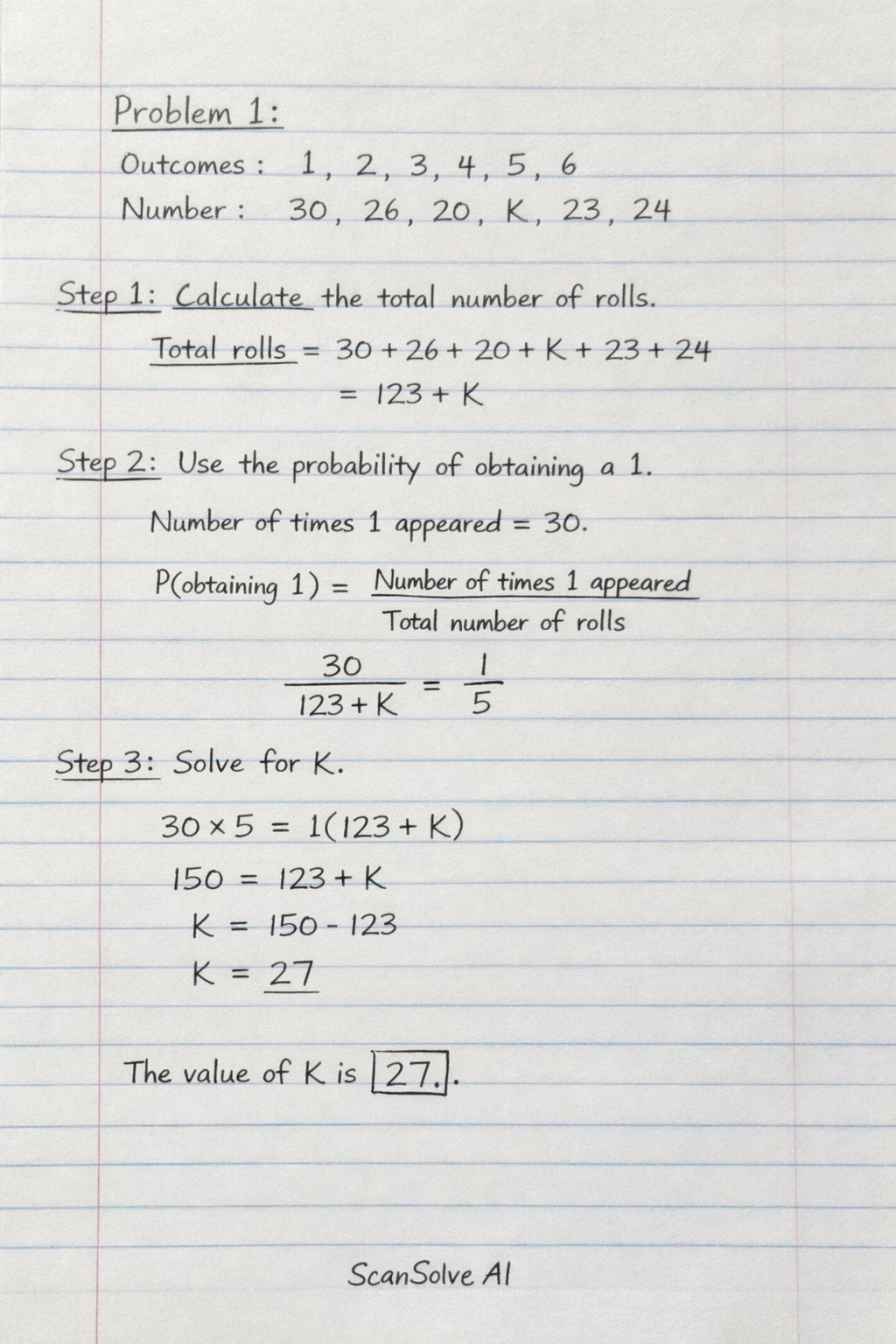
If the probability of obtaining a 1 is , find the value of K.
Calculate the total number of rolls in terms of K.
Total rolls = .
Use the given probability of obtaining a 1.
The number of times 1 was obtained is 30.
Solve for K.
The value of K is .
Part ii· 5 steps
The probability of obtaining an even number or a factor of 6.
Using , the total number of rolls is .
Identify the frequencies of even numbers.
Even numbers are 2, 4, 6.
Frequency of 2 = 26
Frequency of 4 = K = 27
Frequency of 6 = 24
Number of even outcomes = .Identify the frequencies of factors of 6.
Factors of 6 are 1, 2, 3, 6.
Frequency of 1 = 30
Frequency of 2 = 26
Frequency of 3 = 20
Frequency of 6 = 24
Number of factor of 6 outcomes = .Identify the frequencies of outcomes that are both even and a factor of 6.
These are 2 and 6.
Number of (even AND factor of 6) outcomes = .Calculate the number of outcomes that are even OR a factor of 6.
Calculate the probability.
The probability is .
Part b· 24 steps
Solve:
Find the least common multiple (LCM) of the denominators (6, 3, 5), which is 30.
Multiply the entire inequality by 30.
Simplify each term.
Distribute and expand the terms.
Combine like terms on each side.
Move terms with to one side and constants to the other.
Divide by 27.
The solution is .
:
In the diagram, TU is a tangent to the circle. , and . Find the value of .
(Assuming the points Z, S, V, U are on the circle, and R is also on the circle, forming a cyclic pentagon ZSVRU. The angle is interpreted as .)Identify angles subtended by the same arc.
Given . This angle is subtended by arc ZV at point U on the circumference.
Therefore, the angle subtended by the same arc ZV at point S on the circumference is also .Apply the Alternate Segment Theorem.
The angle between the tangent TU and the chord UV is . This angle is equal to the angle subtended by the chord UV in the alternate segment, which is .
So, .Use the given angle .
Since Z, S, V, R, U are points on the circle, is an angle subtended by arc RU at V.
Therefore, (angles subtended by the same arc RU).Find .
We know .
We can write .
However, we need . We have .
We also know .
From the diagram, it appears that Z, S, V, R are consecutive points on the circle.
If and .
We need .
From the diagram, (This is not correct).
Let's use the tangent-chord theorem for .
.
We have .
We know .
We know .
From the diagram, . This is incorrect. is the angle between tangent TU and chord UV.
is the angle between tangent TU and chord UZ.
is an angle inside the circle.Let's re-evaluate the interpretation of . It is likely .
We have .
We have .
From the diagram, it looks like Z, S, V, R are in order around the circle.
Then .
We need .
By the alternate segment theorem, .
We know .
We know .
The angle is the angle between the tangent TU and the chord UV.
The angle is the angle between the tangent TU and the chord UZ.
The angle is not directly given.Let's assume the angle is .
If Z, R, V, U are points on the circle, then .
So . So ZRVU is not a cyclic quadrilateral.Let's assume the angle is . This is the angle between the tangent TU and the chord UV.
If , then by the alternate segment theorem, .
We are given .
Since Z, S, V, U are on the circle, .
We need to find .
.This interpretation seems plausible. Let's assume means .
Identify the angle in the alternate segment.
Given that TU is a tangent at U, and UV is a chord. The angle between the tangent and the chord, , is equal to the angle subtended by the chord in the alternate segment, .
From the problem statement, . Given the diagram, this is most likely referring to (the angle between the tangent and the chord UV).
So, .Identify angles subtended by the same arc.
Given . This angle is subtended by arc ZV at point U on the circumference.
The angle subtended by the same arc ZV at point S on the circumference is .
Therefore, .Calculate .
From the diagram, .
The value of (interpreted as ) is .
:
Given that , 9, are consecutive terms of a Geometric Progression with common ratio . Find the values of x.Use the property of a Geometric Progression (GP).
In a GP, the ratio of consecutive terms is constant. So, .
Cross-multiply to form an equation.
Rearrange the equation into a standard quadratic form .
Solve the quadratic equation using the quadratic formula .
Here, , , .
Find the two possible values for x.
Check the common ratio for each value of x, ensuring .
For :
The terms are , 9, .
Terms are , 9, .
Terms are .
The common ratio . Since , is a valid solution.
For :
The terms are , 9, .
Terms are , 9, .
Terms are .
The common ratio . Since , is also a valid solution.
The problem asks for "the values of x", implying both are valid.The values of x are .
:
Two positive numbers are in the ratio 3:4. The sum of thrice the first number and twice the second is 68. Find the smaller number.Represent the two numbers using the given ratio.
Let the two positive numbers be and , where is a positive constant.
The first number is . The second number is .Form an equation based on the sum of thrice the first and twice the second number.
Thrice the first number = .
Twice the second number = .
The sum is 68:Solve for .
Find the two numbers.
First number = .
Second number = .Identify the smaller number.
The smaller number is 12.
The smaller number is .
Still stuck on this one?
Ask a follow-up, and the answer starts from this question.
More Mathematics Questions
Handwritten Step-by-Step Solution
Get this as a handwritten image on WhatsApp — like a tutor wrote it for you.
Try on WhatsApp