

This mathematics problem involves applying core mathematical principles and formulas. Below you will find a complete step-by-step solution with detailed explanations for each step, helping you understand not just the answer but the method behind it.
ScanSolve AI Answer
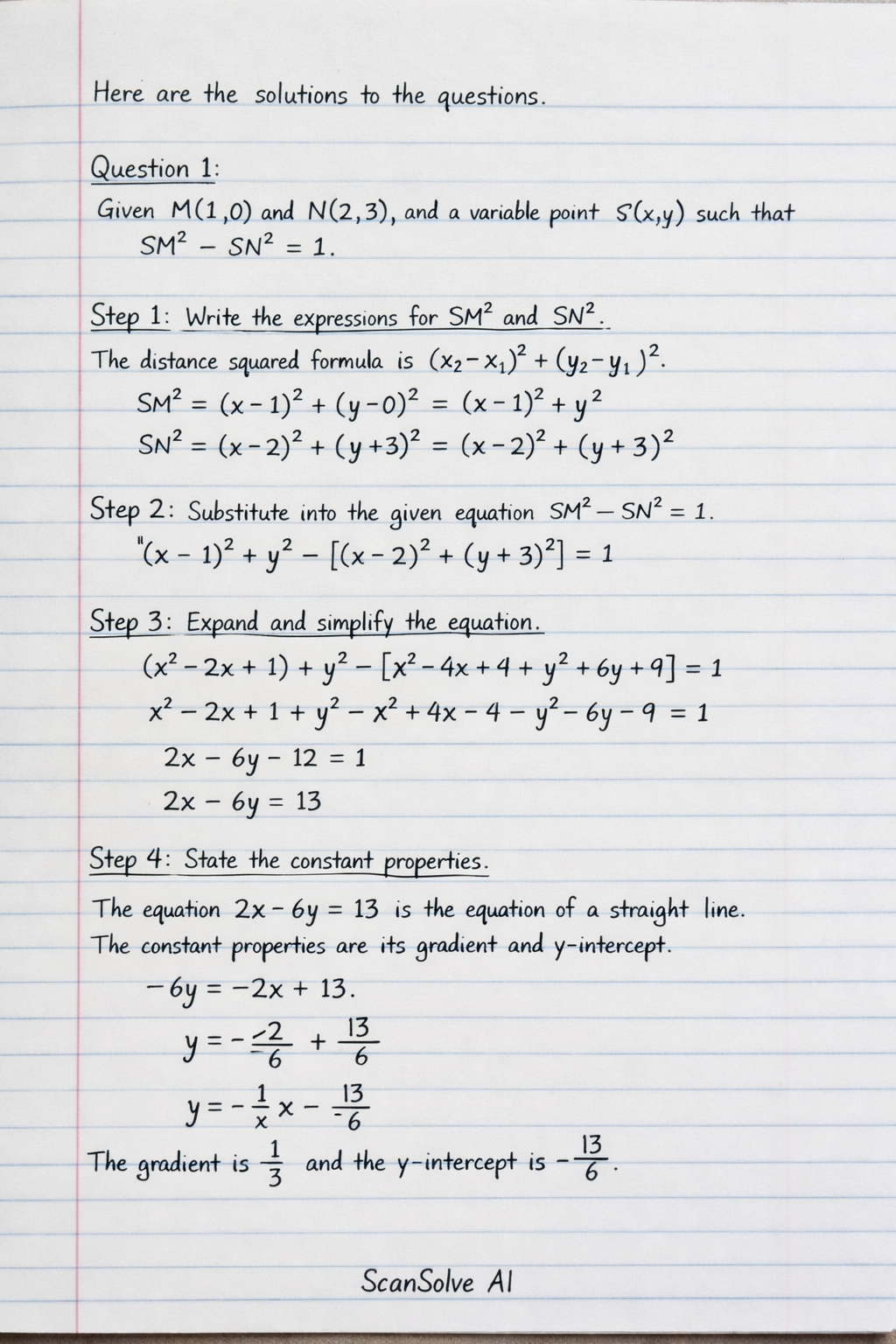
Here are the solutions to the questions. Question 1: Given M(1,0) and N(2,-3), and a variable point S(x,y) such that SM^2 - SN^2 = 1. Step 1: Write the expressions for SM^2 and SN^2. The distance squared formula between two points (x_1, y_1) and (x_2, y_2) is (x_2-x_1)^2 + (y_2-y_1)^2. SM^2 = (x-1)^2 + (y-0)^2 = (x-1)^2 + y^2 SN^2 = (x-2)^2 + (y-(-3))^2 = (x-2)^2 + (y+3)^2 Step 2: Substitute into the given equation SM^2 - SN^2 = 1. (x-1)^2 + y^2 - [(x-2)^2 + (y+3)^2] = 1 Step 3: Expand and simplify the equation. (x^2 - 2x + 1) + y^2 - [(x^2 - 4x + 4) + (y^2 + 6y + 9)] = 1 x^2 - 2x + 1 + y^2 - x^2 + 4x - 4 - y^2 - 6y - 9 = 1 2x - 6y - 12 = 1 2x - 6y = 13 Step 4: State the constant properties. The equation 2x - 6y = 13 is the equation of a straight line. The constant properties are its gradient and y-intercept. Rearrange to slope-intercept form y = mx + c: -6y = -2x + 13 y = (-2)/(-6)x + (13)/(-6) y = (1)/(3)x - (13)/(6) The gradient is (1)/(3) and the y-intercept is -(13)/(6). The equation of the locus of S is 2x - 6y = 13. Its constant properties are: gradient m = (1)/(3) and y-intercept c = -(13)/(6). Question 2: Find the points in which the locus 2x - 6y = 13 meets the y-axis. Step 1: To find where the locus meets the y-axis, set x=0. 2(0) - 6y = 13 Step 2: Solve for y. -6y = 13 y = -(13)/(6) The point where the locus meets the y-axis is (0, -(13)/(6)). The locus meets the y-axis at (0, -(13)/(6)). Question 3: Find the equation of the tangent to the parabola 3y^2 = 16x at (3,4). Step 1: Differentiate the equation of the parabola implicitly with respect to x. 3y^2 = 16x (d)/(dx)(3y^2) = (d)/(dx)(16x) 6y (dy)/(dx) = 16 (dy)/(dx) = (16)/(6y) = (8)/(3y) Step 2: Evaluate (dy)/(dx) at the point (3,4) to find the gradient of the tangent. At (3,4), y=4. m = (dy)/(dx)|_(3,4) = (8)/(3(4)) = (8)/(12) = (2)/(3) Step 3: Use the point-slope form of a line y - y_1 = m(x - x_1). Using the point (x_1, y_1) = (3,4) and gradient m = (2)/(3): y - 4 = (2)/(3)(x - 3) 3(y - 4) = 2(x - 3) 3y - 12 = 2x - 6 3y = 2x + 6 2x - 3y + 6 = 0 The equation of the tangent is 2x - 3y + 6 = 0. Question 4: Obtain from first principles, the derivative of f(x) = sqrt(x). Step 1: Write the definition of the derivative from first principles. f'(x) = _h 0 (f(x+h) - f(x))/(h) Step 2: Substitute f(x) = sqrt(x) into the formula. f'(x) = _h 0 sqrt(x+h) - sqrt(x)h Step 3: Rationalize the numerator by multiplying by the conjugate. f'(x) = _h 0 sqrt(x+h) - sqrt(x)h × sqrt(x+h) + sqrt(x)sqrt(x+h) + sqrt(x) f'(x) = _h 0 ((x+h) - x)/(h(sqrt(x+h) + x)) f'(x) = _h 0 (h)/(h(sqrt(x+h) + x)) Step 4: Simplify and evaluate the limit. f'(x) = _h 0 (1)/(sqrt(x+h) + x) f'(x) = (1)/(sqrt(x+0) + x) f'(x) = (1)/(sqrt(x) + x) f'(x) = (1)/(2sqrt(x)) The derivative of f(x) = sqrt(x) from first principles is (1)/(2sqrt(x)). Question 5: Given y = (x-2)(2x^2 - 3x - 5), find (dy)/(dx). Step 1: Expand the expression for y. y = (x-2)(2x^2 - 3x - 5) y = x(2x^2 - 3x - 5) - 2(2x^2 - 3x - 5) y = 2x^3 - 3x^2 - 5x - 4x^2 + 6x + 10 y = 2x^3 - 7x^2 + x + 10 Step 2: Differentiate y with respect to x. (dy)/(dx) = (d)/(dx)(2x^3 - 7x^2 + x + 10) (dy)/(dx) = 2(3x^3-1) - 7(2x^2-1) + 1x^1-1 + 0 (dy)/(dx) = 6x^2 - 14x + 1 The gradient (dy)/(dx) is 6x^2 - 14x + 1. That's 2 down. 3 left today — send the next one.