
We read your photo as:
A) Explain the criteria used in selecting survey lines and offsets. b) State the limitations on the length of survey lines and offsets. (20 Marks)
Mathematics
ScanSolve AI Answer
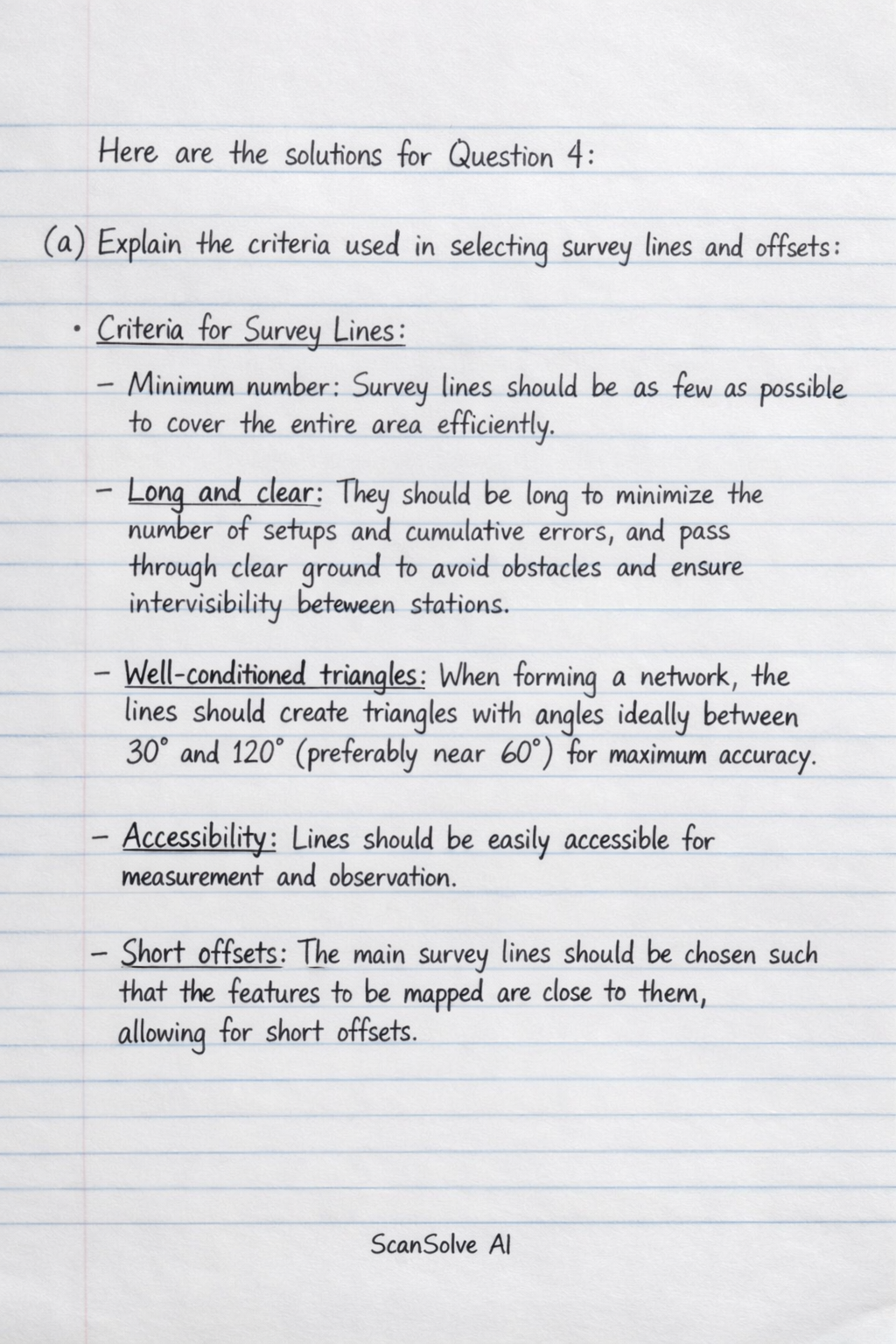
a) Explain the criteria used in selecting survey lines and offsets.
-
Criteria for Survey Lines:
- Minimum number: Survey lines should be as few as possible to cover the entire area efficiently.
- Long and clear: They should be long to minimize the number of setups and cumulative errors, and pass through clear ground to avoid obstacles and ensure intervisibility between stations.
- Well-conditioned triangles: When forming a network, the lines should create triangles with angles ideally between and (preferably near ) for maximum accuracy.
- Accessibility: Lines should be easily accessible for measurement and observation.
- Short offsets: The main survey lines should be chosen such that the features to be mapped are close to them, allowing for short offsets.
-
Criteria for Offsets:
- Perpendicularity: Offsets must be measured strictly perpendicular to the main survey line to ensure accurate plotting.
- Short length: Offsets should be as short as possible to minimize errors in both setting out the perpendicular and measuring the length.
- Key features: Offsets should be taken to all important features that need to be located and mapped.
- Regular intervals: For linear features, offsets should be taken at regular intervals, as well as at points where the feature changes direction.
b) State the limitations on the length of survey lines and offsets.
-
Limitations on Survey Lines:
- Maximum length: Limited by the visibility of stations, the accuracy required, and the terrain. Very long lines can be difficult to measure accurately due to sag, atmospheric conditions, and the accumulation of small errors. For chain surveying, lines are typically limited to a few hundred meters (e.g., 150-300m).
- Minimum length: Lines should not be too short, as short lines can lead to significant angular errors in triangulation and increase the number of setups, which can introduce more errors.
-
Limitations on Offsets:
- Maximum length: Primarily limited by the accuracy of perpendicularity and the precision of measurement. Longer offsets make it harder to ensure they are truly perpendicular to the main line, and small angular errors can lead to significant positional errors. Typically, offsets should not exceed 15-20 meters for ordinary chain surveying.
- Minimum length: While there isn't a strict minimum, very short offsets might be impractical or unnecessary if the feature is extremely close to the main line.
Was this helpful?
Still stuck on this one?
Ask a follow-up, and the answer starts from this question.
Got a different question?Ask your own question
More Mathematics Questions
QA) Explain the concept of Photogrammetry b) Describe Three (3) processes of surveying c) Explain…QSECTION A (10 Marks) Answer all questions in this section. For each of the following questions, work…QA) What are two units used for area measurement? b) What are two types of surface areas in land…QDifferentiate between the following measuring tools: a) Voltmeters and ammeters b) Inside Calipers…QA surveyor is measuring distances on a map. If the scale is 1 cm : 250 m, what are the scale drawing…
Handwritten Step-by-Step Solution
Get this as a handwritten image on WhatsApp — like a tutor wrote it for you.
Try on WhatsApp