

This mathematics problem involves applying core mathematical principles and formulas. Below you will find a complete step-by-step solution with detailed explanations for each step, helping you understand not just the answer but the method behind it.
ScanSolve AI Answer
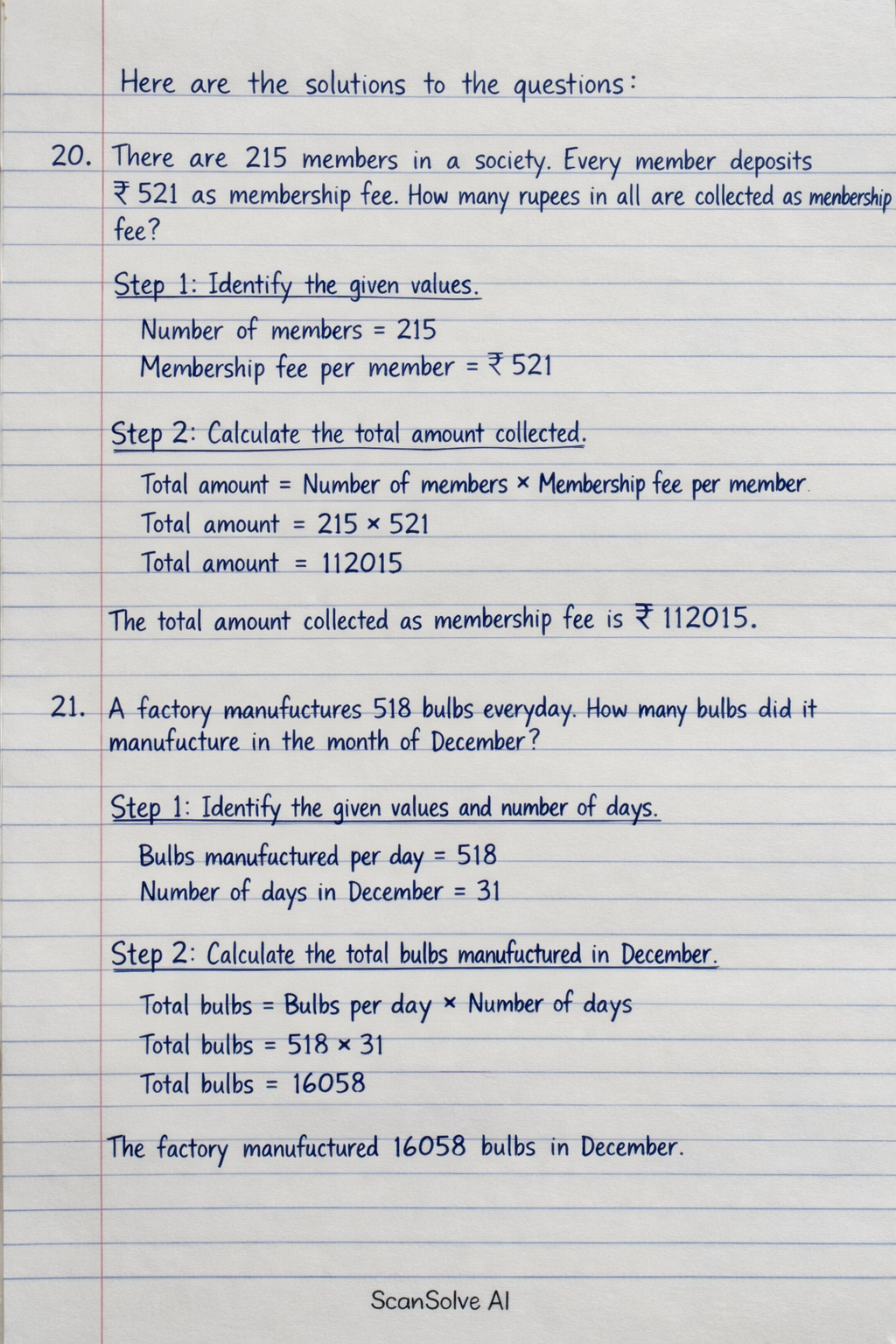
Here are the solutions to the questions: 20. There are 215 members in a society. Every member deposits ₹ 521 as membership fee. How many rupees in all are collected as membership fee? Step 1: Identify the given values. Number of members = 215 Membership fee per member = ₹ 521 Step 2: Calculate the total amount collected. Total amount = Number of members × Membership fee per member Total amount = 215 × 521 Total amount = 112015 The total amount collected as membership fee is ₹ 112015. 21. A factory manufactures 518 bulbs everyday. How many bulbs did it manufacture in the month of December? Step 1: Identify the given values and number of days. Bulbs manufactured per day = 518 Number of days in December = 31 Step 2: Calculate the total bulbs manufactured in December. Total bulbs = Bulbs per day × Number of days Total bulbs = 518 × 31 Total bulbs = 16058 The factory manufactured 16058 bulbs in December. 22. 7429 books are to be arranged on 17 shelves. If the number of books placed on each shelf is the same, how many books will be placed on each shelf? Step 1: Identify the given values. Total number of books = 7429 Number of shelves = 17 Step 2: Calculate the number of books per shelf. Books per shelf = Total books ÷ Number of shelves Books per shelf = 7429 ÷ 17 Books per shelf = 437 There will be 437 books placed on each shelf. 23. 816 students of a school go on picnic by buses. Each bus carries 48 students. How many buses are used to carry the students on picnic? Step 1: Identify the given values. Total number of students = 816 Capacity of each bus = 48 students Step 2: Calculate the number of buses needed. Number of buses = Total students ÷ Capacity per bus Number of buses = 816 ÷ 48 Number of buses = 17 17 buses are used to carry the students on the picnic. 24. There are 1887 trees in 17 rows in a garden. If the number of trees is the same in each row, how many trees are there in one row? Step 1: Identify the given values. Total number of trees = 1887 Number of rows = 17 Step 2: Calculate the number of trees per row. Trees per row = Total trees ÷ Number of rows Trees per row = 1887 ÷ 17 Trees per row = 111 There are 111 trees in one row. 25. The cost of 15 copies is ₹ 210. What is the cost of one dozen copies? Step 1: Find the cost of one copy. Cost of 1 copy = Total cost ÷ Number of copies Cost of 1 copy = 210 ÷ 15 Cost of 1 copy = ₹ 14 Step 2: Calculate the cost of one dozen copies. One dozen = 12 copies Cost of 12 copies = Cost of 1 copy × 12 Cost of 12 copies = 14 × 12 Cost of 12 copies = ₹ 168 The cost of one dozen copies is ₹ 168. 26. There are 12 dozen bottles in 6 crates. How many bottles will be in 8 crates? Step 1: Calculate the total number of bottles in 6 crates. 1 dozen = 12 bottles Total bottles in 6 crates = 12 dozen × 12 bottles/dozen Total bottles in 6 crates = 12 × 12 = 144 bottles Step 2: Find the number of bottles per crate. Bottles per crate = Total bottles ÷ Number of crates Bottles per crate = 144 ÷ 6 Bottles per crate = 24 bottles Step 3: Calculate the number of bottles in 8 crates. Bottles in 8 crates = Bottles per crate × 8 Bottles in 8 crates = 24 × 8 Bottles in 8 crates = 192 bottles There will be 192 bottles in 8 crates. 27. A car consumes 5 litres of petrol in running 95 kilometres. How many kilometres will it run if it consumes 12 litres? Step 1: Find the distance covered per litre of petrol. Distance per litre = Total distance ÷ Litres consumed Distance per litre = 95 ÷ 5 Distance per litre = 19 km/litre Step 2: Calculate the distance covered with 12 litres. Distance with 12 litres = Distance per litre × 12 Distance with 12 litres = 19 × 12 Distance with 12 litres = 228 km The car will run 228 kilometres if it consumes 12 litres of petrol. 28. Write first four multiples of: i. 5: 5 × 1 = 5 5 × 2 = 10 5 × 3 = 15 5 × 4 = 20 The first four multiples of 5 are 5, 10, 15, 20. ii. 6: 6 × 1 = 6 6 × 2 = 12 6 × 3 = 18 6 × 4 = 24 The first four multiples of 6 are 6, 12, 18, 24. iii. 4: 4 × 1 = 4 4 × 2 = 8 4 × 3 = 12 4 × 4 = 16 The first four multiples of 4 are 4, 8, 12, 16. iv. 3: 3 × 1 = 3 3 × 2 = 6 3 × 3 = 9 3 × 4 = 12 The first four multiples of 3 are 3, 6, 9, 12. v. 10: 10 × 1 = 10 10 × 2 = 20 10 × 3 = 30 10 × 4 = 40 The first four multiples of 10 are 10, 20, 30, 40. vi. 12: 12 × 1 = 12 12 × 2 = 24 12 × 3 = 36 12 × 4 = 48 The first four multiples of 12 are 12, 24, 36, 48. 29. Write all the factors of: i. 8: Factors of 8 are numbers that divide 8 evenly. 1 × 8 = 8 2 × 4 = 8 The factors of 8 are 1, 2, 4, 8. ii. 12: Factors of 12 are numbers that divide 12 evenly. 1 × 12 = 12 2 × 6 = 12 3 × 4 = 12 The factors of 12 are 1, 2, 3, 4, 6, 12. iii. 36: Factors of 36 are numbers that divide 36 evenly. 1 × 36 = 36 2 × 18 = 36 3 × 12 = 36 4 × 9 = 36 6 × 6 = 36 The factors of 36 are $1, 2, 3, 4, 6, 9, 1