

This mathematics problem involves applying core mathematical principles and formulas. Below you will find a complete step-by-step solution with detailed explanations for each step, helping you understand not just the answer but the method behind it.
ScanSolve AI Answer
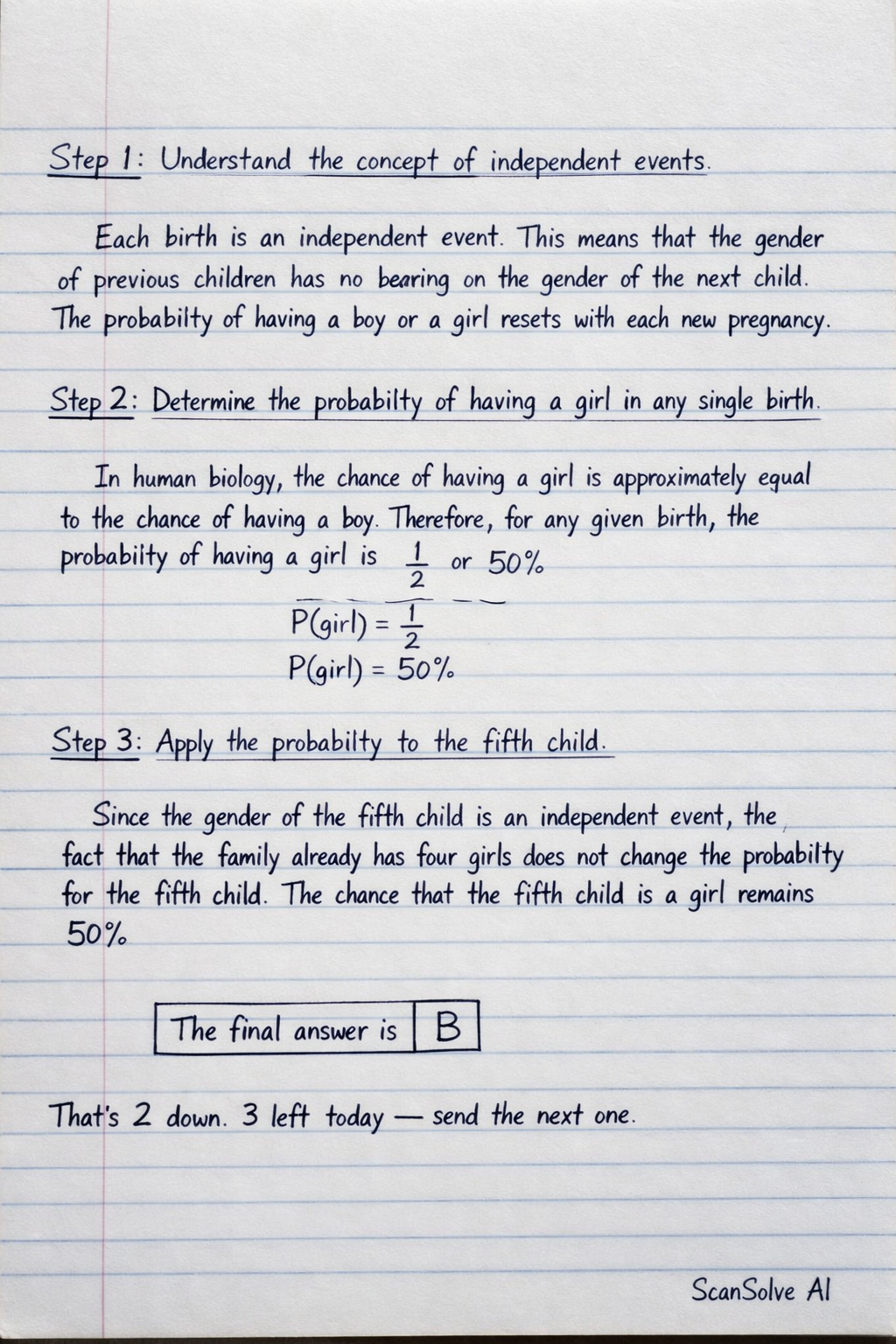
Step 1: Understand the concept of independent events. Each birth is an independent event. This means that the gender of previous children has no bearing on the gender of the next child. The probability of having a boy or a girl resets with each new pregnancy. Step 2: Determine the probability of having a girl in any single birth. In human biology, the chance of having a girl is approximately equal to the chance of having a boy. Therefore, for any given birth, the probability of having a girl is (1)/(2) or 50\%. Step 3: Apply the probability to the fifth child. Since the gender of the fifth child is an independent event, the fact that the family already has four girls does not change the probability for the fifth child. The chance that the fifth child is a girl remains 50\%. The final answer is B That's 2 down. 3 left today — send the next one.