
We read your photo as:
A father left Ksh. 995 for his 8 grandchildren. How much did each grandchild get if the money was divided equally?
ScanSolve AI Answer
Step-by-step solution
21 stepsRound the amount of money to the nearest ten.
Ksh. 995 rounded to the nearest ten is Ksh. 1000.
Round the number of grandchildren to the nearest ten.
8 grandchildren rounded to the nearest ten is 10 grandchildren.
Divide the rounded money by the rounded number of grandchildren.
Each grandchild would get Ksh. 100.
The amount each grandchild got is .
Perform multiplication first according to DMAS (Division, Multiplication, Addition, Subtraction).
Perform addition and subtraction from left to right.
The result is .
- To find an equivalent fraction for , multiply the numerator and denominator by the same non-zero number. Let's multiply by 2.
An equivalent fraction is .
- To find an equivalent fraction for , multiply the numerator and denominator by the same non-zero number. Let's multiply by 2.
An equivalent fraction is .
- To find the simplest form of , divide both the numerator and the denominator by their greatest common divisor (GCD). The GCD of 8 and 16 is 8.
The simplest form is .
Find the fraction of girls.
The total fraction of students is 1.
Fraction of boys = .
Fraction of girls = .Simplify the fraction of girls.
To simplify , divide both the numerator and the denominator by their greatest common divisor (GCD). The GCD of 26 and 50 is 2.
The fraction of girls in its simplest form is .
Compare the fractions for avocados and mangoes.
Avocados:
Mangoes:Find a common denominator to compare the fractions.
The least common multiple (LCM) of 5 and 7 is 35.
Convert :Convert :
Compare the equivalent fractions.
Since , avocados are more than mangoes.
The fruits that are more are avocados.
List the fractions
.
Find a common denominator for all fractions.
The least common multiple (LCM) of 3, 6, 2, and 8 is 24.
Convert each fraction to an equivalent fraction with a denominator of 24.
Arrange the fractions from largest to smallest based on their numerators.
The numerators are 16, 4, 12, 3.
In descending order: 16, 12, 4, 3.Write the original fractions in order from largest to smallest.
List the portions of work done by each learner
John:
Agnes:
Patel:
Otieno:Simplify any fractions if possible.
Patel: .
Find a common denominator for the fractions
.
The least common multiple (LCM) of 8, 12, and 3 is 24.Convert each fraction to an equivalent fraction with a denominator of 24.
John:
Agnes:
Patel:
Otieno:Arrange the fractions from smallest to largest based on their numerators.
The numerators are 9, 14, 16, 10.
In ascending order: 9, 10, 14, 16.Write the learners' names with their original fractions in order from smallest to largest.
Still stuck on this one?
Ask a follow-up, and the answer starts from this question.
More Mathematics Questions
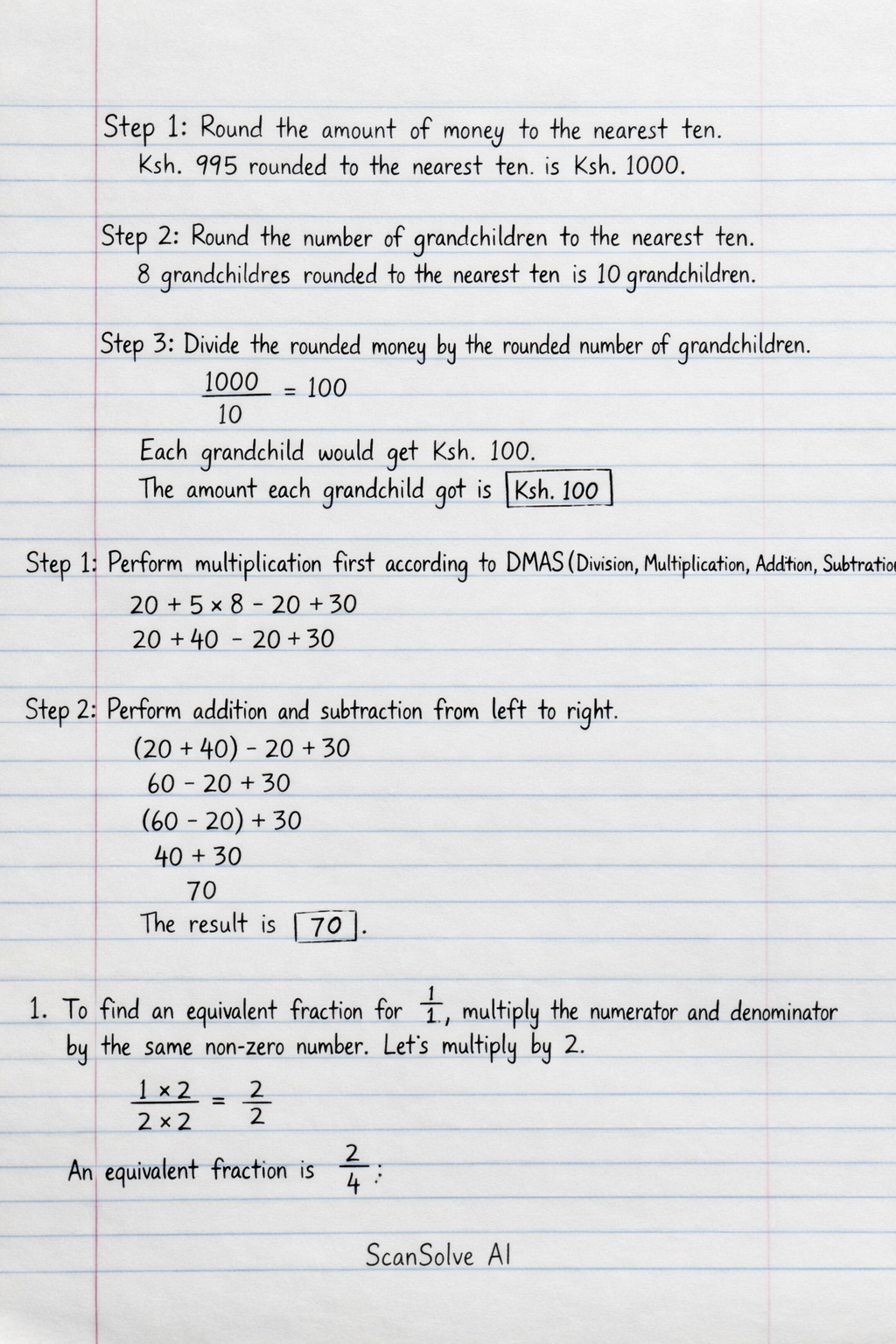
Handwritten Step-by-Step Solution
Get this as a handwritten image on WhatsApp — like a tutor wrote it for you.
Try on WhatsApp