We read your photo as:

A) Find the coordinates of D. b) Find the value of x in the diagram.

Mathematics

ScanSolve AI Answer

Answers

4 parts
a
(-3, 2)
b
80
c
28
d

m=a−ttb+1m = \frac{a - t}{tb + 1}

Step-by-step solution

15 steps

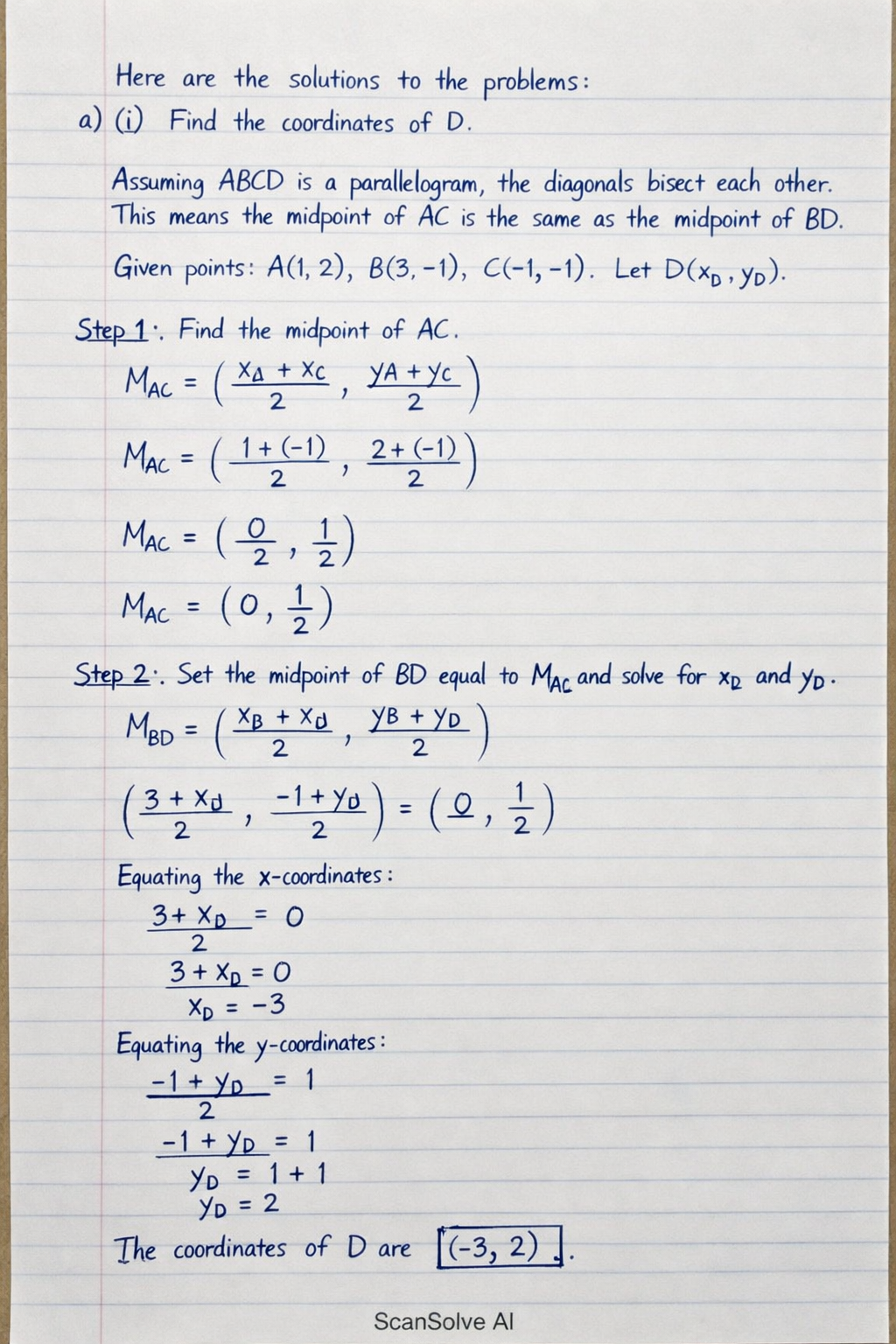
Here are the solutions to the problems:

Part a· 2 steps

(i) Find the coordinates of D

Assuming ABCD is a parallelogram, the diagonals bisect each other. This means the midpoint of AC is the same as the midpoint of BD.
Given points: A(1,2)A(1,2), B(3,−1)B(3,-1), C(−1,−1)C(-1,-1). Let D(xD,yD)D(x_D, y_D).

  1. Find the midpoint of AC.

    MAC=(xA+xC2,yA+yC2)M_{AC} = \left(\frac{x_A + x_C}{2}, \frac{y_A + y_C}{2}\right) MAC=(1+(−1)2,2+(−1)2)M_{AC} = \left(\frac{1 + (-1)}{2}, \frac{2 + (-1)}{2}\right) MAC=(02,12)M_{AC} = \left(\frac{0}{2}, \frac{1}{2}\right) MAC=(0,12)M_{AC} = \left(0, \frac{1}{2}\right)
  2. Set the midpoint of BD equal to MACM_{AC} and solve for xDx_D and yDy_D.

    MBD=(xB+xD2,yB+yD2)M_{BD} = \left(\frac{x_B + x_D}{2}, \frac{y_B + y_D}{2}\right) (3+xD2,−1+yD2)=(0,12)\left(\frac{3 + x_D}{2}, \frac{-1 + y_D}{2}\right) = \left(0, \frac{1}{2}\right)

    Equating the x-coordinates:

    3+xD2=0\frac{3 + x_D}{2} = 0 3+xD=03 + x_D = 0 xD=−3x_D = -3

    Equating the y-coordinates:

    −1+yD2=12\frac{-1 + y_D}{2} = \frac{1}{2} −1+yD=1-1 + y_D = 1 yD=1+1y_D = 1 + 1 yD=2y_D = 2

    The coordinates of D are (−3,2)\boxed{(-3, 2)}.

Part b80

Find the value of x in the diagram

The diagram shows a triangle with an exterior angle at P and two remote interior angles at Q and R. According to the Exterior Angle Theorem, the measure of an exterior angle of a triangle is equal to the sum of the measures of its two remote interior angles.

  1. Set up the equation based on the Exterior Angle Theorem.

    The exterior angle at P is 3x−18∘3x - 18^\circ.
    The remote interior angle at Q is 52∘52^\circ.
    The remote interior angle at R is 2x+10∘2x + 10^\circ.

    3x−18=52+(2x+10)3x - 18 = 52 + (2x + 10)
  2. Simplify the equation.

    3x−18=2x+623x - 18 = 2x + 62
  3. Solve for x.

    3x−2x=62+183x - 2x = 62 + 18 x=80x = 80

    The value of x is 80\boxed{80}.

Part c28

Simplify (35+112)÷14×313\left(\frac{3}{5} + 1\frac{1}{2}\right) \div \frac{1}{4} \times 3\frac{1}{3}

  1. Convert mixed numbers to improper fractions.

    112=1×2+12=321\frac{1}{2} = \frac{1 \times 2 + 1}{2} = \frac{3}{2} 313=3×3+13=1033\frac{1}{3} = \frac{3 \times 3 + 1}{3} = \frac{10}{3}

    The expression becomes:

    (35+32)÷14×103\left(\frac{3}{5} + \frac{3}{2}\right) \div \frac{1}{4} \times \frac{10}{3}
  2. Perform the addition inside the parentheses.

    Find a common denominator for 35\frac{3}{5} and 32\frac{3}{2}, which is 10.

    35+32=3×25×2+3×52×5=610+1510=2110\frac{3}{5} + \frac{3}{2} = \frac{3 \times 2}{5 \times 2} + \frac{3 \times 5}{2 \times 5} = \frac{6}{10} + \frac{15}{10} = \frac{21}{10}

    The expression is now:

    2110÷14×103\frac{21}{10} \div \frac{1}{4} \times \frac{10}{3}
  3. Perform division and multiplication from left to right.

    First, the division. To divide by a fraction, multiply by its reciprocal.

    2110÷14=2110×41=8410=425\frac{21}{10} \div \frac{1}{4} = \frac{21}{10} \times \frac{4}{1} = \frac{84}{10} = \frac{42}{5}

    The expression is now:

    425×103\frac{42}{5} \times \frac{10}{3}
  4. Perform the multiplication.

    425×103=42×105×3=42015\frac{42}{5} \times \frac{10}{3} = \frac{42 \times 10}{5 \times 3} = \frac{420}{15}
  5. Simplify the fraction.

    42015=843=28\frac{420}{15} = \frac{84}{3} = 28

    The simplified value is 28\boxed{28}.

Part d

m=a−ttb+1m = \frac{a - t}{tb + 1}

(i) Make m the subject of the formula t=a−m1+bmt = \frac{a - m}{1 + bm}

  1. Multiply both sides by (1+bm)(1 + bm) to eliminate the denominator.

    t(1+bm)=a−mt(1 + bm) = a - m
  2. Distribute tt on the left side.

    t+tbm=a−mt + tbm = a - m
  3. Gather all terms containing mm on one side and terms without mm on the other side.

    tbm+m=a−ttbm + m = a - t
  4. Factor out mm from the terms on the left side.

    m(tb+1)=a−tm(tb + 1) = a - t
  5. Divide both sides by (tb+1)(tb + 1) to isolate mm.

    m=a−ttb+1m = \frac{a - t}{tb + 1}

    The formula with m as the subject is m=a−ttb+1\boxed{m = \frac{a - t}{tb + 1}}.

Was this helpful?

Try one yourself

A new problem that tests the same skill.

Still stuck on this one?

Ask a follow-up, and the answer starts from this question.

Got a different question?Ask your own question
Handwritten step-by-step solution preview

Handwritten Step-by-Step Solution

Get this as a handwritten image on WhatsApp — like a tutor wrote it for you.

Try on WhatsApp