

This mathematics problem involves applying core mathematical principles and formulas. Below you will find a complete step-by-step solution with detailed explanations for each step, helping you understand not just the answer but the method behind it.
ScanSolve AI Answer
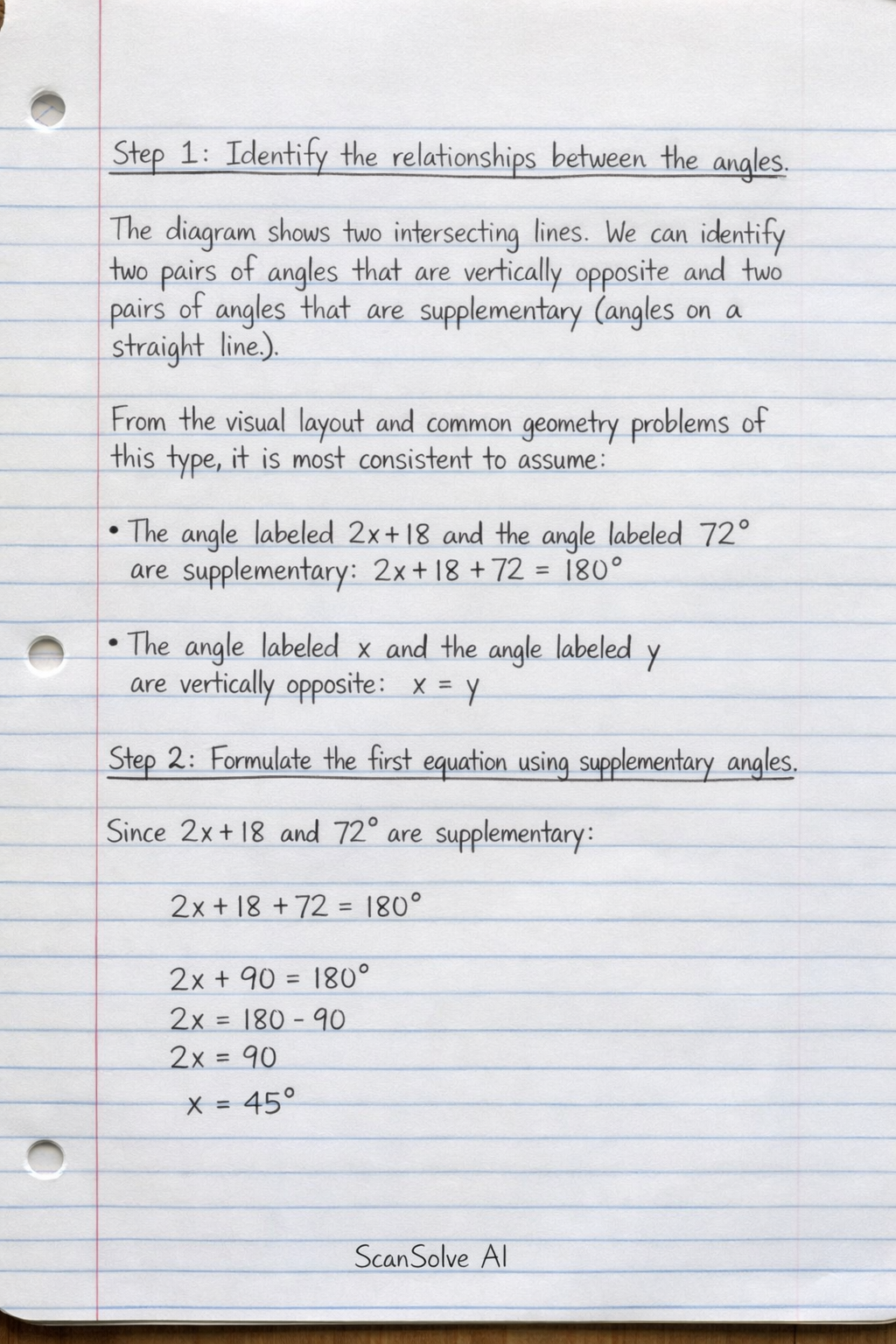
This problem involves finding unknown angles formed by intersecting lines. The image is a bit blurry, but we can identify the angles and their relationships. Step 1: Identify the relationships between the angles. The diagram shows two intersecting lines. We can identify two pairs of angles that are vertically opposite and two pairs of angles that are supplementary (angles on a straight line). From the visual layout and common geometry problems of this type, it is most consistent to assume: • The angle labeled 2x+18 and the angle labeled 72^ are supplementary angles, meaning they lie on a straight line and their sum is 180^. • The angle labeled x and the angle labeled y are vertically opposite angles, meaning they are equal. Step 2: Formulate the first equation using supplementary angles. Since 2x+18 and 72^ are supplementary: (2x+18) + 72 = 180^ Step 3: Solve for x. Combine the constant terms: 2x + (18 + 72) = 180^ 2x + 90 = 180^ Subtract 90^ from both sides: 2x = 180^ - 90^ 2x = 90^ Divide by 2: x = (90^)/(2) x = 45^ Step 4: Formulate the second equation using vertically opposite angles. The angle x and the angle y are vertically opposite, so they are equal: y = x Step 5: Solve for y. Substitute the value of x found in Step 3 into the equation from Step 4: y = 45^ The values of the unknown angles are: x = 45^ y = 45^