
We read your photo as:
A function f: R R is defined by f(x) = {4 + 4x, if x < 1. 4x - - 4 if x > 1. If f(x) has a limit at x = 1, the value of is
ScanSolve AI Answer
Step-by-step solution
4 stepsCalculer la limite à gauche de lorsque approche 1.
Pour , la fonction est .
La limite à gauche est :En substituant , on obtient :
Calculer la limite à droite de lorsque approche 1.
Pour , la fonction est .
La limite à droite est :En substituant , on obtient :
Égaliser les limites pour que la limite existe.
Pour que ait une limite en , les limites à gauche et à droite doivent être égales :
Résoudre l'équation quadratique pour .
Réarrangeons l'équation pour obtenir une forme standard :
Cette équation est un trinôme carré parfait, qui peut être factorisé comme .
En prenant la racine carrée des deux côtés :La valeur de est .
Still stuck on this one?
Ask a follow-up, and the answer starts from this question.
More Mathematics Questions
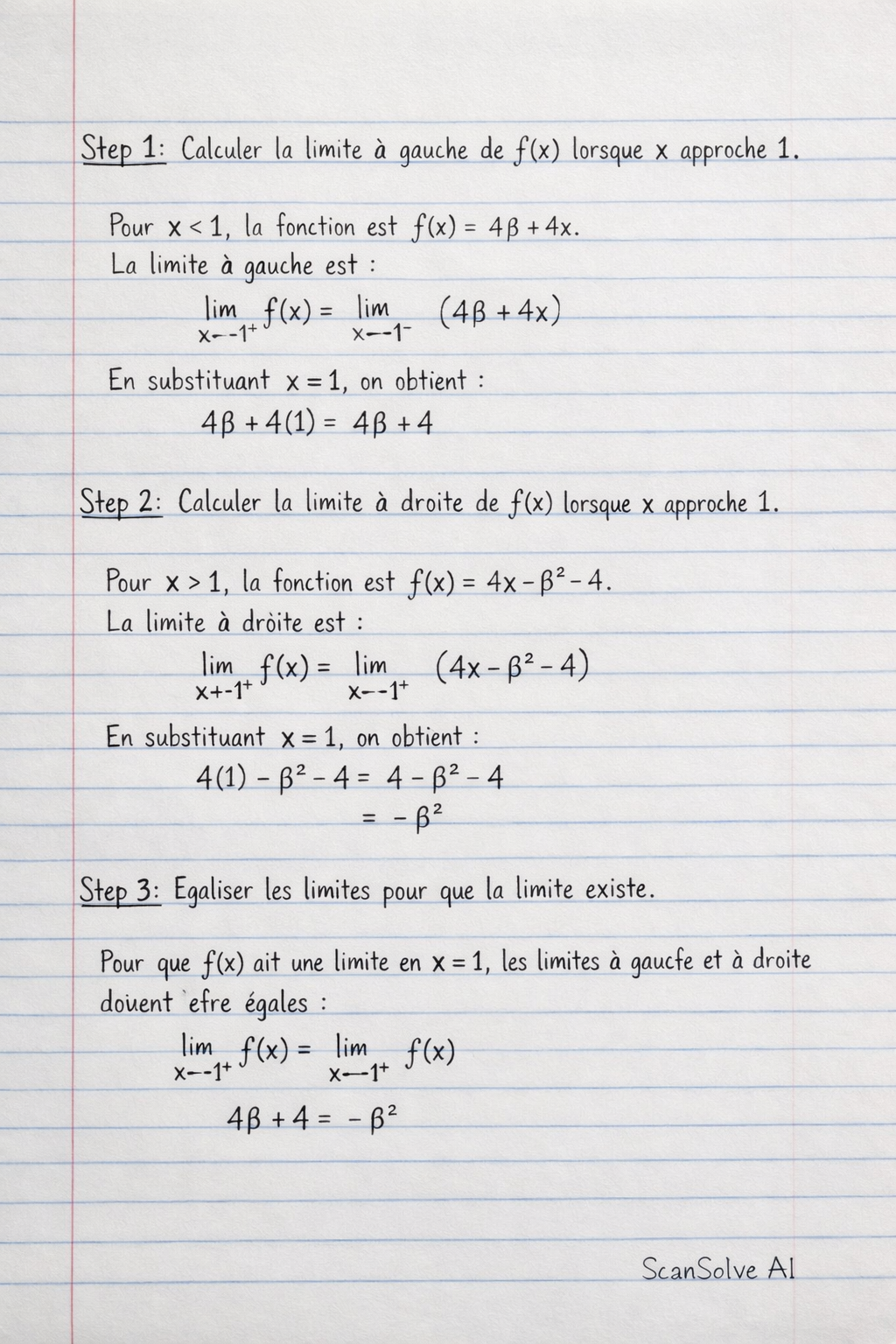
Handwritten Step-by-Step Solution
Get this as a handwritten image on WhatsApp — like a tutor wrote it for you.
Try on WhatsApp