
We read your photo as:
A geometric progression (GP) is a sequence of numbers where each term after the first is found by multiplying the previous one by a constant, non-zero number called the common ratio (r).
ScanSolve AI Answer
Step-by-step solution
3 stepsOkay, let's break down the geometric progression concepts from question 4.
A geometric progression (GP) is a sequence of numbers where each term after the first is found by multiplying the previous one by a constant, non-zero number called the common ratio ().
Here are the key formulas used in question 4:
The -th term ()
This formula helps you find any term in the sequence if you know the first term () and the common ratio ().
- In question 4(i), we used and to find and .
The sum of the first terms ()
This formula calculates the total sum of a specific number of terms in the sequence.
- In question 4(ii), we used this formula with , , and to find the sum of the first 5 terms.
The sum to infinity ()
This formula applies when the common ratio has an absolute value less than 1 (). It calculates the sum of all terms in an infinitely long geometric progression.
- In question 4(iii), we used this formula with and to find the sum to infinity.
Still stuck on this one?
Ask a follow-up, and the answer starts from this question.
More Mathematics Questions
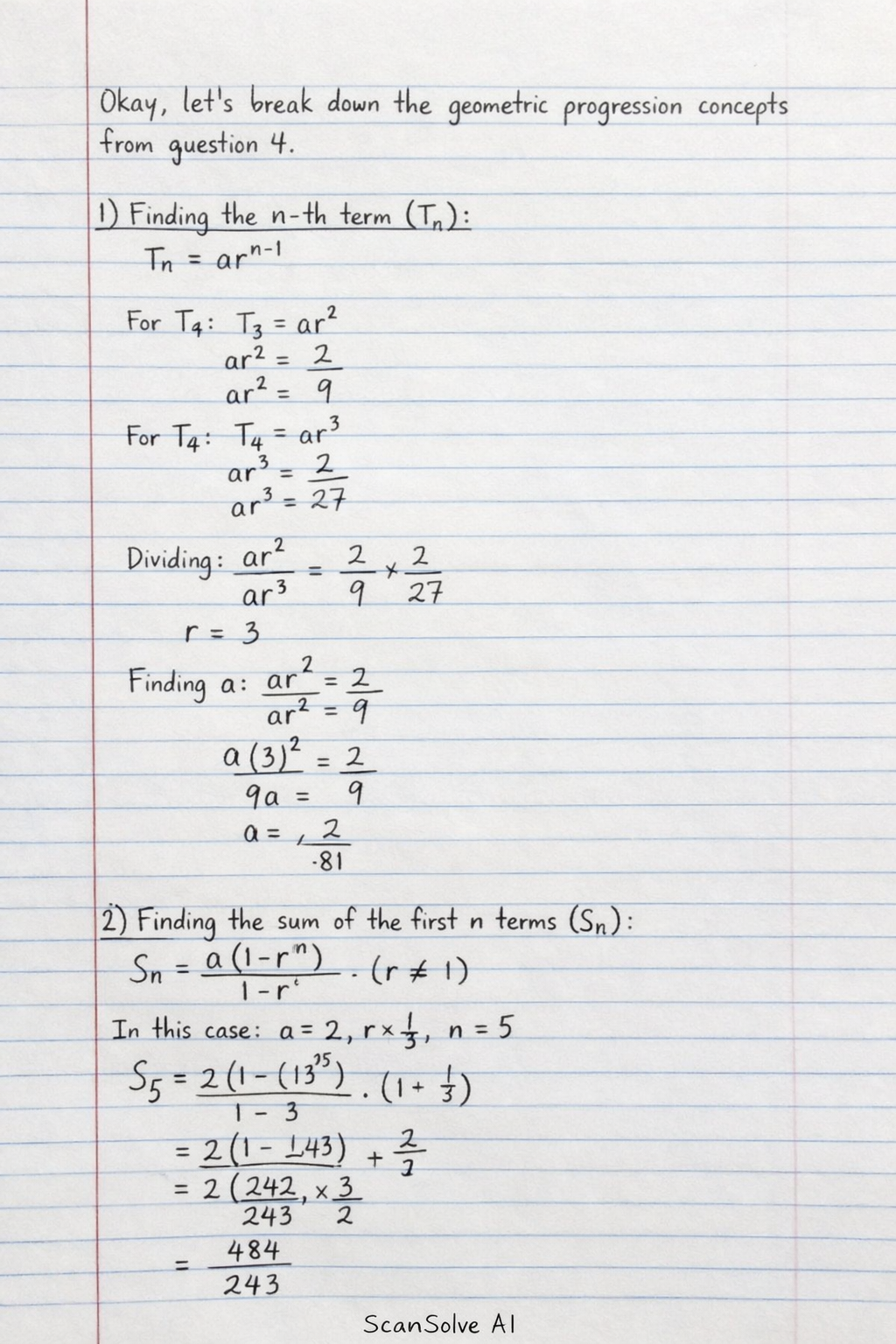
Handwritten Step-by-Step Solution
Get this as a handwritten image on WhatsApp — like a tutor wrote it for you.
Try on WhatsApp