We read your photo as:

A geometric sequence has first term a = 3/128 and sixth term T6 = 3/4. Find the common ratio and the sum of the first 20 terms.

Mathematics

ScanSolve AI Answer

Answer

2
24,576

a=3(5−1)2a = \frac{\sqrt{3}(\sqrt{5}-1)}{2}

Step-by-step solution

15 steps

Question 2

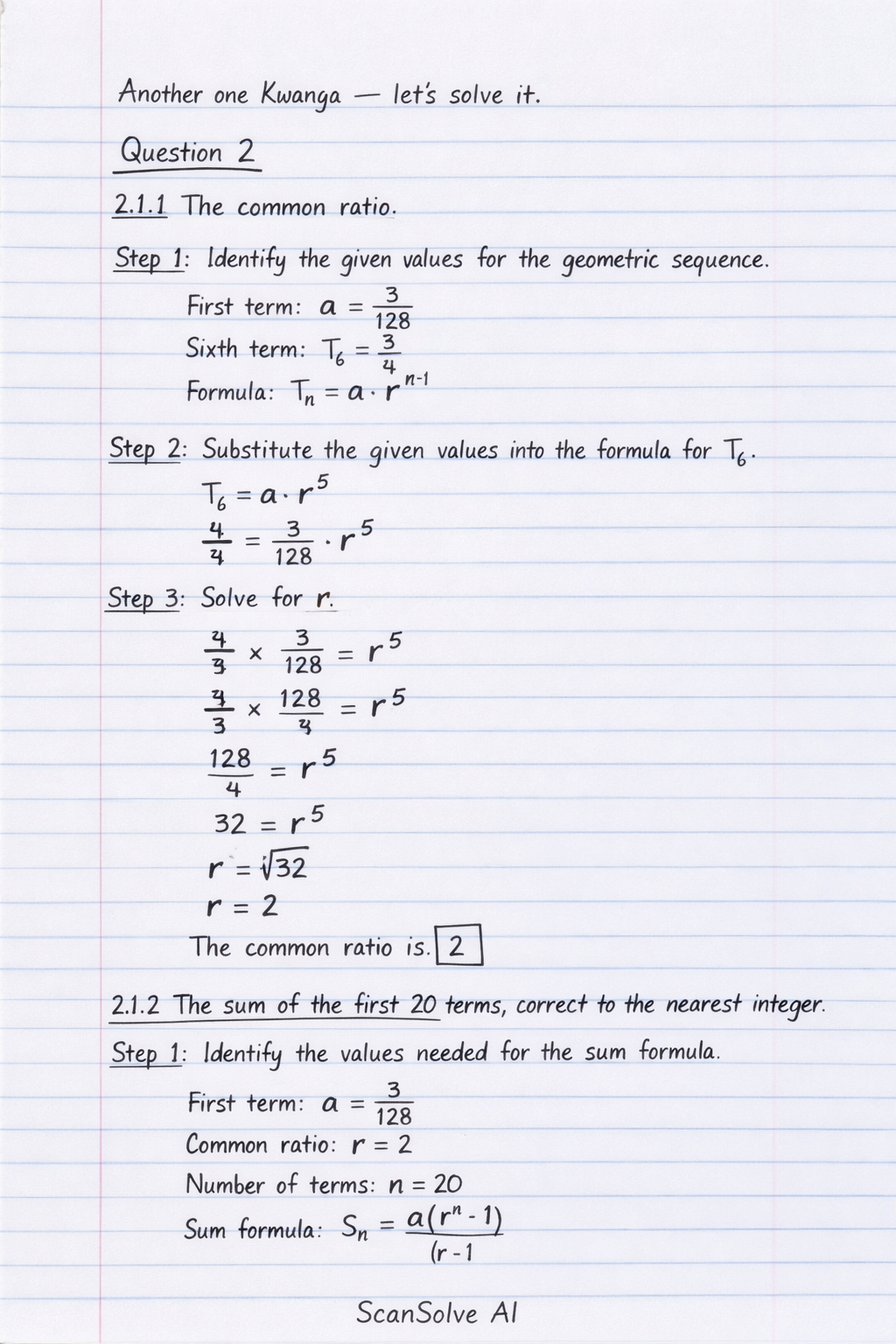
2.1.1 The common ratio.

  1. Identify the given values for the geometric sequence.

    The first term is a=3128a = \frac{3}{128}.
    The sixth term is T6=34T_6 = \frac{3}{4}.
    The formula for the nn-th term of a geometric sequence is Tn=a⋅rn−1T_n = a \cdot r^{n-1}.

  2. Substitute the given values into the formula for T6T_6.

    T6=a⋅r6−1T_6 = a \cdot r^{6-1} 34=3128⋅r5\frac{3}{4} = \frac{3}{128} \cdot r^5
  3. Solve for rr.

    Divide both sides by 3128\frac{3}{128}:

    34÷3128=r5\frac{3}{4} \div \frac{3}{128} = r^5 34×1283=r5\frac{3}{4} \times \frac{128}{3} = r^5 1284=r5\frac{128}{4} = r^5 32=r532 = r^5

    Take the fifth root of both sides:

    r=325r = \sqrt[5]{32} r=2r = 2

    The common ratio is 2\boxed{2}.

    2.1.2 The sum of the first 20 terms, correct to the nearest integer.

  4. Identify the values needed for the sum formula.

    First term a=3128a = \frac{3}{128}.
    Common ratio r=2r = 2 (from 2.1.1).
    Number of terms n=20n = 20.
    The formula for the sum of the first nn terms of a geometric sequence is Sn=a(rn−1)r−1S_n = \frac{a(r^n - 1)}{r - 1}.

  5. Substitute the values into the sum formula.

    S20=3128(220−1)2−1S_{20} = \frac{\frac{3}{128}(2^{20} - 1)}{2 - 1} S20=3128(220−1)S_{20} = \frac{3}{128}(2^{20} - 1)
  6. Calculate 2202^{20}.

    220=1,048,5762^{20} = 1,048,576
  7. Substitute the value and calculate S20S_{20}.

    S20=3128(1,048,576−1)S_{20} = \frac{3}{128}(1,048,576 - 1) S20=3128(1,048,575)S_{20} = \frac{3}{128}(1,048,575) S20=3,145,725128S_{20} = \frac{3,145,725}{128} S20≈24,575.9765625S_{20} \approx 24,575.9765625
  8. Round the sum to the nearest integer.

    S20≈24,576S_{20} \approx 24,576

    The sum of the first 20 terms is 24,576\boxed{24,576}.

    2.2 Prove that a=3(5−1)2a = \frac{\sqrt{3}(\sqrt{5}-1)}{2}.

  9. Use the property of a geometric sequence.

    Given that a,b,3a, b, \sqrt{3} are three consecutive terms of a geometric sequence, the common ratio is constant.

    ba=3b\frac{b}{a} = \frac{\sqrt{3}}{b} b2=a3(∗)b^2 = a\sqrt{3} \quad (*)
  10. Use the property of a right-angled triangle.

    Given that a,b,3a, b, \sqrt{3} are the sides of a right-angled triangle, and a<b<3a < b < \sqrt{3}, then 3\sqrt{3} must be the hypotenuse.
    By the Pythagorean theorem:

    a2+b2=(3)2a^2 + b^2 = (\sqrt{3})^2 a2+b2=3(∗∗)a^2 + b^2 = 3 \quad (**)
  11. Substitute equation (∗)(*) into equation (∗∗)(**).

    a2+a3=3a^2 + a\sqrt{3} = 3

    Rearrange into a quadratic equation:

    a2+a3−3=0a^2 + a\sqrt{3} - 3 = 0
  12. Solve the quadratic equation for aa using the quadratic formula a=−B±B2−4AC2Aa = \frac{-B \pm \sqrt{B^2 - 4AC}}{2A}.

    Here, A=1A=1, B=3B=\sqrt{3}, C=−3C=-3.

    a=−3±(3)2−4(1)(−3)2(1)a = \frac{-\sqrt{3} \pm \sqrt{(\sqrt{3})^2 - 4(1)(-3)}}{2(1)} a=−3±3+122a = \frac{-\sqrt{3} \pm \sqrt{3 + 12}}{2} a=−3±152a = \frac{-\sqrt{3} \pm \sqrt{15}}{2}
  13. Choose the valid solution for aa.

    Since aa represents a side length, it must be positive.

    a=−3+152a = \frac{-\sqrt{3} + \sqrt{15}}{2}

    The other solution, a=−3−152a = \frac{-\sqrt{3} - \sqrt{15}}{2}, is negative and thus not valid for a side length.

  14. Manipulate the expression for aa to match the required form.

    a=15−32a = \frac{\sqrt{15} - \sqrt{3}}{2}

    Factor out 3\sqrt{3} from the numerator:

    a=3×5−32a = \frac{\sqrt{3 \times 5} - \sqrt{3}}{2} a=35−32a = \frac{\sqrt{3}\sqrt{5} - \sqrt{3}}{2} a=3(5−1)2a = \frac{\sqrt{3}(\sqrt{5}-1)}{2}

    This matches the required expression.

  15. Verify the condition a<b<3a < b < \sqrt{3}.

    We have a=3(5−1)2a = \frac{\sqrt{3}(\sqrt{5}-1)}{2}.
    From b2=a3b^2 = a\sqrt{3}:

    b2=(3(5−1)2)3b^2 = \left(\frac{\sqrt{3}(\sqrt{5}-1)}{2}\right)\sqrt{3} b2=3(5−1)2b^2 = \frac{3(\sqrt{5}-1)}{2}

    Since 5≈2.236\sqrt{5} \approx 2.236, 3≈1.732\sqrt{3} \approx 1.732.
    a≈1.732(2.236−1)2=1.732(1.236)2≈1.070a \approx \frac{1.732(2.236-1)}{2} = \frac{1.732(1.236)}{2} \approx 1.070
    b2≈3(2.236−1)2=3(1.236)2≈1.854  ⟹  b≈1.854≈1.361b^2 \approx \frac{3(2.236-1)}{2} = \frac{3(1.236)}{2} \approx 1.854 \implies b \approx \sqrt{1.854} \approx 1.361
    The condition a<b<3a < b < \sqrt{3} becomes 1.070<1.361<1.7321.070 < 1.361 < 1.732, which is true.

    Thus, we have proven that a=3(5−1)2a = \boxed{\frac{\sqrt{3}(\sqrt{5}-1)}{2}}.

Was this helpful?

Try one yourself

A new problem that tests the same skill.

Still stuck on this one?

Ask a follow-up, and the answer starts from this question.

Got a different question?Ask your own question
Handwritten step-by-step solution preview

Handwritten Step-by-Step Solution

Get this as a handwritten image on WhatsApp — like a tutor wrote it for you.

Try on WhatsApp