
We read your photo as:
A) Given that (x-1) is a factor of the polynomial f(x) = ax4 - x3 - 12x2 - x + 2. Find the value of the constant a and verify that f(-1)=0. b) Find the value of the constant k for which the equation x
ScanSolve AI Answer
Answers
2 partsStep-by-step solution
9 stepsHere are the solutions to your questions.
Part 1
Part a· 2 steps
Given that is a factor of the polynomial . Find the value of the constant and verify that .
Use the Factor Theorem.
Since is a factor of , we know that .
Substitute into :Verify with .
Substitute into , so .
Now, substitute into :There seems to be a discrepancy with the verification part of the question, as . Assuming the question meant to ask for or there's a typo in the polynomial or the verification value. Based on the given polynomial and factor, .
Part b
Find the value of the constant for which the equation has one root, double the other.
Set up relationships between roots and coefficients.
Let the roots be and .
From Vieta's formulas:
Sum of roots:
Product of roots:Solve for .
From equation (1), .
Substitute this into equation (2):Factor the quadratic equation:
So, or .
The values of are .
Part 2
Part b(i)
Show that .
Apply double angle identities.
Recall the identities: and .
Substitute these into the left-hand side (LHS) of the equation:Simplify the expression.
Factor out from the denominator:
Cancel the common term , assuming :
This matches the right-hand side (RHS).
Therefore, .
Part b(ii)· 3 steps
Find the general solution of the equation .
Use the double angle identity for .
Recall .
Substitute this into the equation:Factor the equation.
Factor out :
This gives two separate equations:
Solve for $2x$ in each case.
For :
The general solution for is , where .
So,For :
The principal values for are (or ) and .
The general solution for $\sin
Try one yourself
A new problem that tests the same skill.
Still stuck on this one?
Ask a follow-up, and the answer starts from this question.
More Mathematics Questions
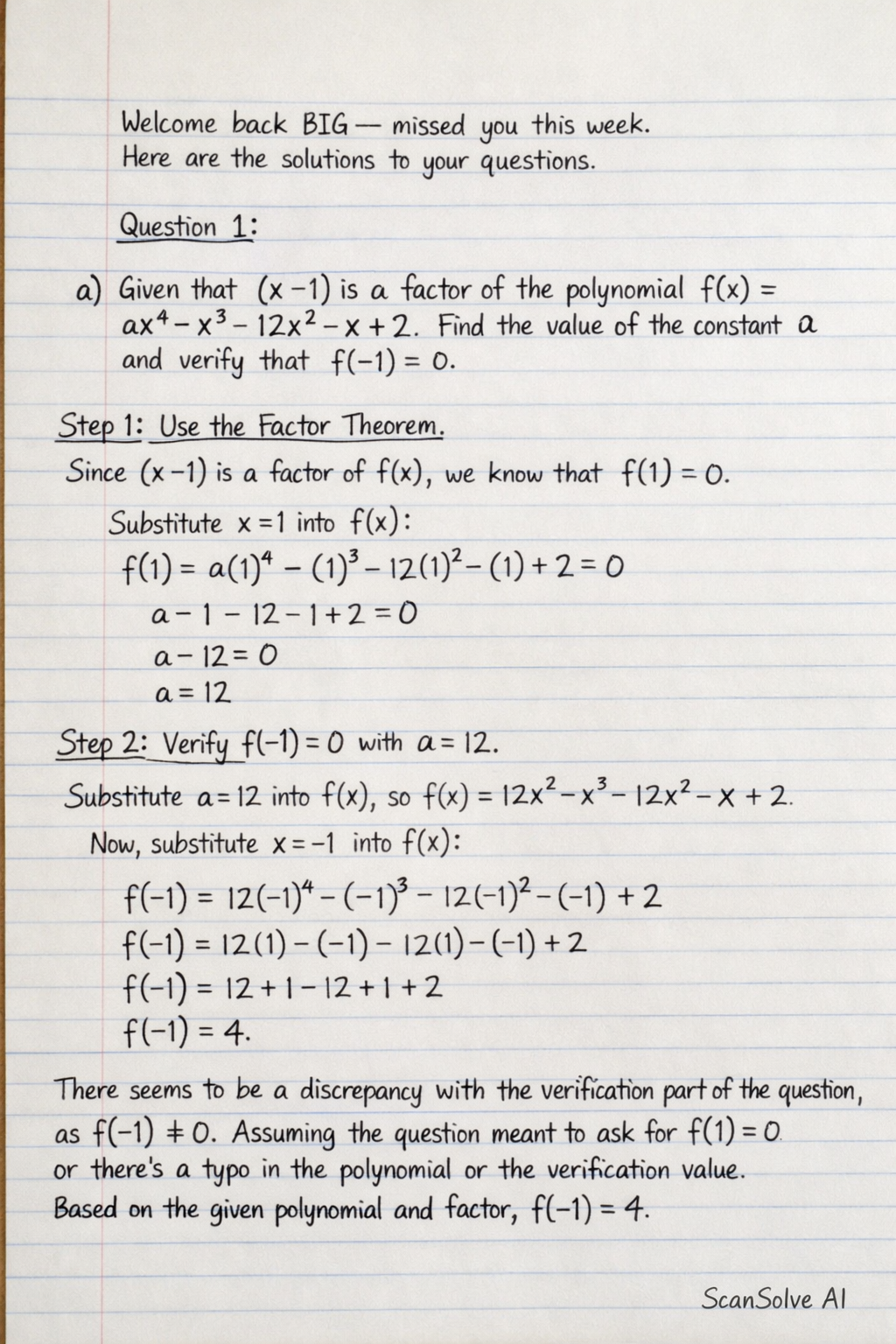
Handwritten Step-by-Step Solution
Get this as a handwritten image on WhatsApp — like a tutor wrote it for you.
Try on WhatsApp