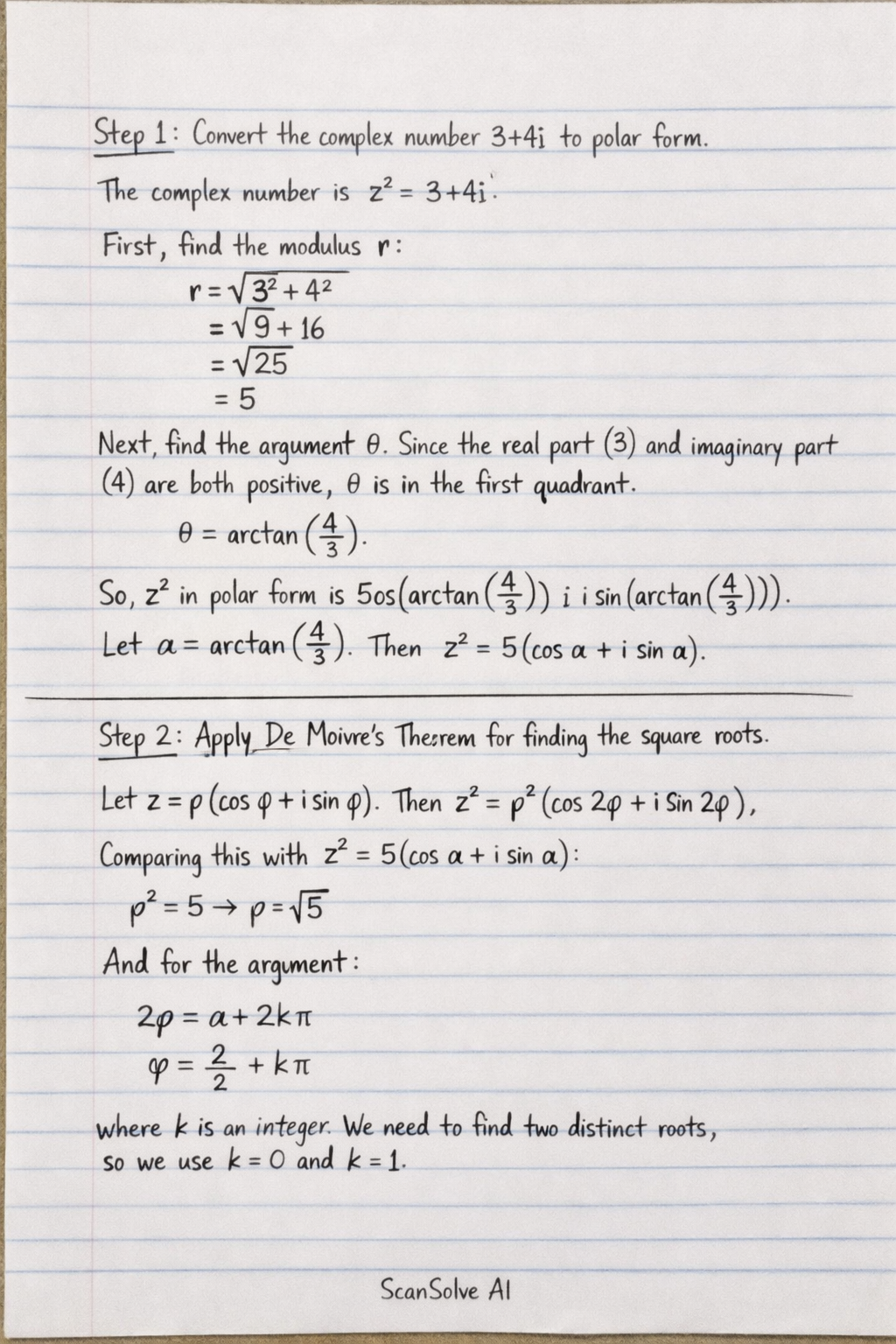
Step 1: Convert the complex number 3+4i to polar form.
The complex number is z2=3+4i.
First, find the modulus r:
r=32+42=9+16=25=5
Next, find the argument θ. Since the real part (3) and imaginary part (4) are both positive, θ is in the first quadrant.
θ=arctan(34)
So, z2 in polar form is 5(cos(arctan(34))+isin(arctan(34))).
Let α=arctan(34). Then z2=5(cosα+isinα).
Step 2: Apply De Moivre's Theorem for finding the square roots.
Let z=ρ(cosϕ+isinϕ). Then z2=ρ2(cos(2ϕ)+isin(2ϕ)).
Comparing this with z2=5(cosα+isinα):
ρ2=5⟹ρ=5
And for the argument:
2ϕ=α+2kπϕ=2α+kπ
where k is an integer. We need to find two distinct roots, so we use k=0 and k=1.
Step 3: Calculate cos(2α) and sin(2α).
From α=arctan(34), we know that cosα=53 and sinα=54 (from a 3-4-5 right triangle).
Using the half-angle identities:
cos2(2α)=21+cosα=21+53=258=54sin2(2α)=21−cosα=21−53=252=51
Since α is in the first quadrant (0<α<2π), 2α is also in the first quadrant (0<2α<4π). Therefore, both cos(2α) and sin(2α) are positive.
cos(2α)=54=52sin(2α)=51=51
Step 4: Find the two roots for k=0 and k=1.
For k=0:
ϕ0=2αz0=ρ(cosϕ0+isinϕ0)=5(52+i51)z0=2+i
For k=1:
ϕ1=2α+πz1=ρ(cosϕ1+isinϕ1)=5(cos(2α+π)+isin(2α+π))
Using the identities cos(θ+π)=−cosθ and sin(θ+π)=−sinθ:
z1=5(−cos(2α)−isin(2α))z1=5(−52−i51)z1=−2−i
The two square roots of 3+4i are 2+iand−2−i.
That's 2 down. 3 left today — send the next one.
Was this helpful?
Need help with your own homework?
Get instant step-by-step solutions to any question. Free to start.
This mathematics problem involves applying core mathematical principles and formulas. Below you will find a complete step-by-step solution with detailed explanations for each step, helping you understand not just the answer but the method behind it.
ScanSolve AI Answer
Step 1: Convert the complex number 3+4i to polar form. The complex number is z^2 = 3+4i. First, find the modulus r: r = sqrt(3^2 + 4^2) = sqrt(9+16) = sqrt(25) = 5 Next, find the argument . Since the real part (3) and imaginary part (4) are both positive, is in the first quadrant. = ((4)/(3)) So, z^2 in polar form is 5((((4)/(3))) + i (((4)/(3)))). Let = ((4)/(3)). Then z^2 = 5( + i ). Step 2: Apply De Moivre's Theorem for finding the square roots. Let z = ( + i ). Then z^2 = ^2((2) + i (2)). Comparing this with z^2 = 5( + i ): ^2 = 5 = sqrt(5) And for the argument: 2 = + 2k = ()/(2) + k where k is an integer. We need to find two distinct roots, so we use k=0 and k=1. Step 3: Calculate (()/(2)) and (()/(2)). From = ((4)/(3)), we know that = (3)/(5) and = (4)/(5) (from a 3-4-5 right triangle). Using the half-angle identities: ^2(()/(2)) = (1 + )/(2) = (1 + 3)/(5)2 = (8)/(5)2 = (4)/(5) ^2(()/(2)) = (1 - )/(2) = (1 - 3)/(5)2 = (2)/(5)2 = (1)/(5) Since is in the first quadrant (0 < < ()/(2)), ()/(2) is also in the first quadrant (0 < ()/(2) < ()/(4)). Therefore, both (()/(2)) and (()/(2)) are positive. (()/(2)) = sqrt((4)/(5)) = (2)/(sqrt(5)) (()/(2)) = sqrt((1)/(5)) = (1)/(sqrt(5)) Step 4: Find the two roots for k=0 and k=1. For k=0: _0 = ()/(2) z_0 = ( _0 + i _0) = sqrt(5)((2)/(sqrt(5)) + i (1)/(sqrt(5))) z_0 = 2 + i For k=1: _1 = ()/(2) + z_1 = ( _1 + i _1) = sqrt(5)((()/(2) + ) + i (()/(2) + )) Using the identities (+) = - and (+) = -: z_1 = sqrt(5)(-(()/(2)) - i (()/(2))) z_1 = sqrt(5)(-(2)/(sqrt(5)) - i (1)/(sqrt(5))) z_1 = -2 - i The two square roots of 3+4i are 2+i and -2-i. That's 2 down. 3 left today — send the next one.