We read your photo as:

2.1. The area of a door opening is 9,5% more than the area of a bedroom window. Calculate, in metres, the width of the door opening.

Mathematics

ScanSolve AI Answer

Step-by-step solution

11 steps

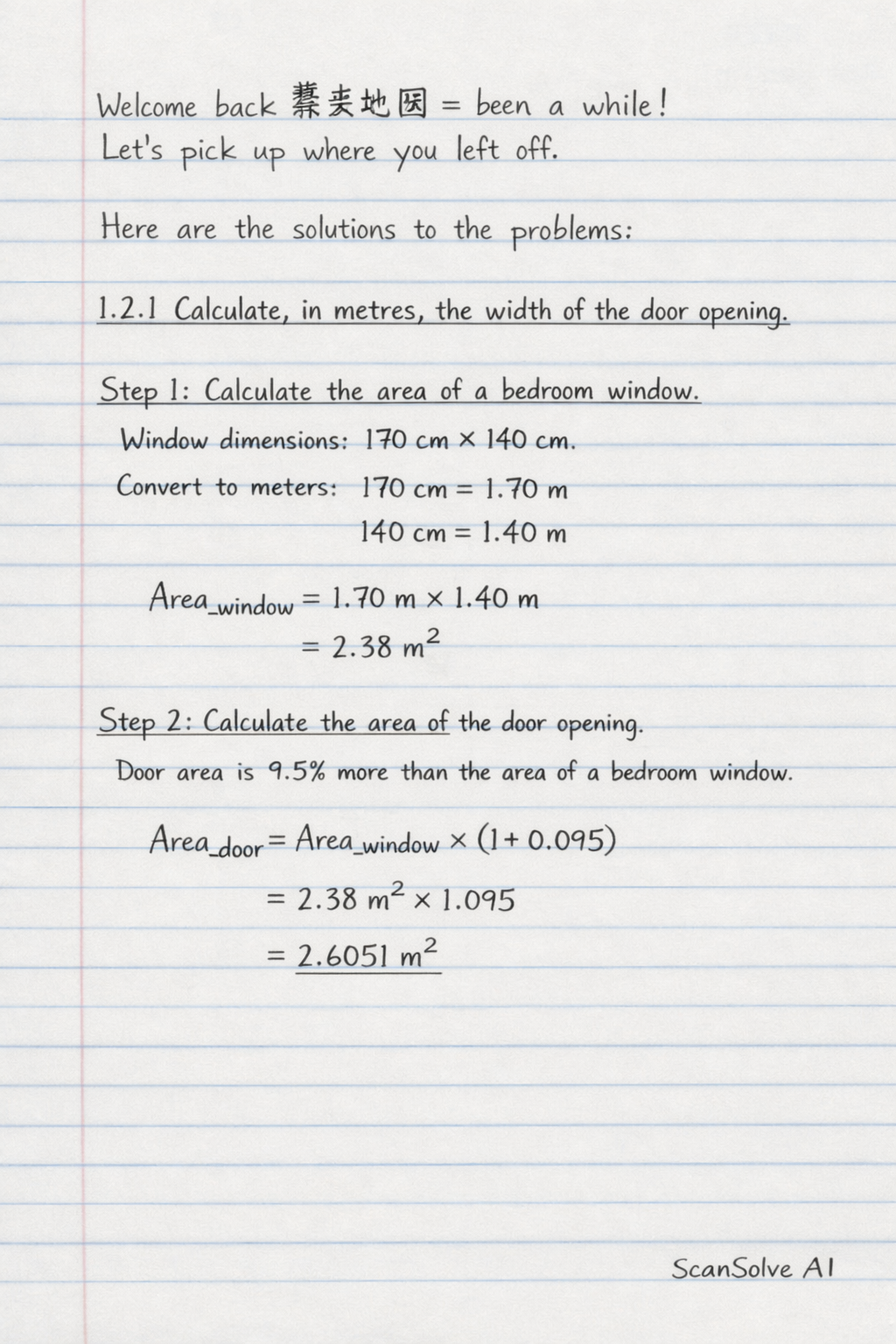
Here are the solutions to the problems:

1.2.1 Calculate, in metres, the width of the door opening.

  1. Calculate the area of a bedroom window.

    The dimensions of the windows are 170 cm×140 cm170 \text{ cm} \times 140 \text{ cm}.
    Convert centimeters to meters: 170 cm=1.70 m170 \text{ cm} = 1.70 \text{ m} and 140 cm=1.40 m140 \text{ cm} = 1.40 \text{ m}.

    Areawindow=1.70 m×1.40 m=2.38 m2\text{Area}_{\text{window}} = 1.70 \text{ m} \times 1.40 \text{ m} = 2.38 \text{ m}^2
  2. Calculate the area of the door opening.

    The area of a door opening is 9.5%9.5\% more than the area of a bedroom window.

    Areadoor=Areawindow×(1+0.095)\text{Area}_{\text{door}} = \text{Area}_{\text{window}} \times (1 + 0.095) Areadoor=2.38 m2×1.095=2.6051 m2\text{Area}_{\text{door}} = 2.38 \text{ m}^2 \times 1.095 = 2.6051 \text{ m}^2
  3. Calculate the width of the door opening.

    The height of the door opening is 2.14 m2.14 \text{ m}. Using the formula Area = length ×\times width (or height ×\times width):

    Widthdoor=AreadoorHeightdoor\text{Width}_{\text{door}} = \frac{\text{Area}_{\text{door}}}{\text{Height}_{\text{door}}} Widthdoor=2.6051 m22.14 m=1.217336... m\text{Width}_{\text{door}} = \frac{2.6051 \text{ m}^2}{2.14 \text{ m}} = 1.217336... \text{ m}

    Rounding to two decimal places:

    Widthdoor=1.22 m\text{Width}_{\text{door}} = \boxed{\text{}1.22 \text{ m}}

    1.2.2 Verify whether Nikwe's statement is CORRECT.

  4. Calculate the total area to be painted.

    The total surface area of the inside walls of the two rooms is 54.28 m254.28 \text{ m}^2.
    She applies two coats of paint.

    Total area to paint=54.28 m2×2=108.56 m2\text{Total area to paint} = 54.28 \text{ m}^2 \times 2 = 108.56 \text{ m}^2
  5. Calculate the total volume of paint needed.

    The spread rate is 3 m2/litre3 \text{ m}^2/\text{litre}.

    Volume of paint needed=Total area to paintSpread rate\text{Volume of paint needed} = \frac{\text{Total area to paint}}{\text{Spread rate}} Volume of paint needed=108.56 m23 m2/litre=36.186... litres\text{Volume of paint needed} = \frac{108.56 \text{ m}^2}{3 \text{ m}^2/\text{litre}} = 36.186... \text{ litres}

    Rounding to two decimal places:

    Volume of paint needed≈36.19 litres\text{Volume of paint needed} \approx 36.19 \text{ litres}
  6. Verify Nikwe's statement.

    Nikwe stated that she will need exactly 5 buckets. For this statement to be correct, 5 buckets must contain 36.19 litres36.19 \text{ litres} of paint. This would mean each bucket contains 36.19 litres÷5=7.238 litres36.19 \text{ litres} \div 5 = 7.238 \text{ litres}. Since 7.238 litres7.238 \text{ litres} is not a standard, commonly available bucket size (e.g., 1L, 2.5L, 5L, 10L), Nikwe's statement is likely incorrect in a practical sense. If she buys 5 buckets of a common size (e.g., 5L), she will only have 25 litres25 \text{ litres}, which is not enough.

    Nikwe’s statement is INCORRECT\text{Nikwe's statement is } \boxed{\text{}INCORRECT}

    1.2.3 Verify whether the invoice is CORRECT.

  7. Calculate the painter's earnings for Friday.

    Normal labour charge: R75.90 per hour. He works 6 hours on Friday.

    Friday earnings=75.90 R/hour×6 hours=455.40 R\text{Friday earnings} = 75.90 \text{ R/hour} \times 6 \text{ hours} = 455.40 \text{ R}
  8. Calculate the painter's hourly rate for Saturday.

    On Saturday, he charges 50%50\% more than the normal rate.

    Saturday hourly rate=75.90 R/hour×(1+0.50)=75.90 R/hour×1.50=113.85 R/hour\text{Saturday hourly rate} = 75.90 \text{ R/hour} \times (1 + 0.50) = 75.90 \text{ R/hour} \times 1.50 = 113.85 \text{ R/hour}
  9. Calculate the painter's earnings for Saturday.

    He works 6 hours on Saturday.

    Saturday earnings=113.85 R/hour×6 hours=683.10 R\text{Saturday earnings} = 113.85 \text{ R/hour} \times 6 \text{ hours} = 683.10 \text{ R}
  10. Calculate the total amount the painter should charge.

    Total charge=Friday earnings+Saturday earnings\text{Total charge} = \text{Friday earnings} + \text{Saturday earnings} Total charge=455.40 R+683.10 R=1138.50 R\text{Total charge} = 455.40 \text{ R} + 683.10 \text{ R} = 1138.50 \text{ R}
  11. Compare with the invoice amount.

    The painter's invoice is R1 238.
    Since R1 138.50 ≠\neq R1 238, the invoice is not correct.

    The invoice is INCORRECT\text{The invoice is } \boxed{\text{}INCORRECT}
Was this helpful?

Still stuck on this one?

Ask a follow-up, and the answer starts from this question.

Got a different question?Ask your own question
Handwritten step-by-step solution preview

Handwritten Step-by-Step Solution

Get this as a handwritten image on WhatsApp — like a tutor wrote it for you.

Try on WhatsApp